


Direct Answer
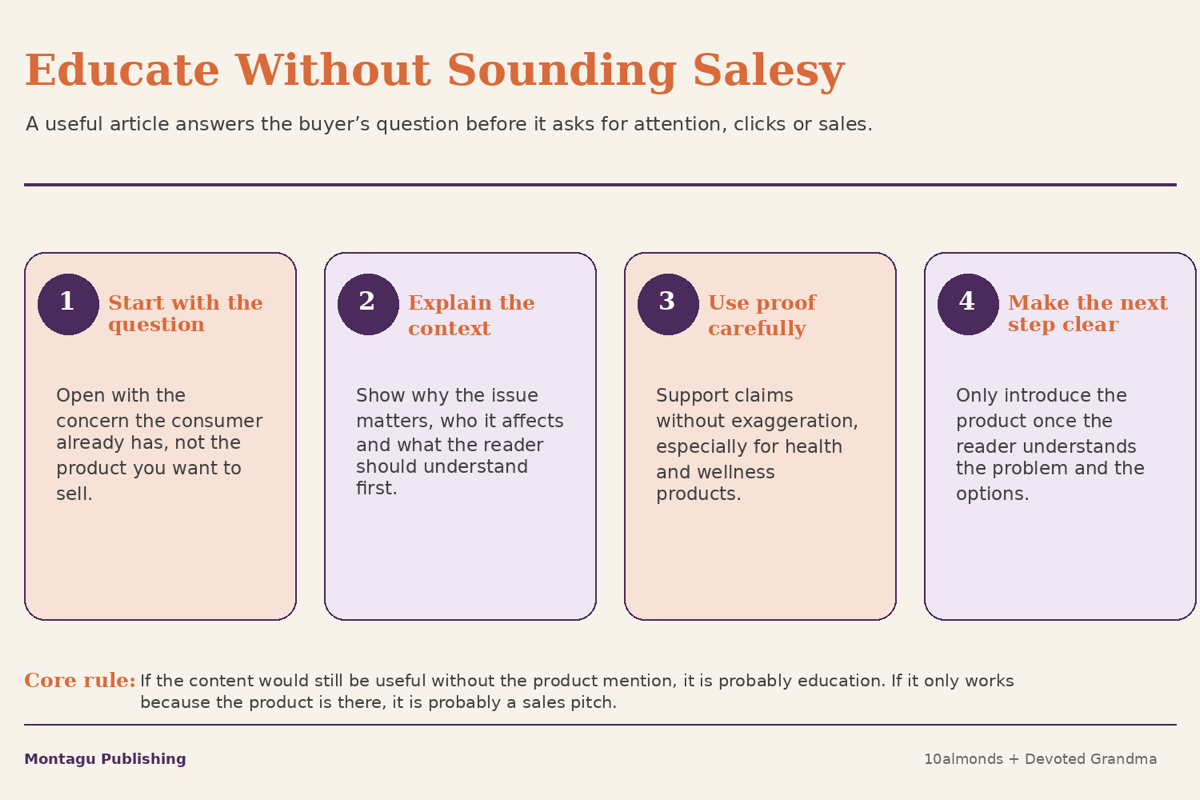
To educate consumers about complex products without sounding salesy, start with the question the customer is already asking, not the product you want to promote.
A strong educational article explains the problem, gives useful context, shows what buyers should consider, and only then introduces the product as one possible next step. This is especially important for wellness, health-adjacent and technical products where people need time to understand ingredients, evidence, benefits, risks, limitations or use cases before they feel comfortable taking action.
The goal is not to hide the commercial purpose. The goal is to make the content useful enough that the reader learns something before being asked to buy.
Quick Summary
- Complex products need explanation before persuasion.
- Salesy content usually starts with the brand. Useful educational content starts with the buyer’s question.
- Health and wellness brands should be especially careful with claims, evidence and disclosures.
- A good educational article gives every section a job: clarify the problem, explain the context, support the claim, compare options and guide the next step.
- Newsletter partnerships work best when the article helps readers understand the topic before introducing the brand.
Why Complex Products Are Harder to Market
Some products are easy to understand in seconds. A pair of shoes, a water bottle or a scented candle can often be judged quickly by appearance, price, reviews and personal preference.
Other products need more work. A magnesium supplement, menopause support programme, mobility product, blood sugar monitor, financial planning tool or home safety service asks the customer to understand something before she can judge the offer properly.
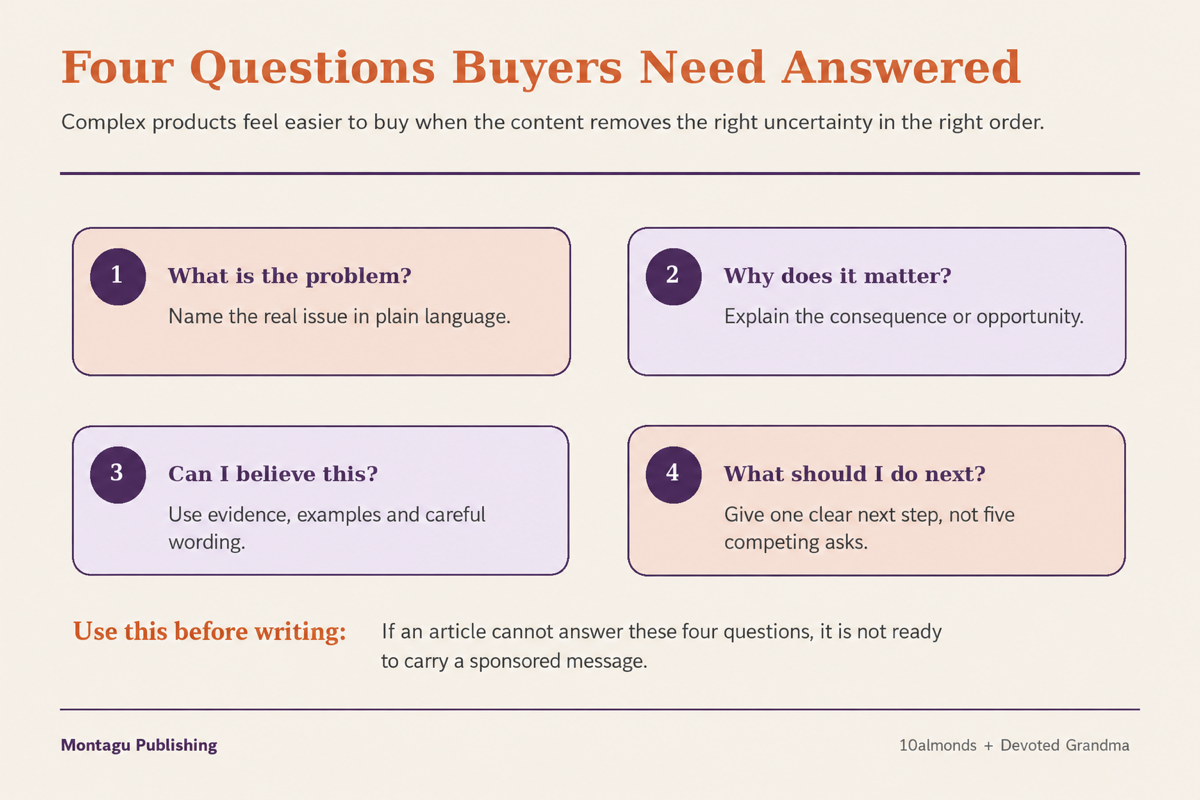
That changes the role of marketing. The campaign is no longer only trying to create notice. It also has to reduce uncertainty. What is the problem? Why does it matter? What options exist? Can the claim be believed? Is this product relevant to me?
If the content jumps straight to the product before those questions are answered, it feels like a pitch. If it answers those questions first, it feels useful.
The Biggest Mistake Brands Make
The biggest mistake is trying to make education behave like a direct-response ad.
A direct-response ad can work when demand already exists. Someone knows they need the product, recognises the category and is ready to compare offers. In that case, a concise message, clear benefit and strong call to action may be enough.
Educational content does a different job. It helps create understanding before the buyer is ready to act — the same distinction we drew out in what makes educational content more effective than traditional ads. Measuring it only by immediate sales often undervalues its role because the article may influence research, trust, branded search, returning visitors and later conversions.
This does not mean educational content should avoid commercial outcomes. It means the commercial outcome usually comes after understanding, not before it.
Start With the Buyer’s Question
A salesy article often opens like this: Our new formula supports better sleep.
A more useful article might open like this: Why does sleep become more disrupted with age, and what should women look at before trying a supplement?
The second version is stronger because it begins where the reader is. She may not know the brand. She may not even know the product category. But she recognises the problem and wants a clearer explanation.
For complex products, the reader’s question is usually more valuable than the brand’s claim. The question gives the article a reason to exist. The product only earns its place after the article has helped the reader understand the issue.
Give Every Section One Job
A good educational article should not wander. Every section should move the reader one step closer to clarity.
The opening should name the problem. The next section should explain why the problem exists. The middle of the article should give context, options and practical considerations. Proof should appear where it helps the reader judge credibility. The product mention should arrive only when the reader understands why a solution might be useful.
This is where many sponsored articles go wrong. They use educational headings, but the copy keeps circling back to the product too early. Readers notice. The article begins to feel like advertising wearing an educational costume.
Salesy Content vs Useful Education
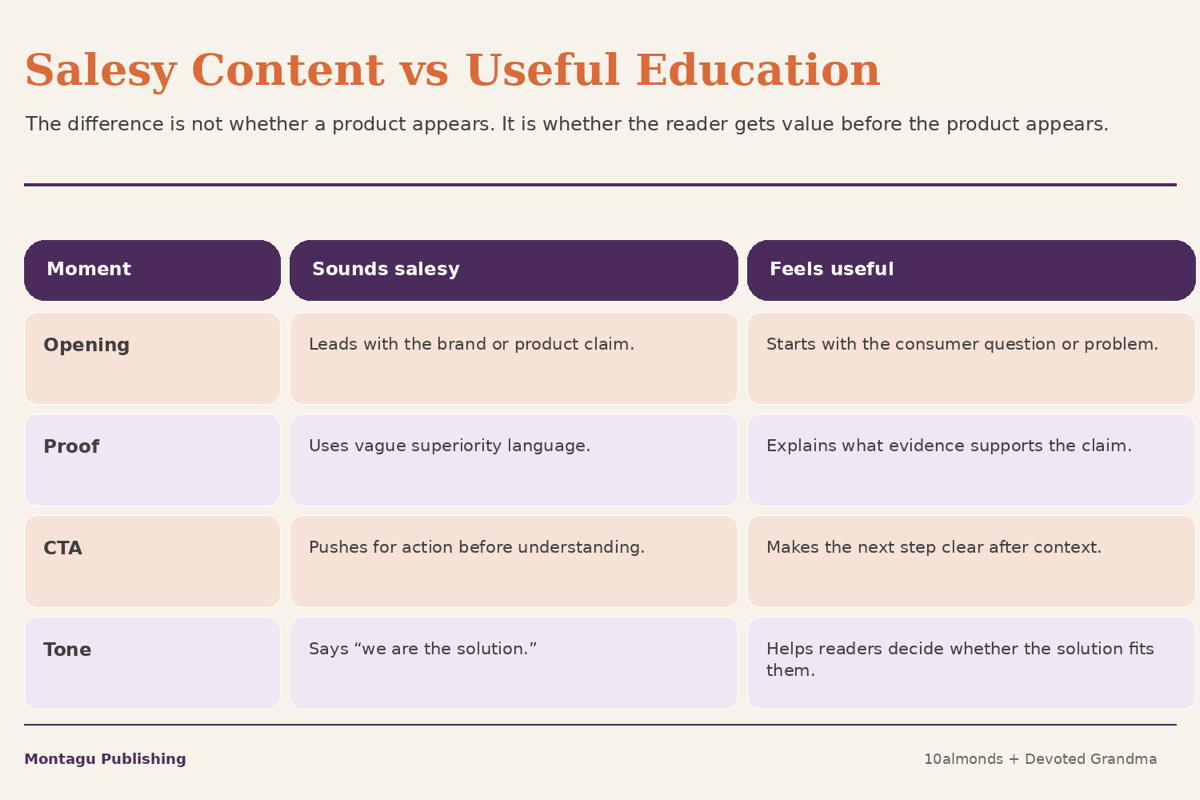
| Salesy content | Useful education |
|---|---|
| Starts with the product claim. | Starts with the consumer question. |
| Pushes for action before the reader understands the issue. | Explains the issue before suggesting a next step. |
| Uses vague superiority language. | Uses careful proof, plain language and relevant examples. |
| Treats the article as a long advertisement. | Makes the article useful even before the brand appears. |
Be Careful With Proof and Claims
For wellness and health-adjacent products, proof matters. So does restraint.
The FTC’s Health Products Compliance Guidance says advertising should be truthful, not misleading and adequately substantiated. It also says health benefit or safety claims for foods, dietary supplements, drugs and other health-related products generally require competent and reliable scientific evidence.
For marketers, the practical implication is simple: do not turn weak evidence into strong claims. Do not imply certainty where the evidence is limited. Do not use scientific language as decoration. If the claim needs qualification, the qualification should be clear enough for ordinary readers to notice and understand.
Educational content is not an excuse to soften compliance. It should make the claim easier to understand, not easier to hide — and where the content is sponsored, the FTC’s Native Advertising guidance is a useful reference for keeping the commercial relationship clear and conspicuous.
Use Plain Language Without Dumbing It Down
Plain language is not the same as oversimplification.
For example, a supplement brand does not need to explain every biochemical pathway behind an ingredient. But it should explain what the ingredient is, why people use it, what the evidence can reasonably support, who may want to ask a professional first and what the product is not claiming to do.
This is especially important when writing for older consumers. The audience may be highly capable, informed and experienced, but they are also more likely to reject exaggerated claims or patronising language. Clear writing respects the reader’s intelligence.
Where Newsletter Partnerships Fit
Newsletter partnerships can be useful when a product needs more context than a short ad can provide — though as covered in how brands should test newsletter sponsorships for the first time, this is worth testing deliberately rather than assumed.
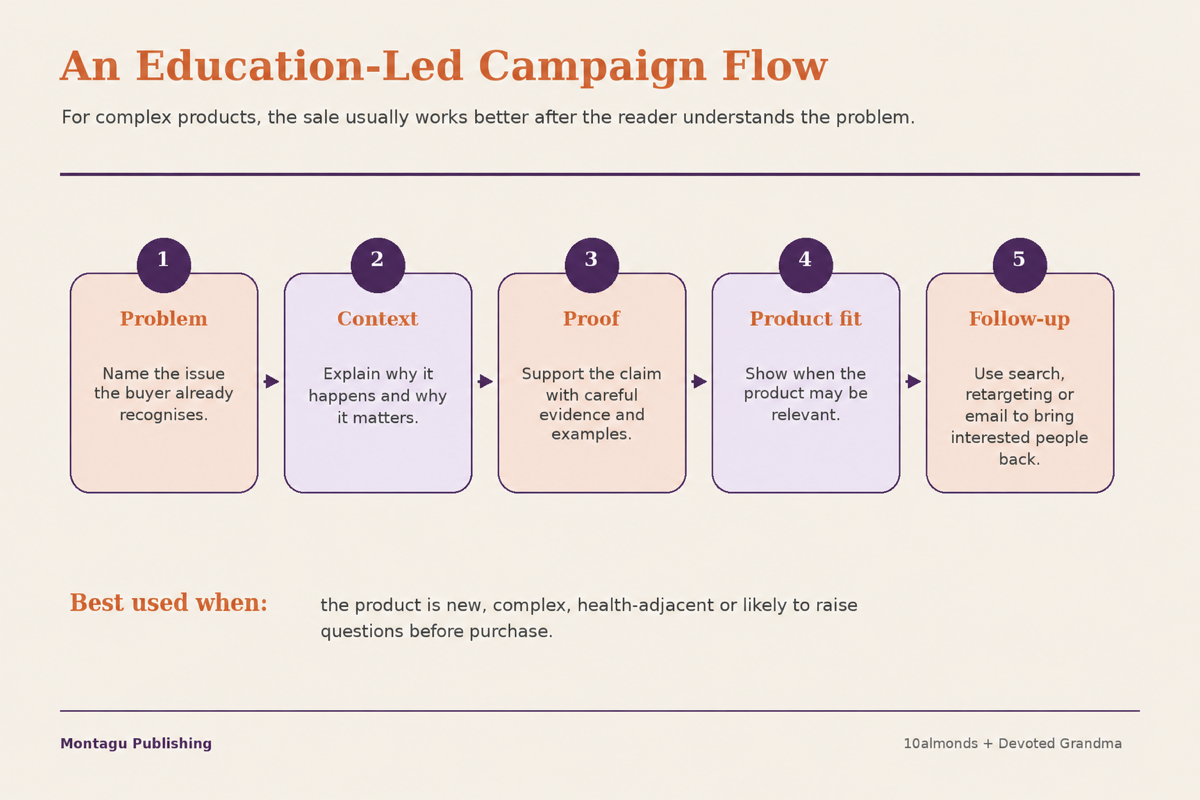
A paid social ad might introduce the topic. Search might capture people already looking for a solution. Retargeting might bring interested visitors back. But a sponsored educational article or newsletter placement can give the reader time to understand the topic properly.
For 10almonds, this is most relevant when a brand wants to reach health-conscious readers who already expect practical, evidence-informed wellness content — the kind of channel fit mapped out in which channels women over 50 actually trust. For Devoted Grandma, it can work when the buying decision sits inside family life, household care, healthy ageing, travel, gifting or products chosen for both the reader and people she cares about.
The newsletter is not valuable simply because it delivers a message. It is valuable because the reader has chosen an environment where learning is already part of the experience.
What We Would Do
If we were helping a wellness brand educate consumers about a complex product, we would not start by writing a product-led article.
We would first list the questions a cautious buyer is likely to ask before taking action. For a magnesium supplement, that might include: What does magnesium do? Why might older adults care about it? What are the different forms? What does the evidence suggest? Are there situations where someone should speak to a clinician first? What makes one product different from another?
Only after those questions are answered would we introduce the brand — the same audience-first sequencing behind how a wellness brand should spend its next $10,000 to reach women over 50. The product would not be the opening argument. It would be the next step for readers who now understand the topic well enough to evaluate whether it is relevant.
A Mistake We Often See
Some brands treat education as a longer version of an ad, the same pattern we described in how brands build trust before asking consumers to buy.
They add more words, but the structure is still the same: product, benefit, claim, call to action. That is not education. It is a sales page with extra paragraphs.
A better article should be able to stand on its own even if the product mention were removed. If the reader would still find the article useful, the sponsored message has a stronger chance of feeling credible when it appears.
Frequently Asked Questions
The Bottom Line
Complex products need more than attention. They need understanding.
If a consumer does not understand the problem, she is unlikely to care about the solution. If she does not believe the claim, she is unlikely to trust the brand. If the content asks for action too early, it can feel like pressure instead of guidance.
The better approach is to educate in the order the buyer actually thinks: problem, context, proof, options and next step.
That is how educational content avoids sounding salesy. It earns the right to introduce the product by helping the reader make a more confident decision first.
Considering Sponsored Educational Content?
If your product needs explanation before purchase, sponsored educational content can help consumers understand the topic before they are asked to act.
Through 10almonds and Devoted Grandma, Montagu Publishing works with brands to create newsletter placements and sponsored content that reach engaged female audiences in trusted reading environments.
If this approach might fit an upcoming campaign, reach out to sales@10almonds.com.