


Direct Answer
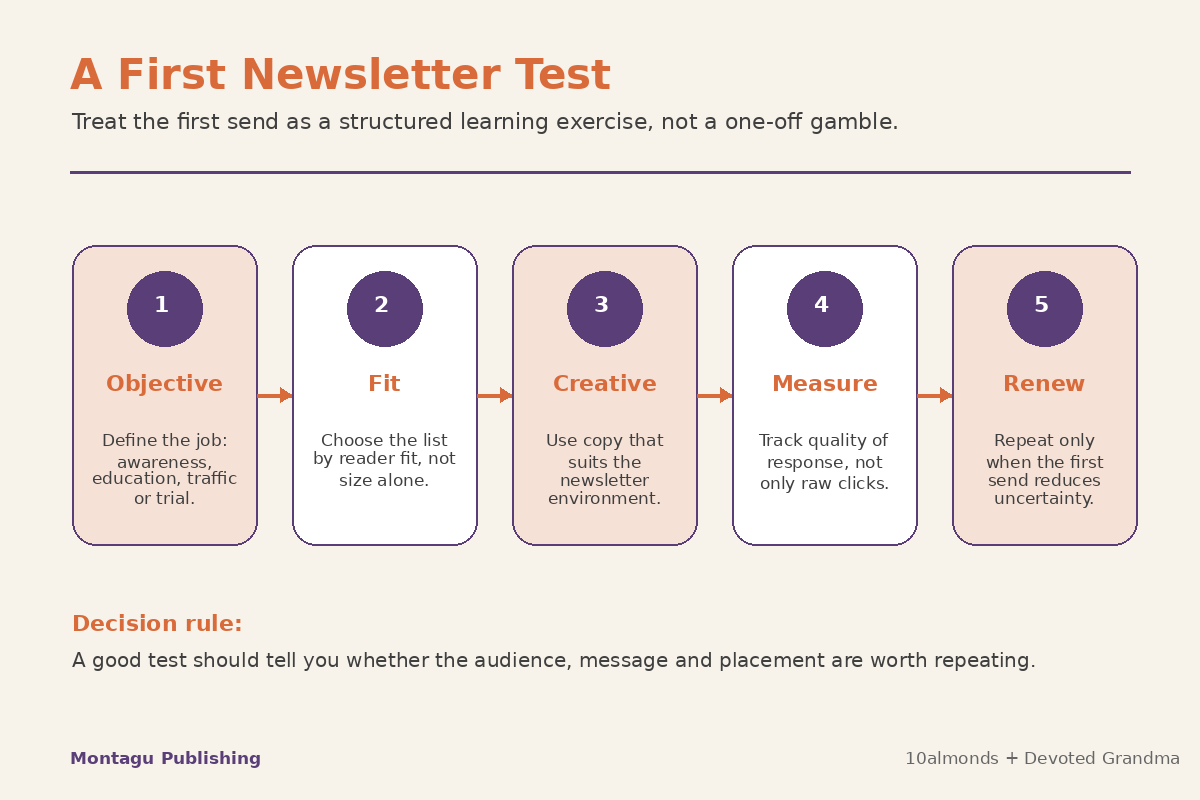
Brands should test newsletter sponsorships as a structured learning exercise, not as a one-off gamble. A good first test should answer four questions: does the audience fit the buyer, does the message suit the newsletter environment, does the traffic look qualified, and is there enough evidence to justify another send?
The goal is not to find the biggest list or the cheapest placement. The goal is to find a trusted audience where your product feels relevant, your message has enough room to be understood, and the first campaign gives you useful information for the next decision.
Quick Summary
- A first newsletter sponsorship should reduce uncertainty, not promise instant scale.
- Audience fit matters more than raw subscriber count.
- Brands should compare reader profile, content context, placement type, expected reporting and creative guidance before booking.
- Email data has limits, so first-party reader surveys and publisher context are valuable.
- The first send should be judged by qualified traffic, reader behaviour and learning, not clicks alone.
- Renewals should go to the newsletters that show audience fit and give the brand a clear path to improve the next placement.
Why First-Time Newsletter Sponsorships Feel Risky
Many brands arrive at newsletter sponsorships after spending years on familiar platforms such as Meta, Google or LinkedIn. Those channels have dashboards, bidding systems and reporting formats that marketing teams already understand. Newsletter sponsorships can feel less familiar because every publication has its own audience, format, pricing and editorial style.
That uncertainty is not a reason to avoid the channel. It is a reason to test it properly.
The mistake is treating the first sponsorship as a final verdict on the entire channel. One send in one newsletter tells you something, but it does not tell you everything. It tells you whether that audience, that message and that placement were a reasonable fit at that moment.
A useful newsletter test is designed to learn, not just to spend.
Your First Sponsorship Is an Audition
The first newsletter placement is rarely just about the first placement. It is an audition for whether the brand should invest again.
This is why small first bookings matter. A brand may start cautiously because it is still learning how the channel works, but a strong first experience can lead to repeat placements, larger packages or educational sponsored content.
For the brand, the first test should answer whether the audience is worth returning to. For the publisher, it is a chance to prove that they understand their readers well enough to help the sponsor perform.
That means speed, clarity and advice matter. The best publisher partners do not simply take copy and run it. They help the brand understand what will feel natural to the audience, what might underperform, and how to make the placement easier for the reader to act on.
Do Not Start With the Biggest List
A large subscriber count can be useful, but it is not the same as audience fit.
A newsletter with a smaller, highly engaged audience in the right category may be more useful than a much larger list with weak relevance — the same logic behind choosing the most cost-effective way to reach women over 50. This is especially true for wellness, finance, travel and household products where the buying decision often depends on trust and context.
If you are selling a menopause support product, a newsletter read by health-conscious women over 50 is likely to be more relevant than a larger general lifestyle list. If you are promoting family travel, the buying context may matter more than the total number of subscribers.
The question to ask is not, how many people could see this? The better question is, how many of the right people are likely to care?
What to Compare Before Booking
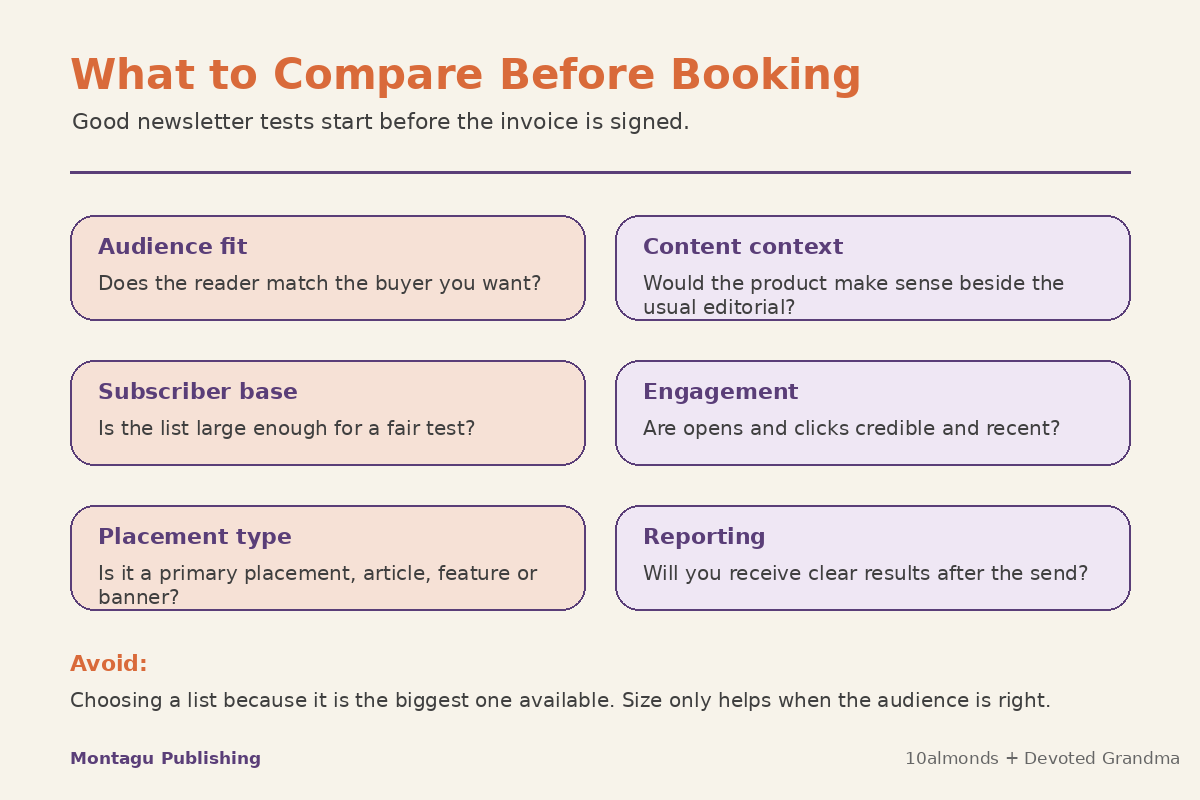
Brands often compare newsletters side by side, and they should. The comparison becomes more useful when it goes beyond subscriber count.
| What to compare | Why it matters | Question to ask |
|---|---|---|
| Audience fit | A relevant reader is more valuable than a larger but mismatched audience. | Who reads this newsletter, and why do they subscribe? |
| Content context | The closer the product sits to the editorial world, the more natural the placement feels. | Would this product make sense beside your usual content? |
| Subscriber count | Size helps, but only after fit is established. | Is the list large enough for a fair test? |
| Open and click history | Recent engagement gives a better view than old averages. | What performance range should we realistically expect? |
| Placement format | A primary placement, sponsored article and small banner do different jobs. | Where will the sponsor appear, and how much room does the message get? |
| Reporting | Brands need enough data to decide whether to renew. | What will we receive after the send, and when? |
This is where clear media kits matter. If the most important information is missing, the brand may move on before anyone has read a single issue of the newsletter.
What Email Data Can and Cannot Tell You
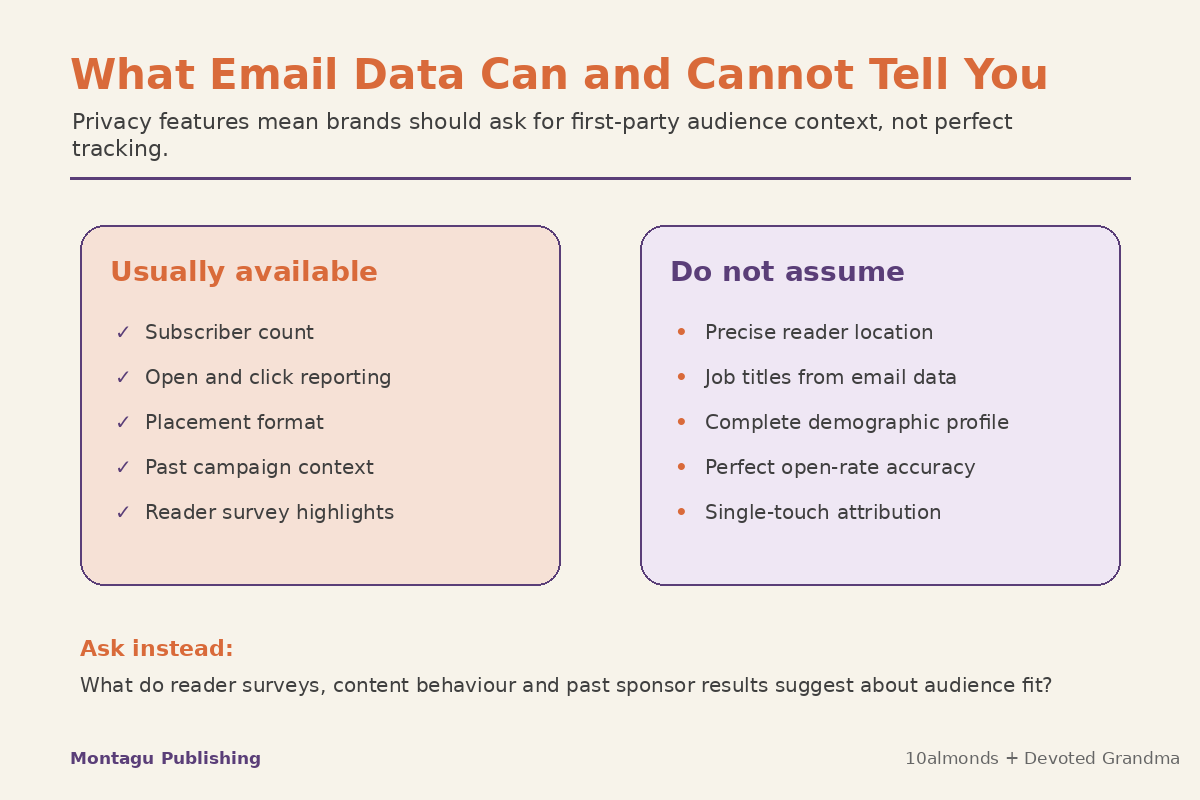
Brands often want to know exactly who the readers are: age, location, income, job title, household role and buying behaviour. Some of that can be answered through first-party reader surveys, subscription forms and editorial insight. Some of it cannot be reliably inferred from email platform data alone.
Privacy features have made some email signals less precise. Apple Mail Privacy Protection can hide a reader’s IP address from senders and privately download remote content in the background. Gmail also states that senders cannot use image loading to get information about a recipient’s computer or location.
That does not make newsletter data useless. It means brands should ask better questions.
Instead of asking for perfect tracking, ask for available reader context: survey findings, audience geography at a broad level, content categories that perform well, and examples of products or topics the audience has previously engaged with.
A publisher that can explain its audience clearly has an advantage because it reduces guesswork before the first send.
How to Structure a Small Newsletter Test Budget
There is no fixed number of newsletters every brand should test. A large brand may test several publications at once. A smaller brand may only have the budget to test one or two carefully chosen newsletters.
The principle is simple: do not spread the budget so thin that no placement has a fair chance, and do not spend the entire test budget on one audience unless the fit is very strong.
| Budget situation | Sensible approach | What to learn |
|---|---|---|
| Very small test budget | Choose one highly aligned newsletter and make the creative as strong as possible. | Does this audience respond to the message at all? |
| Moderate test budget | Test two or three newsletters with different audience contexts. | Which audience produces the best quality response? |
| Larger test budget | Test several newsletters, then renew the strongest performers. | Where should repeat budget go? |
A newsletter test is strongest when the brand plans for the second decision before the first send goes live. If it works, what would justify renewing? If it does not work, what would you need to know before trying again?
What to Ask the Publisher Before You Book
The right questions reduce the chance of a weak test. Before booking, ask the publisher:
- Who is the reader, and what does she come to the newsletter for?
- Which sponsor formats usually work best with this audience?
- What kind of copy tends to perform poorly?
- Can the publisher advise on subject matter, tone or positioning?
- Where will the placement sit in the newsletter?
- What assets are needed, and by when?
- What reporting will be shared after the campaign?
- Can the placement be paired with educational content if the product needs explanation?
The answers will tell you a lot about the quality of the partnership. A publisher that understands its audience should be able to offer guidance beyond dimensions, deadlines and invoice details.
Creative Matters More Than Brands Expect
Many first-time sponsors reuse creative from paid social or display campaigns. Sometimes that works. Often, it does not.
A newsletter reader is in a different mindset from someone scrolling through a social feed. She has chosen to open a piece of content and spend time with it. Heavy-handed sales copy can feel out of place. Clear, useful and reader-aware copy usually has a better chance.
For wellness brands, this often means leading with the problem or question before introducing the product. For example, a magnesium brand may perform better by explaining why sleep quality changes with age than by opening with a discount code. The discount can still appear, but it should not be asked to do all of the work.
How to Judge the First Send
Clicks matter, but they are not the whole story. A newsletter sponsorship should be judged against the job it was designed to do.
| Signal | What it tells you | How to use it |
|---|---|---|
| Clicks | Whether the offer or topic created enough interest to act. | Compare against placement type and audience fit, not every other channel. |
| Qualified traffic | Whether visitors behaved like potential buyers. | Review time on site, pages viewed, sign-ups or product page visits. |
| Creative feedback | Whether the message suited the audience. | Use publisher comments to improve the next send. |
| Assisted conversions | Whether the placement influenced later purchase behaviour. | Track with UTM links, landing pages and broader campaign reporting. |
| Learning value | Whether the test clarified the next decision. | Renew, revise or move on based on evidence, not instinct. |
The first send does not need to answer every question. It should answer enough to decide what happens next.
When to Renew and When to Move On
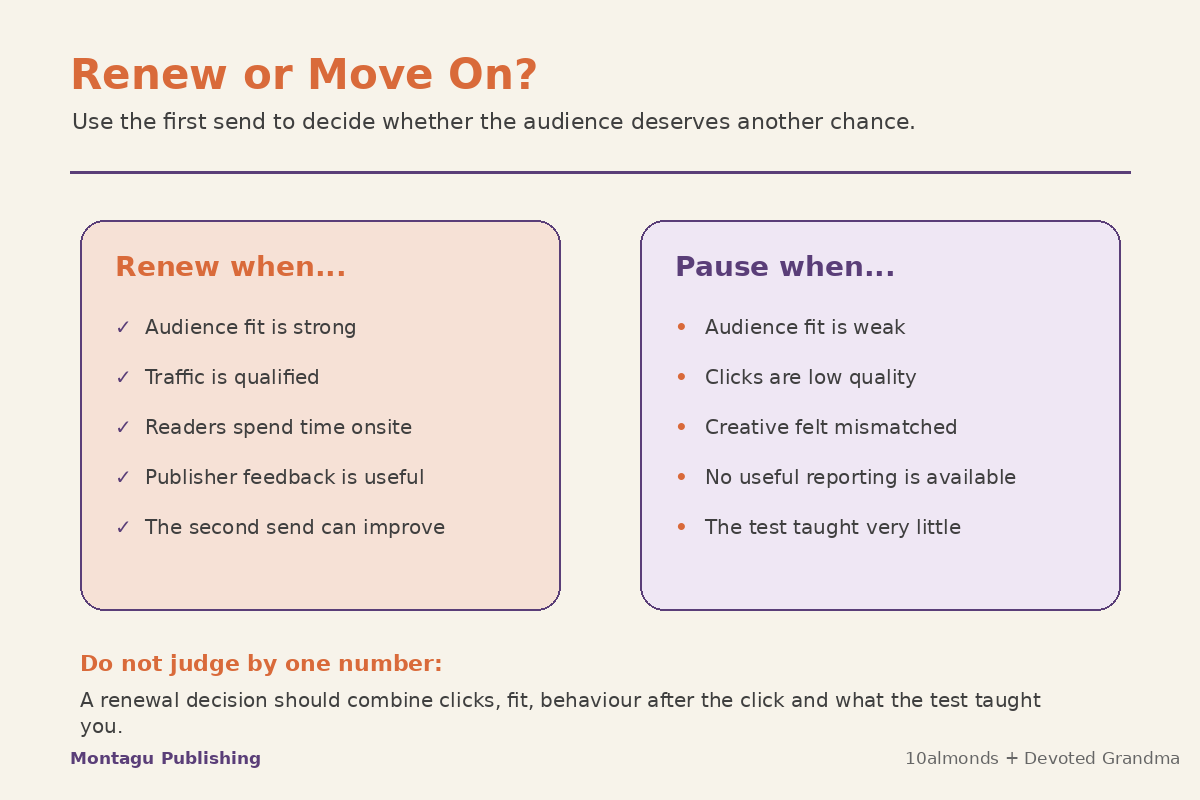
A renewal is not automatically deserved because a placement ran. It should be earned by evidence.
| Renew when | Pause or move on when |
|---|---|
| The audience fit is strong and the traffic looks qualified. | The audience was too broad or poorly matched. |
| Readers spent meaningful time on the site or content. | Clicks were low quality or bounced quickly. |
| The publisher gave useful guidance for improving the next placement. | The publisher provided little context or reporting. |
| The product clearly belongs in the editorial environment. | The product felt forced or unrelated to reader interests. |
| There is a clear idea for how the second send can improve. | The first send did not produce enough learning to justify another. |
The best newsletter partners become more valuable over time because each placement teaches both sides something. The first send is rarely perfect. The question is whether it gives you a reason to improve and repeat.
Where 10almonds and Devoted Grandma Fit
10almonds and Devoted Grandma are useful in different campaign contexts, so brands should not treat them as interchangeable.
10almonds is better suited to brands that want to reach women who are actively interested in their own health and wellbeing. It is a natural fit for wellness, supplements, nutrition, sleep, healthy ageing, skincare, menopause support, gut health and longevity brands where education plays an important role before purchase.
Devoted Grandma is better suited to brands that want to reach women making decisions within a wider family or household context. This can include travel, household health, gifting, family services, home safety, financial planning and products that matter across generations.
A brand choosing between them should start with the buying context. Is the reader mainly deciding for herself, or is she thinking about her family and household as well? That answer will often make the media choice clearer.
A Mistake We Often See
The most common mistake is judging a newsletter sponsorship as if it were a paid search ad — the same category error we flagged in how a wellness brand should spend its next $10,000 to reach women over 50.
Paid search captures someone who is already looking. A newsletter placement often does a different job. It helps create understanding, trust and interest before the consumer searches, compares or buys.
If you judge an education-led placement only by immediate last-click sales, you may miss the value it created earlier in the decision journey.
What We Would Do
If we were testing newsletter sponsorships for a wellness brand for the first time, we would begin with one clear product, one clear audience and one clear message — the same discipline that helps smaller brands compete without bigger budgets. We would not test five different offers at once.
We would choose a newsletter where the product naturally belongs, ask the publisher for creative guidance, and build the placement around a question the reader already has. We would use UTM links, a dedicated landing page where possible, and a simple post-campaign review that looks at traffic quality as well as clicks.
If the first send showed strong audience fit, we would not start from scratch. We would renew with a sharper message, a stronger call to action or an educational article that gives the reader more context before asking for the sale.
Frequently Asked Questions
The Bottom Line
The smartest way to test newsletter sponsorships is not to chase the biggest list or the cheapest placement. It is to choose a relevant audience, give the publisher enough context to help, run a clear first test, and measure whether the audience deserves another chance.
A good newsletter sponsorship should reduce uncertainty. It should help you understand whether a specific audience cares about your message, whether the creative needs adjusting, and whether another placement is worth the spend.
For brands with limited budgets, that kind of learning is valuable. It turns a first send from a gamble into a decision-making tool.
Considering a Newsletter Sponsorship?
If your brand is planning a campaign for women over 50 and wants to test newsletter sponsorships in a structured way, Montagu Publishing can help you assess whether 10almonds or Devoted Grandma is the better fit.
Through primary newsletter placements and brand-supported educational content, we work with sponsors to reach readers in environments where they are already reading, learning and making decisions.
To discuss an upcoming campaign, reach out to sales@10almonds.com.