


Direct Answer
Smaller brands compete without bigger budgets by refusing to play the same game as larger competitors. They should not try to match reach, frequency or production spend. They should narrow the audience, choose one problem they can explain better than anyone else, invest in channels that build understanding, and use retargeting to bring interested people back.
A limited budget can still work hard when every channel has a clear job. Search captures existing demand. Educational content builds trust. Newsletter partnerships give the brand space to explain. Retargeting follows up with people who have already shown interest. The aim is not to look bigger. The aim is to make better decisions faster.
Quick Summary
- Smaller brands should not compete by trying to buy the same reach as larger competitors.
- A narrow audience usually produces better results than a broad campaign with weak relevance.
- The strongest small-budget campaigns focus on one customer problem, one core message and a small number of channels.
- Educational content helps smaller brands earn trust before asking for the sale.
- Newsletter partnerships can be useful when a product needs explanation and credibility before purchase.
- Retargeting and email follow-up help smaller brands avoid wasting the interest they have already created.
The Wrong Way to Compete
A smaller brand can lose money very quickly by trying to behave like a larger one.
Larger competitors can buy more impressions, produce more creative, run more tests and stay visible for longer. If a smaller brand tries to copy that approach with a fraction of the budget, it usually ends up with a weaker version of the same plan — the same trap we described in why increasing Meta spend can make the underlying problem worse. It reaches fewer people, appears less often and runs out of budget before the campaign has taught the team anything useful.
That is not a media problem. It is a strategy problem.
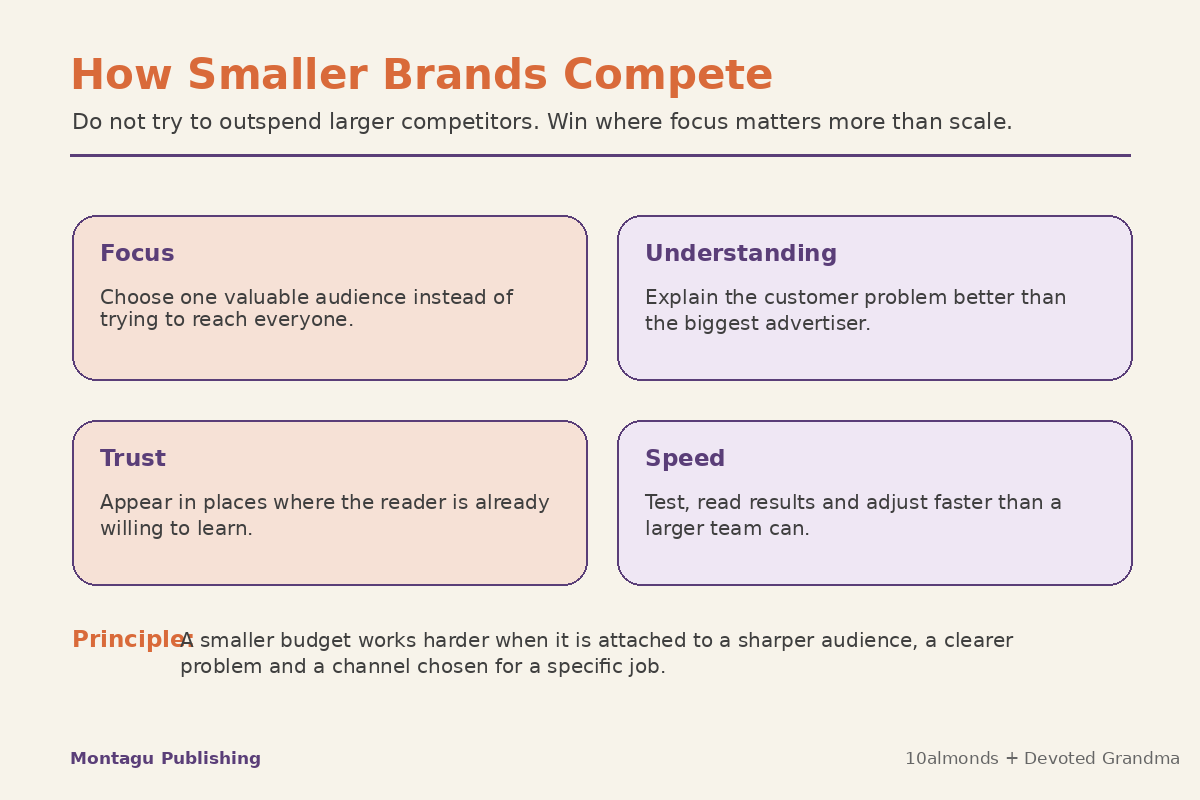
Smaller brands need to compete where the advantage does not depend entirely on spend. That means sharper audience selection, clearer education, better timing and stronger follow-up.
Start by Narrowing the Audience
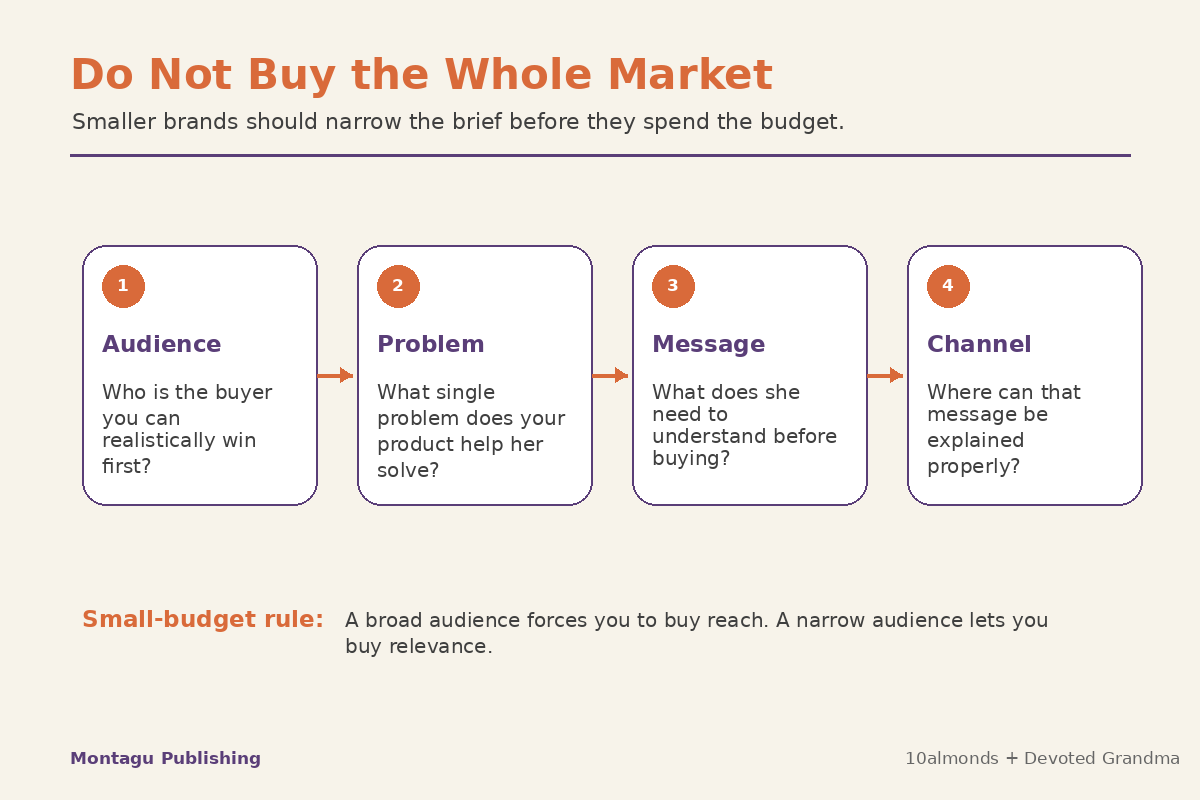
A small budget becomes weaker every time the audience gets broader.
A wellness brand targeting all women over 40 is buying a huge amount of waste. A wellness brand targeting women over 50 who are actively researching sleep, joint mobility or healthy ageing has a much clearer opportunity.
The narrower audience is not smaller in a bad way. It is more useful because the message can be more specific.
Instead of saying, this supplement supports everyday wellbeing, the brand can say, this article explains why sleep quality often changes after 50 and what to look for before choosing a supplement. One message is easy to ignore. The other answers a question the reader may already have — the same principle behind choosing the most cost-effective way to reach women over 50.
What Bigger Brands Can Buy and What Smaller Brands Can Beat Them At
Smaller brands should be honest about where larger competitors have an advantage. They should also be clear about where scale is less important.
| Area | Bigger brands can buy | Smaller brands can beat them by |
|---|---|---|
| Reach | More impressions across more platforms | Choosing a narrower audience with less waste |
| Creative volume | More ads and more versions | Making one message clearer and more useful |
| Trust | Familiarity through repeated exposure | Borrowing trust from credible environments |
| Speed | Large campaigns and longer planning cycles | Testing quickly and changing direction faster |
This is not about pretending that budget does not matter. Budget matters. But it does not matter equally in every part of the campaign.
Give the Budget Fewer Jobs
A common small-brand mistake is spreading a limited budget across too many platforms because each one feels important.
A small budget should not be asked to build awareness, educate the market, generate immediate sales, grow an email list, test creative, build community and prove long-term brand lift all at once. That is too much pressure for one campaign.
A better approach is to give the budget three or four jobs only.
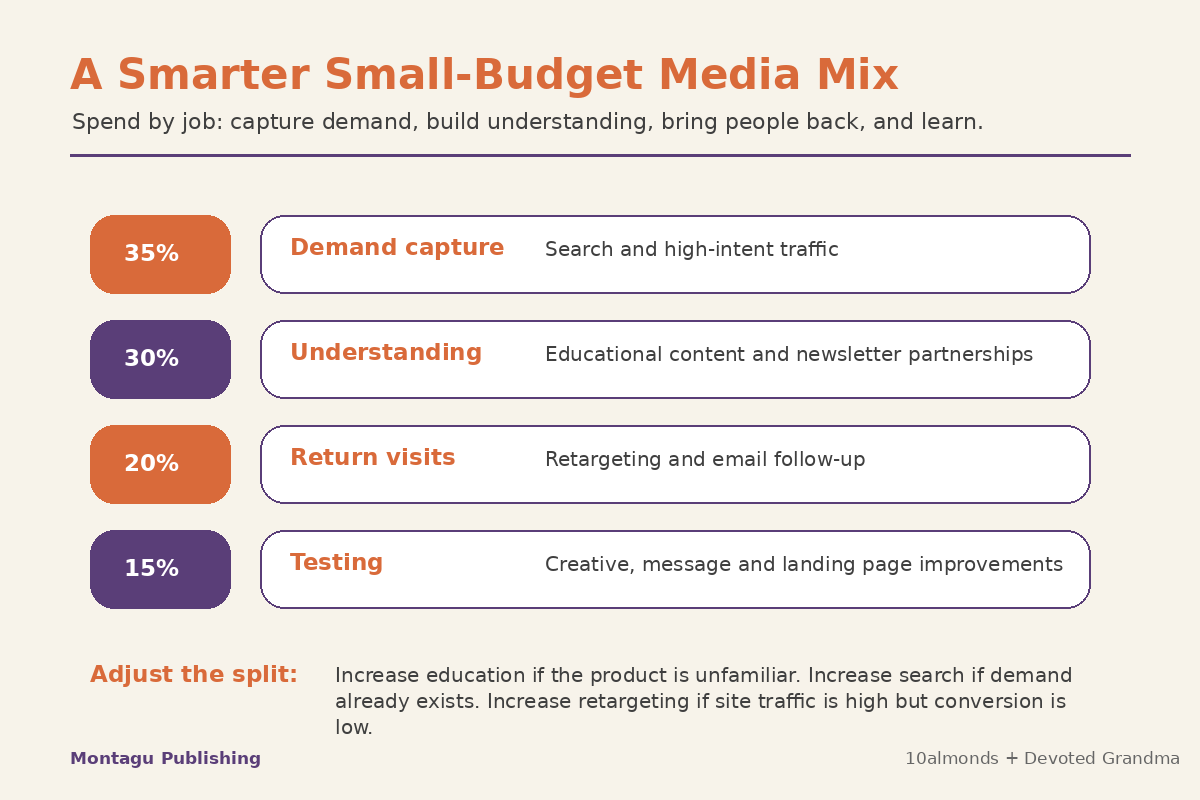
First, capture demand that already exists. Second, build understanding with the people who need more information before buying. Third, bring interested visitors back. Fourth, learn which message or channel deserves more spend next time.
A Practical Small-Budget Media Mix
For a smaller brand with a limited campaign budget, a useful starting point might look like this — the same by-the-job logic used in how a wellness brand should spend its next $10,000 to reach women over 50. The numbers should move depending on the product, category and previous results, but the principle is simple: spend by job, not by habit.
| Budget Share | Job | Example Channels | What to Measure |
|---|---|---|---|
| 35% | Capture demand | Paid search, high-intent landing pages | Qualified traffic, product page visits |
| 30% | Build understanding | Educational articles, newsletter partnerships | Reading time, click quality, returning visitors |
| 20% | Bring people back | Retargeting, email follow-up | Return visits, assisted conversions |
| 15% | Improve the message | Creative tests, landing page improvements | CTR, conversion rate, engagement quality |
This split is deliberately not built around one platform. It is built around the jobs that a smaller brand needs done.
Why Education Helps Smaller Brands
Bigger brands often win because people already recognise them. Smaller brands usually do not have that advantage.
That means a smaller brand has to answer more questions before the consumer feels comfortable buying. What is this product? Why does it matter? Why should I trust it? How is it different from the alternatives? Is this relevant to me now?
Short ads rarely answer those questions properly. Educational content can.
For wellness, healthcare, healthy ageing and supplements, education is not a nice extra. It is often the bridge between curiosity and purchase. When a smaller brand explains the problem clearly, it has a better chance of being remembered for the solution.
Five Ways to Make a Small Budget Work Harder
- Choose one customer problem. Do not launch a campaign around the whole product range. Pick the problem that is easiest for the audience to recognise and build the campaign around that.
- Use paid media to support content, not replace it. A paid ad can introduce the message, but it should lead somewhere that explains the idea properly.
- Retarget people who showed genuine interest. Someone who read an article, visited a product page or clicked from a newsletter is more valuable than a cold audience seeing the brand for the first time.
- Measure quality as well as quantity. A lower number of better-qualified visitors can be more valuable than thousands of low-intent clicks.
- Reuse one strong idea across channels. A useful educational article can become paid social copy, email content, retargeting angles and sales material. Smaller brands should not create from scratch every time.
Where Newsletter Partnerships Fit
Newsletter partnerships are not a shortcut to becoming a large brand overnight. They are more useful than that. They help smaller brands reach a specific audience in a setting where the reader has already chosen to spend time with content — the same trusted-attention logic behind where brands should invest when Meta performance starts declining.
For a smaller wellness brand, that matters because trust is often the missing piece. The consumer may be interested in the category but unfamiliar with the brand. A newsletter article gives the brand space to educate before asking for the click.
This is where publications such as 10almonds and Devoted Grandma can be useful inside a small-budget plan. 10almonds is a natural fit for brands speaking to women who are actively researching their own health, wellbeing, sleep, nutrition, mobility and healthy ageing. Devoted Grandma is useful when the product or service connects to family life, household decisions, travel, gifting, safety or wellbeing across generations.
The value is not only that the brand reaches readers. It is that the brand reaches them in a moment when they are open to learning.
What Smaller Brands Should Not Do
- Do not spend most of the budget trying to look bigger than you are. Consumers do not need a smaller brand to behave like a global brand. They need it to be clear, useful and credible.
- Do not chase cheap reach if the audience is wrong. Low-cost impressions are still expensive if they reach people who are never likely to buy.
- Do not judge educational content only by immediate sales. Its job is often to build the understanding that makes future conversion more likely.
- Do not copy a competitor’s media plan without knowing their objective. Their campaign may be solving a problem you do not have.
What We Would Do
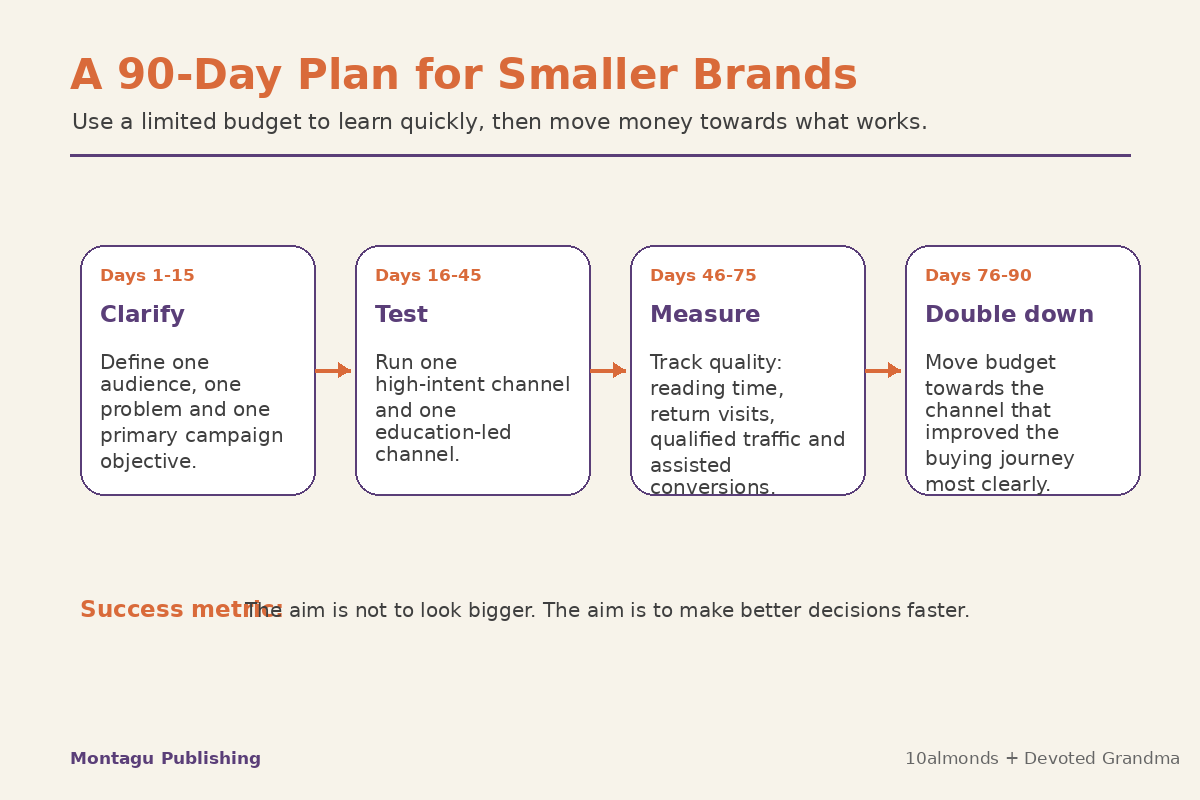
If we were helping a smaller wellness brand with a limited budget, we would not start by asking how to get the most impressions. We would start by choosing the one audience most likely to care and the one question that audience needs answered before buying.
For example, a brand selling a magnesium supplement for women over 50 might begin with an educational article about sleep quality, muscle function and what to look for in a supplement. It could then use paid social to introduce the article, search to capture existing demand, a newsletter partnership to reach a relevant audience, and retargeting to bring back people who showed interest.
That plan will not make the brand famous in 30 days. But it gives the budget a real chance of doing something useful: creating understanding, building trust and identifying which audience deserves the next round of spend.
Frequently Asked Questions
The Bottom Line
Smaller brands do not need bigger budgets to compete well. They need sharper decisions.
A large brand can afford waste that a smaller brand cannot. That means every audience choice, message, channel and follow-up has to work harder. The advantage comes from focus: choosing a specific buyer, answering a specific question and investing in channels that support the way that buyer actually makes decisions.
The better question is not how can we look bigger. It is how can we become more useful to the right audience than the bigger brand is.
That is where smaller brands can win.
Considering a Newsletter Partnership?
If your brand needs to explain a product, build trust with women over 50 or reach readers in a more focused environment, a newsletter partnership may be worth testing alongside your existing paid channels.
Through 10almonds and Devoted Grandma, Montagu Publishing works with brands through newsletter placements and brand-supported educational content designed to help readers learn before they buy.
If this approach might fit an upcoming campaign, reach out to sales@10almonds.com.