


Direct Answer
If Meta advertising performance is declining, the answer is not to spend more on Meta to compensate. Rising costs and falling returns on a single platform are usually a sign that a media plan has become too dependent on one channel to do every job at once: capturing demand, building awareness and earning trust.
The more reliable Meta advertising alternative is to look at what Meta has been covering well, then reallocate a portion of that budget toward paid search, retargeting and trusted publisher partnerships that can pick up the stages Meta is no longer covering efficiently.
Brands that treat a Meta downturn as a diversification signal, rather than a spending problem, tend to come out with a stronger, more resilient media mix.
Quick Summary
- A decline in Meta performance is rarely a sign to spend more on Meta. It is usually a sign the media plan has become too concentrated.
- Rising cost per click or per acquisition often means a platform has become more competitive, not that a product has become less appealing.
- Paid search, retargeting and newsletter partnerships each cover different parts of the customer journey that Meta alone cannot fully own.
- Diversifying is a risk-management decision as much as a growth decision.
- The goal is not to abandon Meta. It is to stop asking it to do a job it was never built to do alone.
Why Is Meta Suddenly So Expensive?
Three months ago, cost per acquisition on Meta was manageable and campaigns were hitting targets. This quarter, the same budget is producing fewer conversions, and cost per click has crept up without any change to creative or targeting.
The first instinct is usually to fix the Meta campaign: new creative, a different audience, a revised bid strategy. Sometimes that works. But if performance keeps sliding no matter what changes, the problem may not be the campaign. It may be that too much of the media plan depends on one platform continuing to perform at the same level indefinitely.
Why Meta Performance Naturally Declines Over Time
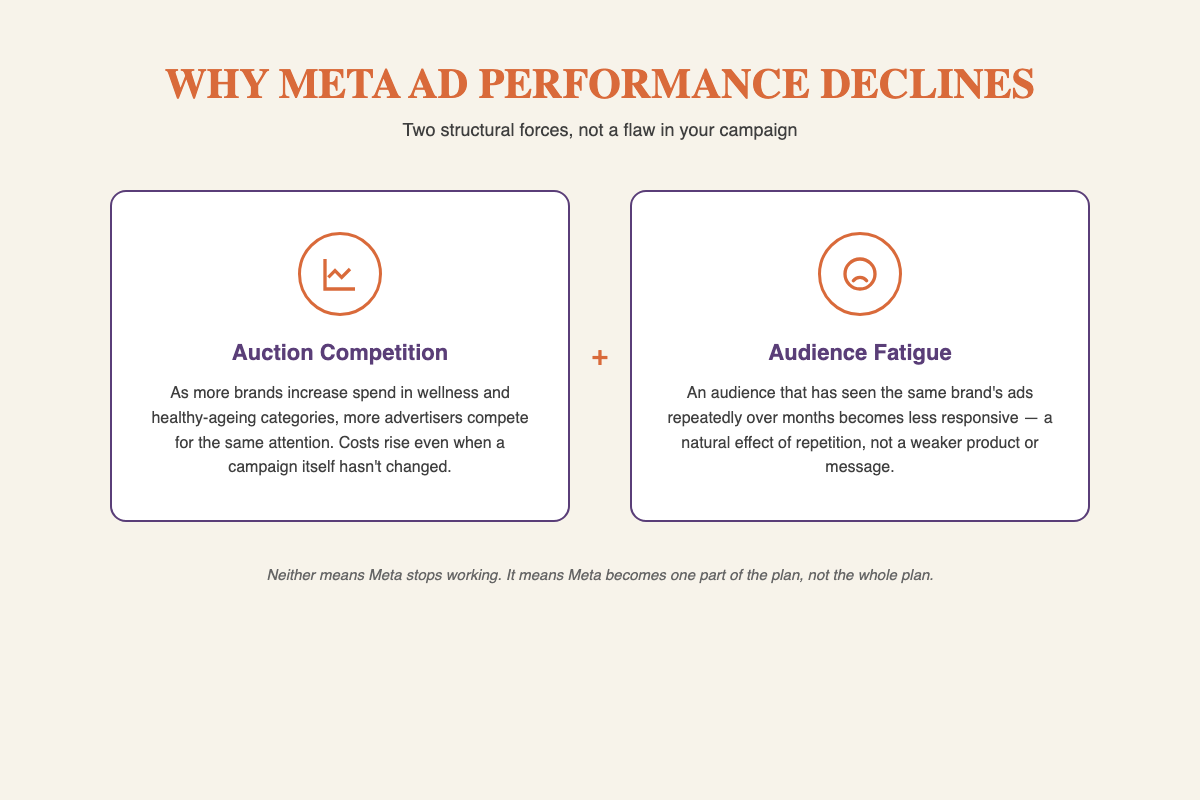
Meta’s advertising auction becomes more competitive as more brands increase spend in the same categories, particularly in wellness, supplements and healthy ageing, where demand for reaching older female audiences has grown quickly. As more advertisers compete for the same attention, costs rise even when a campaign itself has not changed.
At the same time, an audience that has seen the same brand’s ads repeatedly over several months can become less responsive. That is ad fatigue, not a flaw in the product or the message.
None of this means Meta stops working. It means Meta becomes one part of a media plan rather than the entire plan, and brands that built their entire acquisition strategy around it feel the shift the hardest.
Where the Budget Should Go Instead
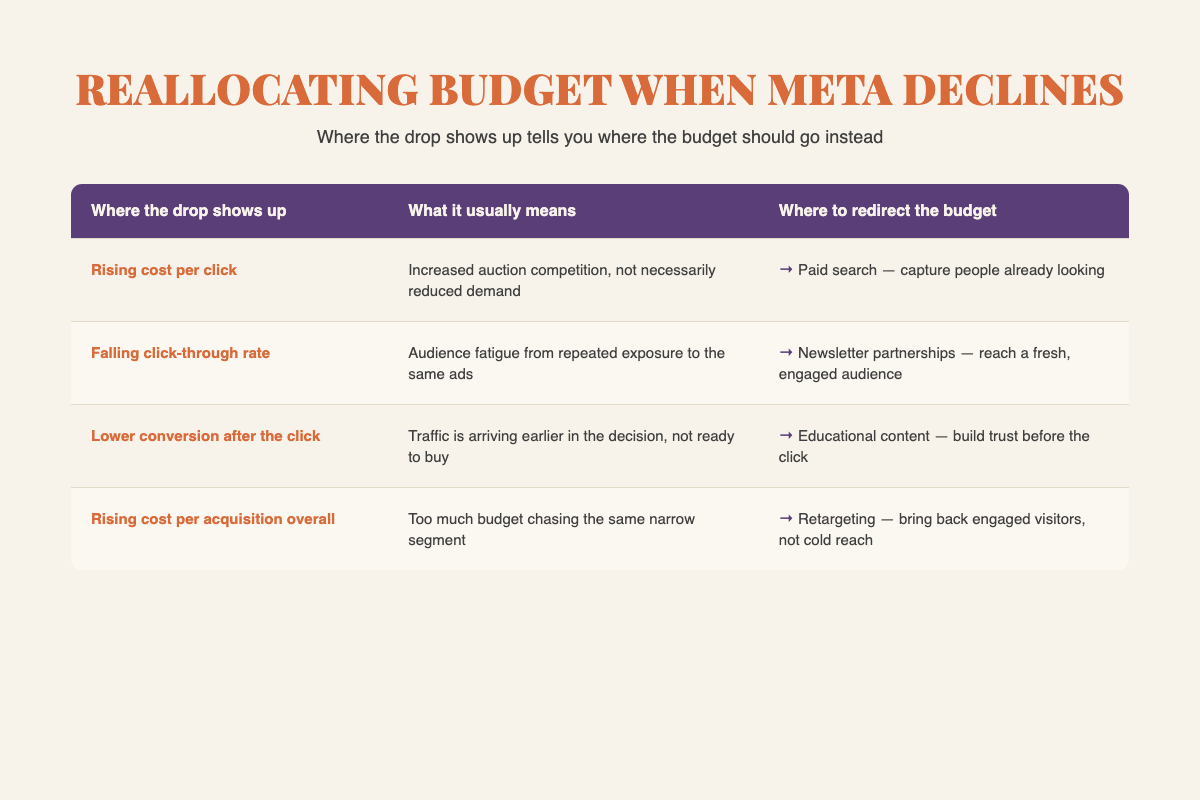
Not every decline shows up the same way, and the right response depends on where the drop is actually happening — a similar principle to the one we used when working out how a wellness brand should spend its next $10,000 to reach women over 50.
| Where the drop shows up | What it usually means | Where to redirect the budget |
|---|---|---|
| Rising cost per click | Increased auction competition, not necessarily reduced demand | Paid search — capture people already looking |
| Falling click-through rate | Audience fatigue from repeated exposure to the same ads | Newsletter partnerships — reach a fresh, engaged audience |
| Lower conversion after the click | Traffic is arriving earlier in the decision, not ready to buy | Educational content — build trust before the click |
| Rising cost per acquisition overall | Too much budget chasing the same narrow segment | Retargeting — bring back engaged visitors, not cold reach |
Give Every Channel One Job
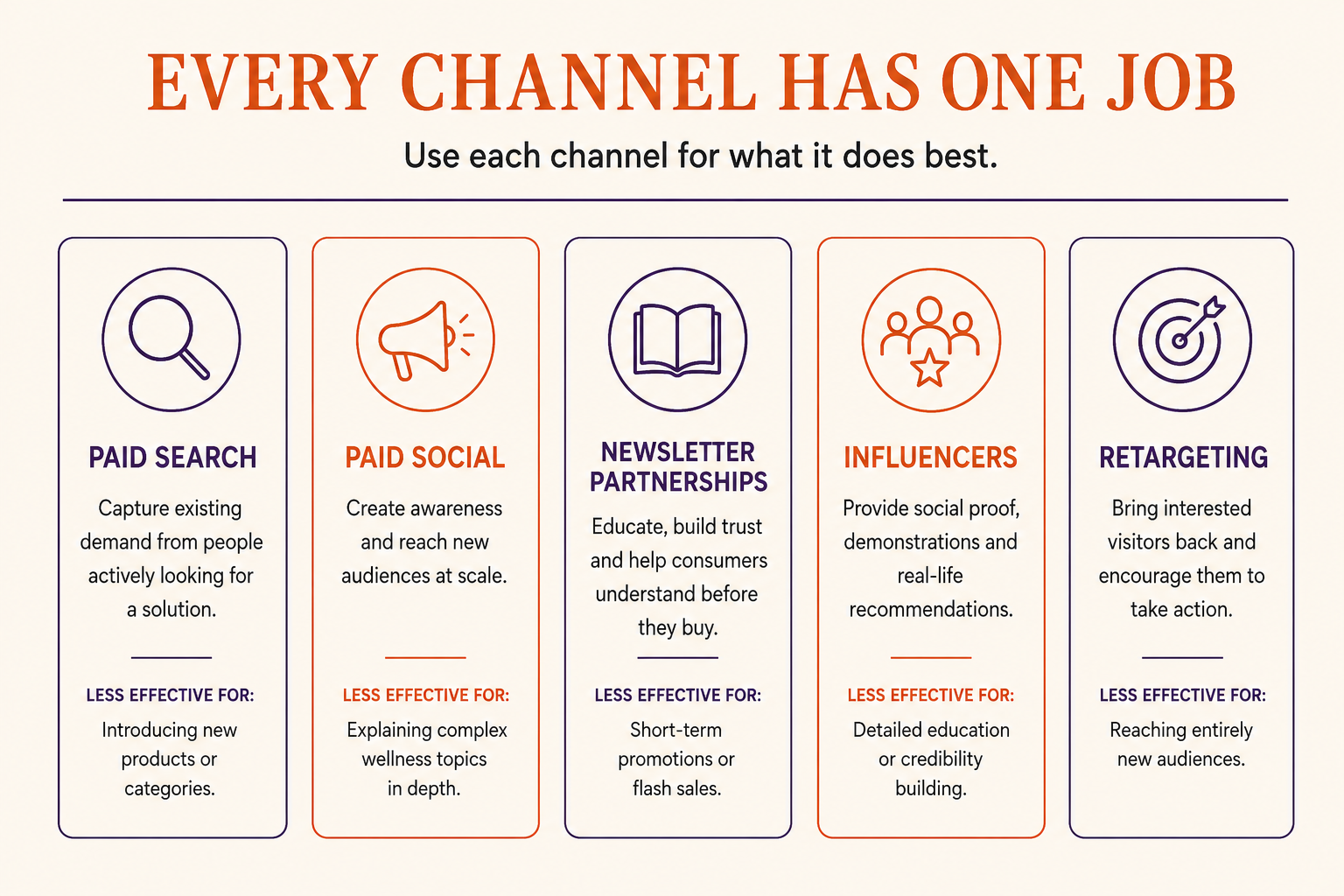
Search captures demand. Social creates awareness. Newsletter partnerships educate. Retargeting closes the loop. When Meta is asked to do all four jobs at once, cost per result rises because the budget is paying premium auction prices for an audience segment that is not yet ready to convert — the same reasoning behind choosing the right channel for each stage of the customer journey.
Where It Falls Short
Paid search only works if people already know they have the problem a product solves, so it cannot introduce a new supplement category to someone unfamiliar with it. Retargeting cannot create new audiences from nothing. Newsletter partnerships are not built for same-week urgency, such as a 48-hour flash sale. Every alternative to Meta has a job it does well, and a job it should not be asked to do.
A Mistake We Often See
When Meta costs increase, some teams simply cut the budget without addressing where the resulting gap sits in the funnel. That often reduces reach at every stage rather than fixing the one stage that is underperforming. Cutting Meta spend without reallocating it to the parts of the journey it was covering can leave a hole in awareness or trust, not just fewer clicks.
What We Would Do
If we were advising a supplements brand seeing Meta costs rise 30 to 40 percent over two quarters, we would not start by asking how to make Meta cheaper again. We would ask which stage of the customer’s decision Meta had quietly been covering. Often it is a mix of light awareness and last-touch conversion, rather than the deeper education stage.
We would protect a smaller, more targeted Meta budget for retargeting and top-of-funnel awareness, and move a meaningful share of the freed-up budget into paid search, to capture people already searching, and newsletter partnerships, to build the understanding that turns cold traffic into confident buyers.
Where 10almonds and Devoted Grandma Fit
For brands selling supplements, healthy ageing products or preventative health solutions to women over 50, a newsletter partnership through 10almonds gives a declining Meta budget somewhere useful to go: an audience that already reads for health information and does not need to be persuaded the way a cold social audience does.
For brands whose Meta struggles involve a broader household audience, such as household products, family travel or financial planning, Devoted Grandma reaches women making decisions for their families as well as themselves, filling a similar education gap that Meta cannot cover on its own.
Neither publication replaces Meta. Both give a declining platform’s freed-up budget somewhere to do useful work, in a part of the customer journey Meta was never well suited to cover alone.
The Better Question Is…
The question most marketing teams ask is, how do we make Meta perform like it used to? A more useful question is, which part of our customer’s journey has quietly become dependent on Meta, and what else could cover it? That reframing tends to produce a more resilient media plan, whether or not Meta’s costs ever come back down.
The Bottom Line
A decline in Meta performance is a signal, not a failure. It points to where a media plan has become too concentrated, not to a product or audience that has disappeared. Brands that respond by diversifying into search, retargeting and trusted publisher partnerships tend to build a stronger position than brands that simply pay more to keep Meta doing a job it was never meant to do alone.
Considering a Newsletter Partnership?
If rising Meta costs are pushing a search for other channels worth testing, it may be worth exploring how educational newsletter placements through 10almonds or Devoted Grandma could take on some of the awareness and trust-building work paid social used to do more cheaply.
Rather than replacing existing channels, the goal is to give the budget freed up by a declining platform somewhere useful to go.
If this approach might fit an upcoming campaign, reach out to sales@10almonds.com.