


Direct Answer
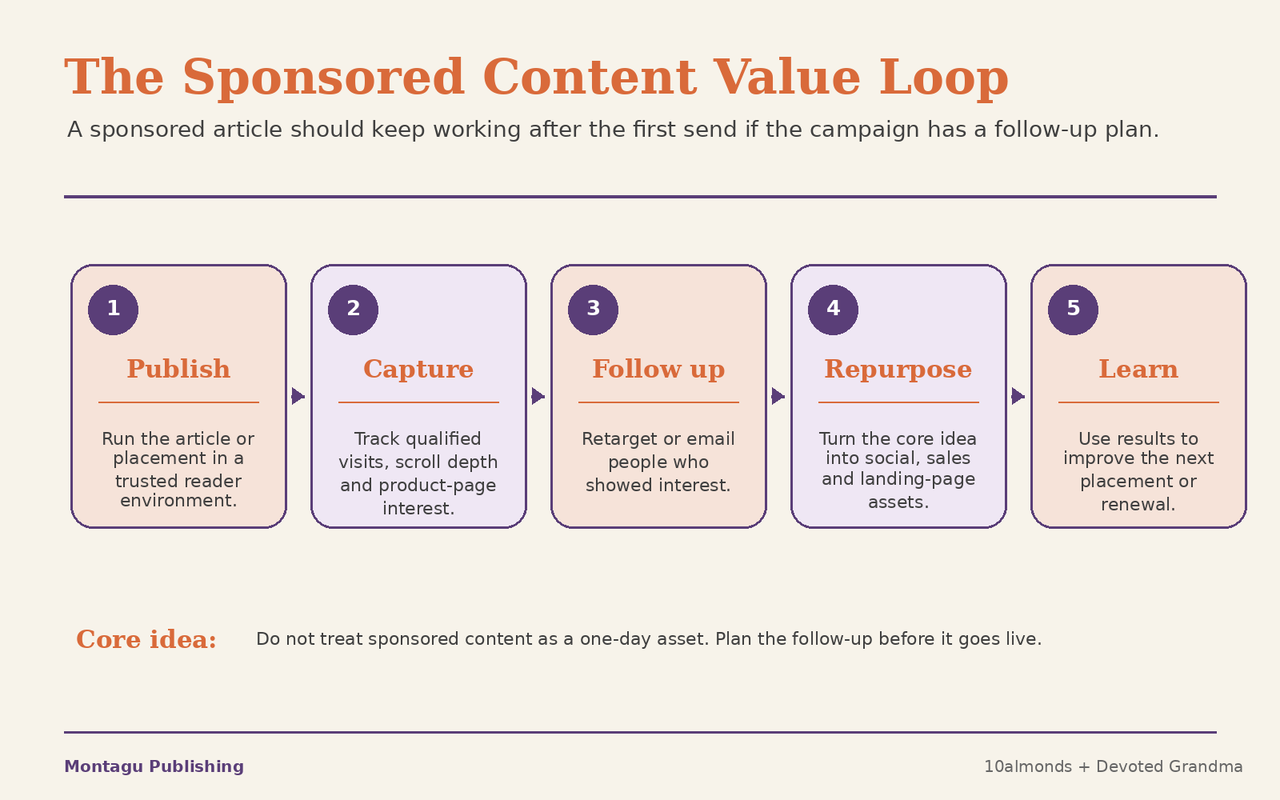
A brand gets more value from sponsored content by planning what happens after publication before the article goes live.
The first send or article placement should not be treated as the whole campaign. It should create a useful starting point: a clear explanation, qualified traffic, reader behaviour data and a message that can be carried into retargeting, sales emails, landing pages and future placements.
For a marketing manager with a tight budget, this matters because sponsored content is expensive if it is used once and forgotten. It becomes more efficient when the article also helps the brand learn, follow up and improve the next campaign.
Quick Summary
- Plan the follow-up before the sponsored article goes live.
- Repurpose the central insight, not the entire article word for word.
- Use the article to support retargeting, email, sales conversations and landing-page clarity.
- Measure reader behaviour, return signals and assisted conversion as well as immediate clicks.
- Keep disclosure and claim support consistent when sponsored content is reused elsewhere.
Why This Question Matters
Many brands treat sponsored content like a single publishing moment. The article goes live, the newsletter is sent, the report arrives and everyone moves on.
That is a waste of the work already done.
A good sponsored article contains more than an ad message. It usually contains the buyer question, the explanation, the proof, the audience angle and the most useful way to introduce the product. Those ingredients can support more than one placement if the brand knows how to use them.
The problem is that repurposing often happens too late. Someone asks for a LinkedIn post, a retargeting line or a sales email after the campaign has already run. By then, the article has lost momentum and the follow-up is rushed.
Start With the Afterlife of the Article
Before the article is written, ask what the content should do after publication.
Will it help retarget interested readers? Will it become a follow-up email? Will it support a product landing page? Will the strongest section be turned into a short paid social test? Will the sales team use it to answer a common objection?
These questions do not make the article less editorial. They make the campaign more useful.
If the only plan is to publish once and wait for clicks, the brand is asking one asset to carry the entire journey alone.
The First Job Is Education
Sponsored content is strongest when it gives the reader enough context to understand why the product, service or category matters — the same clarity test explained in how to educate consumers about complex products without sounding salesy.
That does not mean every article should be long or academic. It means the content should answer a real question before asking for action.
For a wellness brand, that question may be about symptoms, ingredients, product fit or how to compare options. For a family product, it may be about usefulness, safety, convenience or value. For a financial product, it may be about risk, timing or trust.
Once the article answers that question clearly, the brand can use the same explanation in other places where consumers need reassurance.
Repurpose the Insight, Not the Article
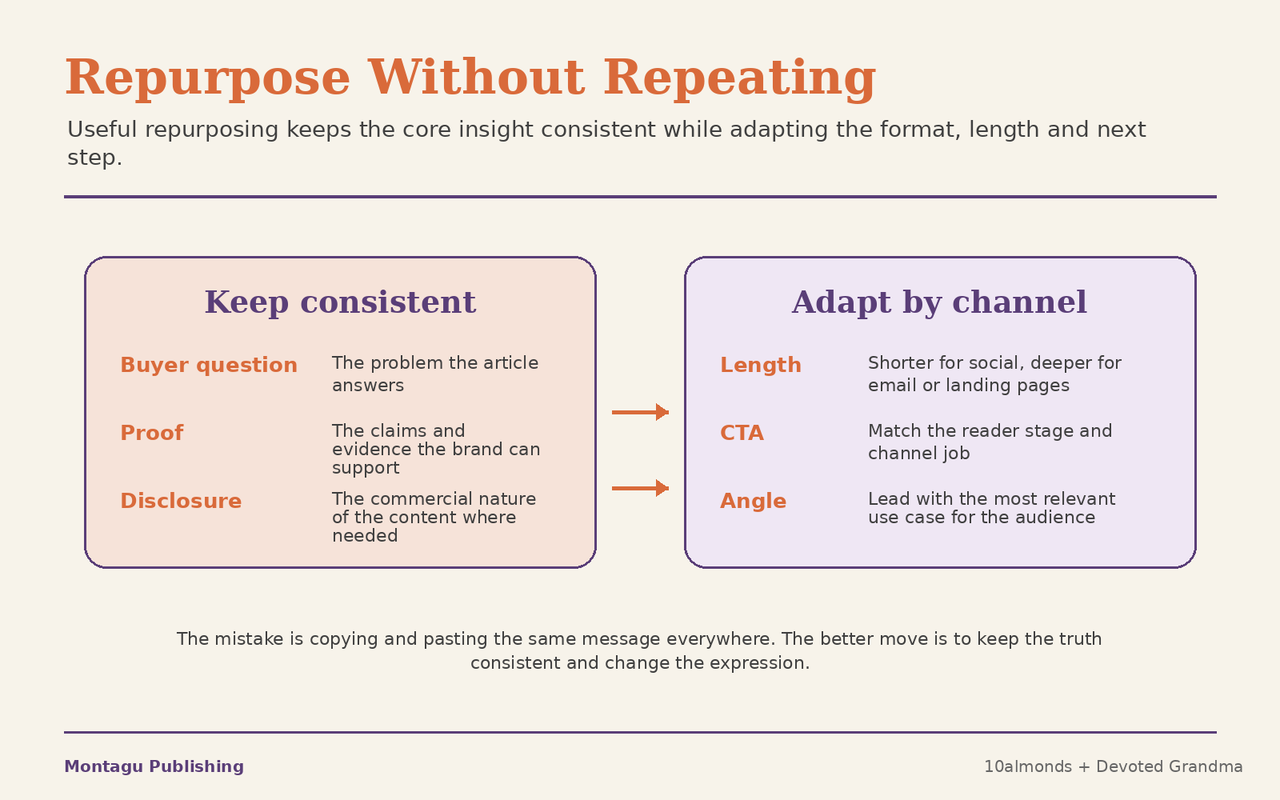
The mistake is copying the article into every channel.
A newsletter article, a paid social ad, a sales email and a product landing page do not need the same amount of detail. They need the same core truth expressed at the right depth.
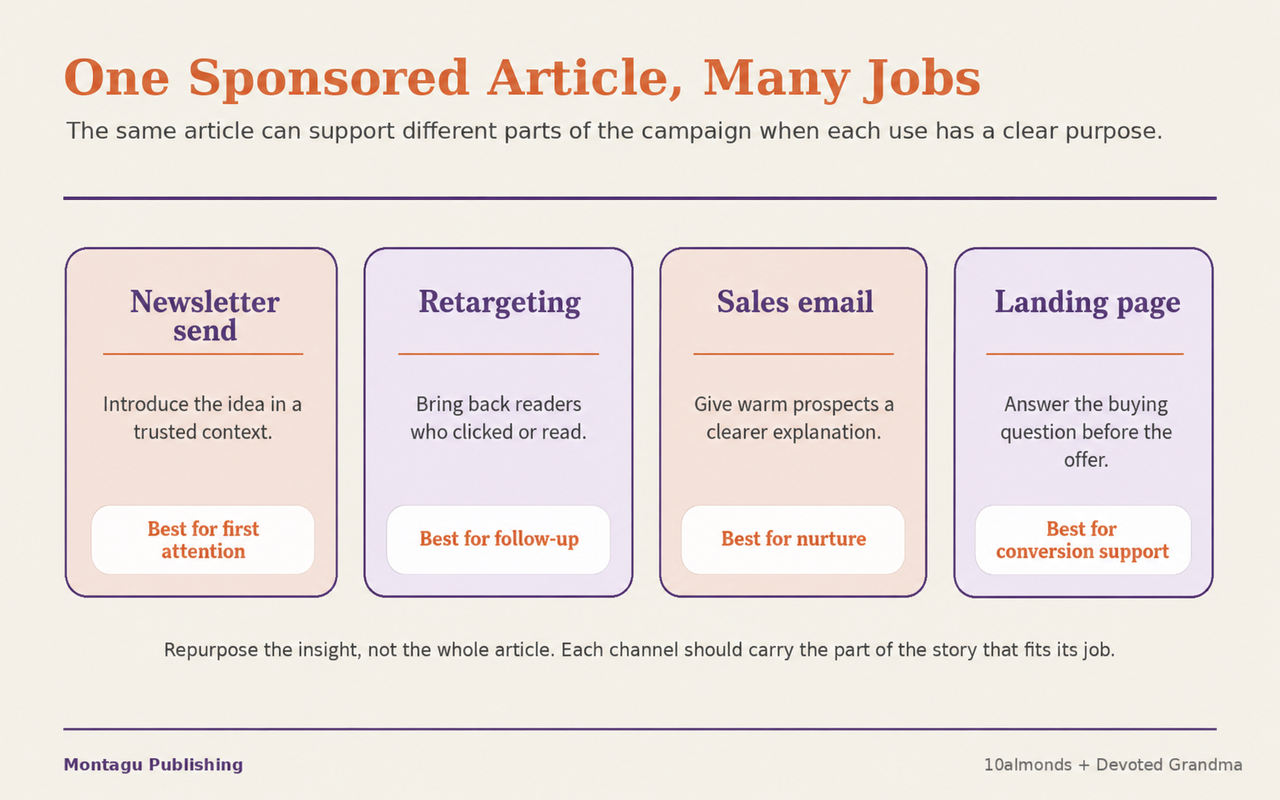
The article may carry the full explanation. A retargeting ad may carry one remembered idea. A sales email may carry the strongest objection and answer. A landing page may carry the proof and next step.
This is how sponsored content starts to work harder. It becomes the centre of a campaign system rather than a one-off placement.
Where Sponsored Content Can Be Reused
A sponsored article can often support several campaign assets, provided each use is adapted properly.
| Asset | How the article helps | What to adapt |
|---|---|---|
| Retargeting | Gives interested readers a clear reminder of the problem or benefit. | Use one idea, not the whole article. |
| Sales email | Helps explain the product to warmer prospects. | Lead with the objection or question the article answered. |
| Landing page | Adds context before the product claim or offer. | Keep the explanation concise and close to the CTA. |
| Paid social | Turns the strongest insight into a short awareness message. | Simplify without exaggerating the claim. |
| Next newsletter placement | Builds on what readers already saw. | Advance the story rather than repeating it. |
What Not to Repurpose Blindly
Not every part of a sponsored article should be reused without thought.
Health, wellness and financial claims need careful handling. If a claim was approved in one context, do not assume it can be shortened, intensified or moved into another channel without review.
The same applies to disclosure. If content is sponsored or materially connected to an advertiser, the commercial nature of that content should not become unclear when it is reused. The FTC’s native advertising guidance focuses on avoiding misleading presentation and using clear, prominent disclosures when needed to prevent deception.
In practical terms, repurposing should keep the evidence, limitations and disclosure discipline intact.
A Simple 30-Day Follow-Up Plan
The first month after publication is where many brands lose value.
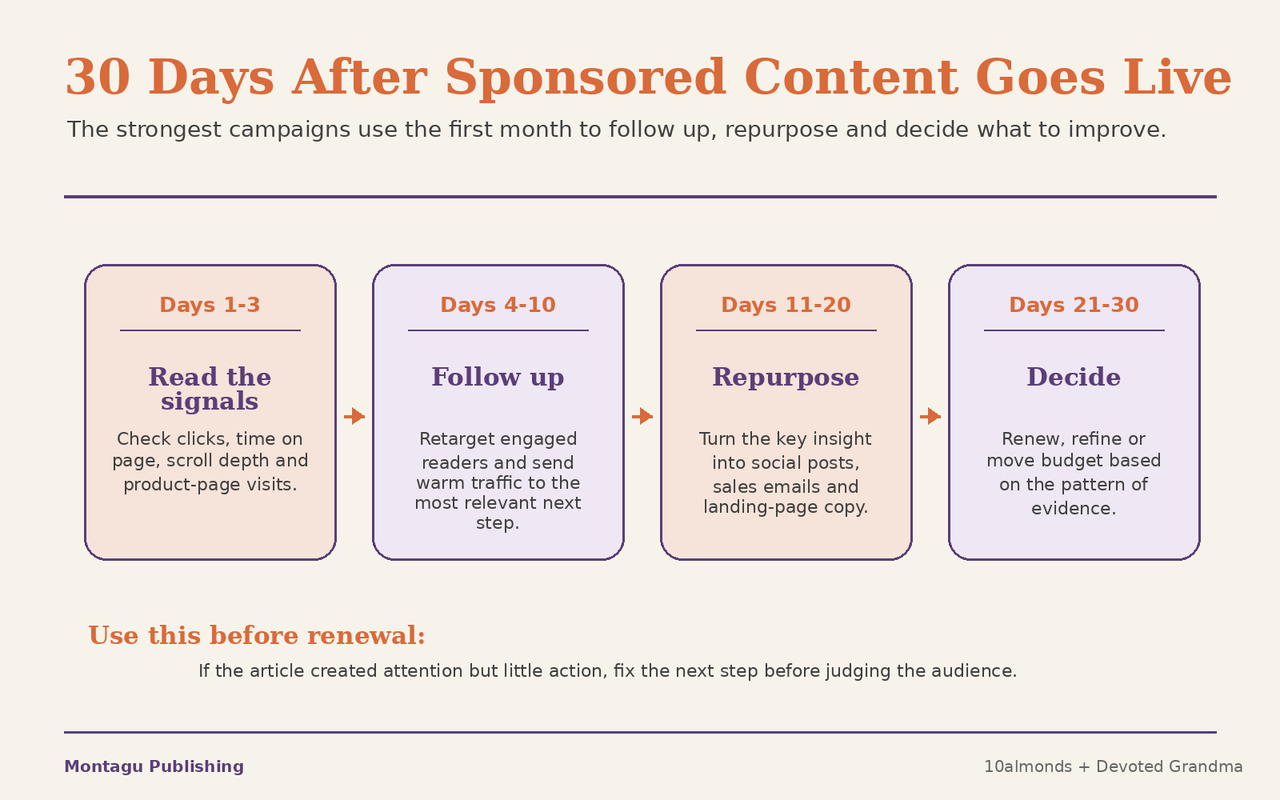
Instead of waiting for a final report and deciding whether the campaign “worked,” use the first 30 days to learn and improve.
| Timing | What to do | Why it matters |
|---|---|---|
| Days 1-3 | Review clicks, time on page, scroll depth and product-page visits. | Shows whether the article earned useful attention. |
| Days 4-10 | Retarget readers who clicked or spent meaningful time with the content. | Keeps the conversation going while interest is warm. |
| Days 11-20 | Repurpose the strongest insight into email, social or landing-page copy. | Extends the value of the explanation. |
| Days 21-30 | Review return behaviour, assisted conversion and follow-up performance. | Supports a better renewal decision. |
How to Measure the Extended Value
Immediate clicks are useful, but they are not the whole value of sponsored content — the same case made in how brands should measure sponsored content beyond clicks.
Look at whether readers stayed long enough to learn, whether they moved to product pages, whether they returned later, whether branded search increased, whether retargeting audiences grew and whether assisted conversions appeared over time.
The right measurement depends on the job the content was asked to do. If the article was designed to educate, then time on page, scroll depth, related-content clicks and return behaviour are not soft metrics. They are evidence of whether the content reduced uncertainty.
What We Would Do
If we were helping a wellness brand use sponsored content with a limited budget, we would build the follow-up into the campaign from the start.
First, we would identify the buyer question the article needs to answer — the same starting point behind what a brand should include in a newsletter sponsorship brief. Then we would decide which parts of the article could support retargeting, email and the product landing page. We would prepare the follow-up assets before the article goes live, not after.
After publication, we would look at the first wave of reader behaviour. If readers clicked but did not stay, the landing page or article opening may need work. If readers stayed but did not act, the next step may be too aggressive or unclear. If readers returned later, that may be a reason to continue the sequence rather than stop after one placement.
The goal would not be to squeeze every possible asset from one article. The goal would be to make sure the best explanation keeps helping the campaign after the first send.
Where 10almonds and Devoted Grandma Fit
For Montagu Publishing, this is especially relevant because 10almonds and Devoted Grandma are not only placement environments. They are reader contexts.
10almonds can be useful when the brand needs to explain a health, wellness, nutrition, healthy ageing or prevention-related topic to readers who are already interested in understanding their own wellbeing — the same scaled-education approach covered in how wellness brands can educate consumers at scale.
Devoted Grandma can be useful when the product connects to family life, household decisions, grandchildren, everyday lifestyle or shared experiences.
In both cases, the strongest sponsored content does more than introduce a product. It gives the brand a clearer way to explain why the product matters to that audience, and that explanation can support the rest of the campaign.
Frequently Asked Questions
The Bottom Line
Sponsored content should not end when the article is published.
Used well, it can create the explanation, proof and audience insight that other channels often lack. It can support retargeting, email, landing pages, sales conversations and the next sponsored placement — the same format-choice discipline covered in newsletter ad vs sponsored content: which should a brand choose.
The key is to plan that extended value before the campaign goes live.
For marketers with tight budgets, the question is not only whether sponsored content generated enough clicks on day one. It is whether the article gave the brand a clearer, more useful way to move interested consumers from curiosity to confidence.
Planning Sponsored Content?
If you are considering sponsored educational content or newsletter placements through 10almonds or Devoted Grandma, a useful starting point is the reader question your campaign needs to answer.
Montagu Publishing works with brands to shape sponsored content and newsletter placements that fit the audience context, while also giving marketers usable follow-up opportunities beyond the first send.
Reach out to sales@10almonds.com to discuss an upcoming campaign.