


Direct Answer
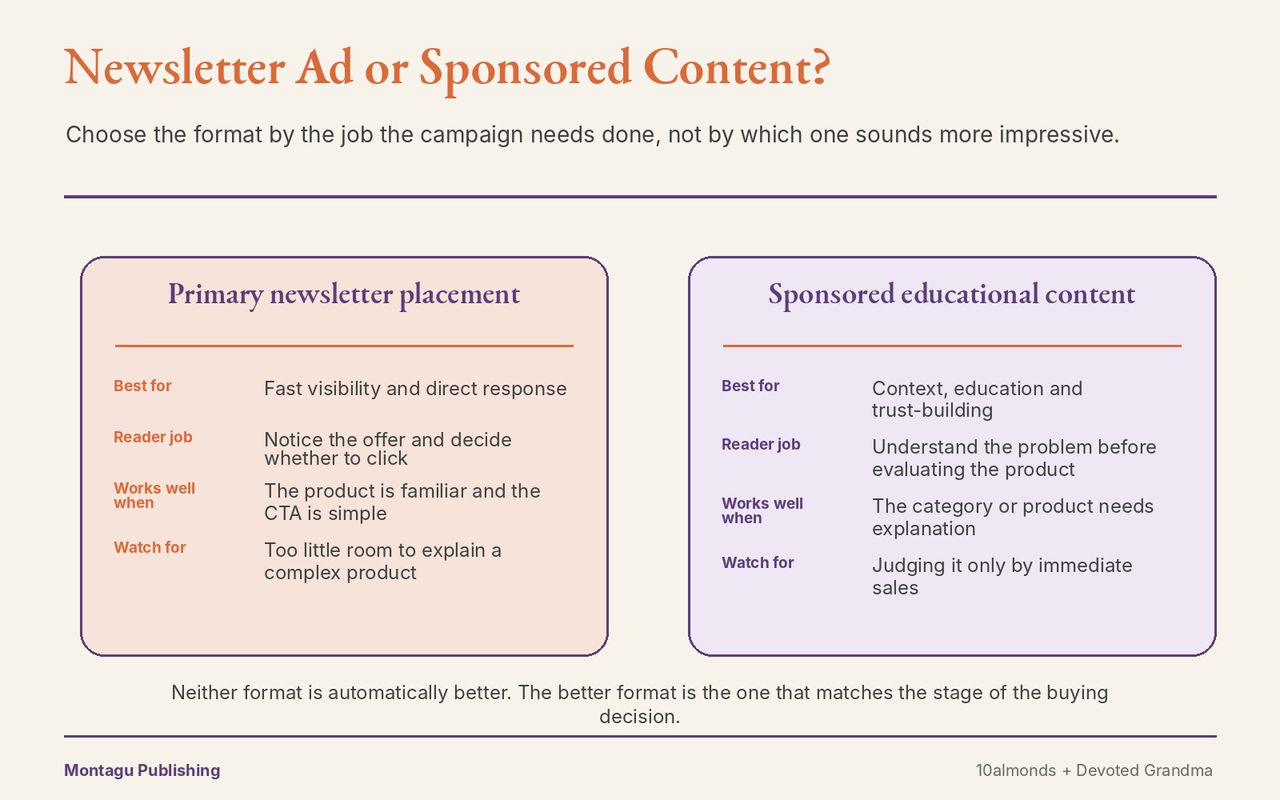
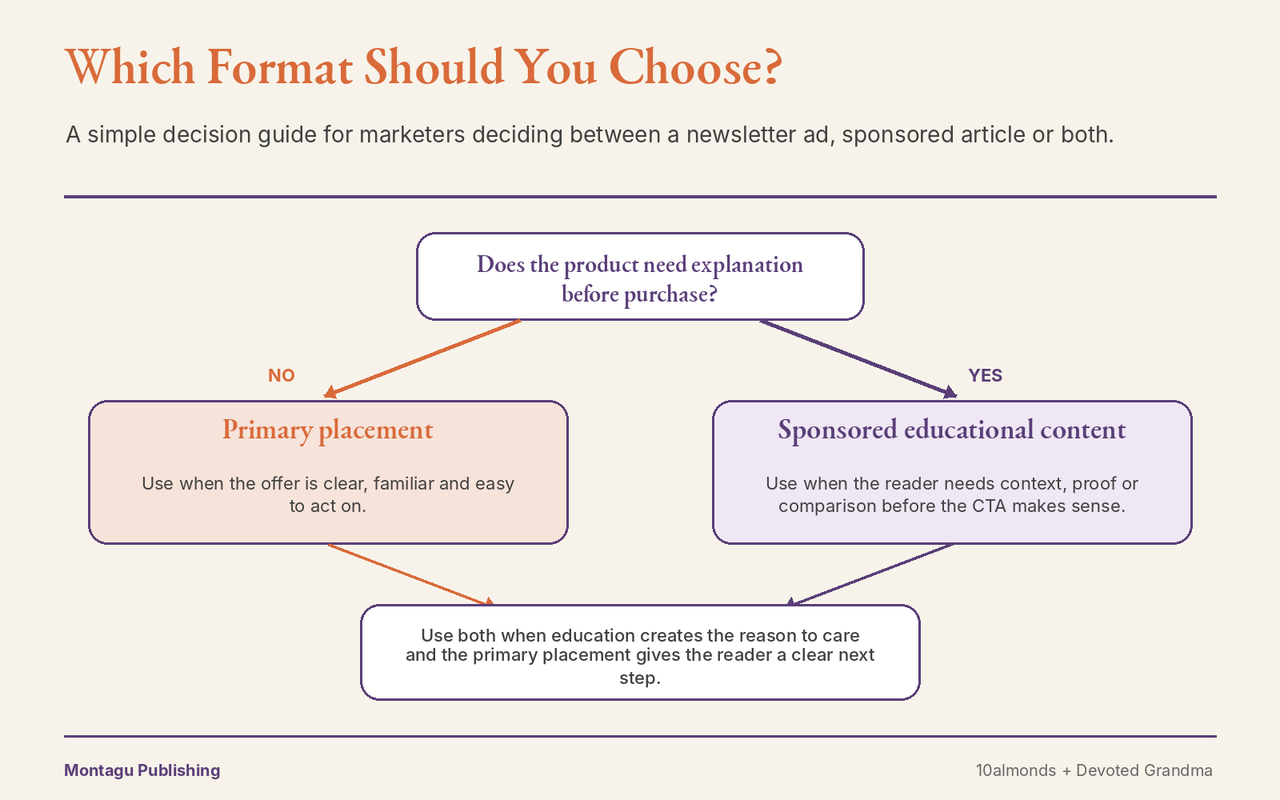
A primary newsletter placement and sponsored educational content do different jobs. A newsletter ad is usually the better choice when the product is already understood, the offer is simple and the marketer wants a clear path to a click, sign-up or purchase. Sponsored educational content becomes more useful when the consumer first needs context, proof or explanation before the product feels relevant.
For many wellness, supplement and healthy-ageing brands, the strongest answer is not one format or the other. It is a sequence. Educational content answers the question that makes the product matter. A primary placement then gives interested readers a clear next step.
The decision should therefore start with the customer journey, not the format menu. Ask what the reader needs to understand before she is ready to act. Then choose the format with enough room to do that job.
Quick Summary
- A primary newsletter placement is strongest when the offer is familiar and action is the main objective.
- Sponsored educational content is stronger when the product or category needs explanation before purchase.
- The two formats should not be measured in exactly the same way.
- Using both can work well when education creates confidence and a direct placement captures the next step.
- The wrong choice is usually not a bad format. It is a good format being asked to do the wrong job.
Why Brands Get This Decision Wrong
Newsletter sponsorship menus can make the choice look deceptively simple. One option is a primary ad placement. Another is an educational article. The marketer compares the price, estimated reach and expected clicks, then chooses the format that looks easiest to justify.
That approach misses the more important question: what does the consumer need from the campaign?
If she already understands the product and simply needs a reason to act, a direct placement may be enough. If she is still asking what the problem is, why it matters or whether the claim is credible, an advertisement has very little space to solve that uncertainty.
Tight budgets make this distinction more important, not less. A small campaign cannot afford to spend money creating the wrong kind of interaction.
Start With the Job, Not the Format
Give the campaign one primary job before deciding what to buy.
Is the job to create notice? Explain an unfamiliar category? Build confidence? Capture existing demand? Bring interested people back?
Those jobs require different amounts of attention from the reader. A placement designed for a quick scan should not be expected to explain a complicated ingredient. A 1,200-word sponsored article should not be judged as though its only purpose were to generate an immediate flash-sale conversion.
Once the job is clear, the format decision becomes much easier.
When a Primary Newsletter Placement Makes Sense
A primary newsletter placement works best when the reader can understand the proposition quickly.
The product may already belong to a familiar category. The benefit may be easy to explain in a headline and a few lines. The offer may be strong enough that the reader can decide whether to investigate without needing a long explanation.
Examples could include a familiar skincare product, a straightforward subscription offer, a travel deal, a household product or a supplement from a category the audience already understands.
The main advantage is focus. The placement can make one promise, show one product and give the reader one clear next step.
When Sponsored Educational Content Makes Sense
Sponsored educational content earns its value earlier in the decision.
It is useful when the brand needs to answer questions before it can reasonably ask for the sale. Why does this issue matter? What does the evidence actually support? How should a consumer compare options? Who is the product relevant for, and who might not need it?
This is particularly important in health-adjacent categories because the audience may be cautious, informed and unwilling to accept a claim simply because it appears in an advertisement.
The article should still be useful even though it is sponsored. The commercial relationship should be transparent, and the content should not disguise promotion as independent editorial. FTC guidance on native advertising focuses on avoiding misleading presentation and using clear, prominent disclosures when needed to prevent deception.
The Most Important Difference: Space to Remove Uncertainty
The real difference between a primary placement and an educational article is not the number of words. It is the amount of uncertainty each format can reasonably remove.
A direct placement can answer: What is this? Why should I click now?
An educational article can answer: Why should I care about this issue at all? What should I know before comparing products? What does the evidence suggest? Where might this product fit?
That difference is why a complex product can underperform in a perfectly good ad slot. The campaign may be asking for a decision before the reader has enough information to make one.
When Using Both Is the Better Answer
For products that need explanation but still need a measurable response, the formats can work together.
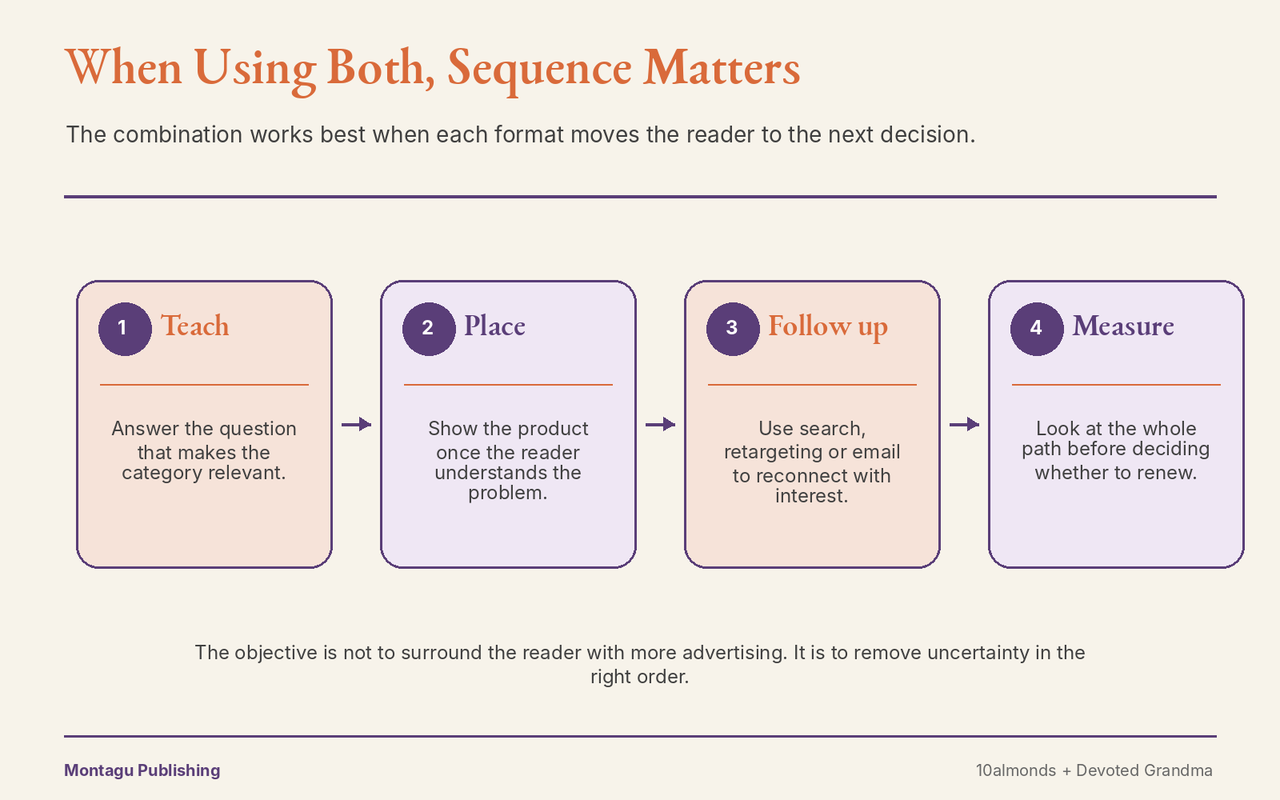
The sponsored article can introduce the problem, explain the category and establish the basis for comparison. A later primary placement can then present the product and give the reader a clear next step. Search, retargeting or the brand’s own email can continue the journey afterwards.
The important part is sequence. Simply placing an article and an ad on the same day does not automatically create a strategy. Each touchpoint should answer the next question the consumer is likely to have.
A Simple Decision Table
| Campaign need | Best starting format | Why |
|---|---|---|
| The product is familiar and the offer is simple | Primary placement | The reader can understand and act quickly. |
| The category is unfamiliar or complex | Sponsored educational content | The campaign needs room to explain before asking for action. |
| The brand needs trust before response | Sponsored educational content | Useful context can reduce uncertainty and improve later consideration. |
| The brand needs education and measurable response | Use both in sequence | Education creates the reason to care; the placement captures the next step. |
| The campaign is a short promotion | Primary placement | Speed and clarity matter more than deep explanation. |
Measure the Formats Differently
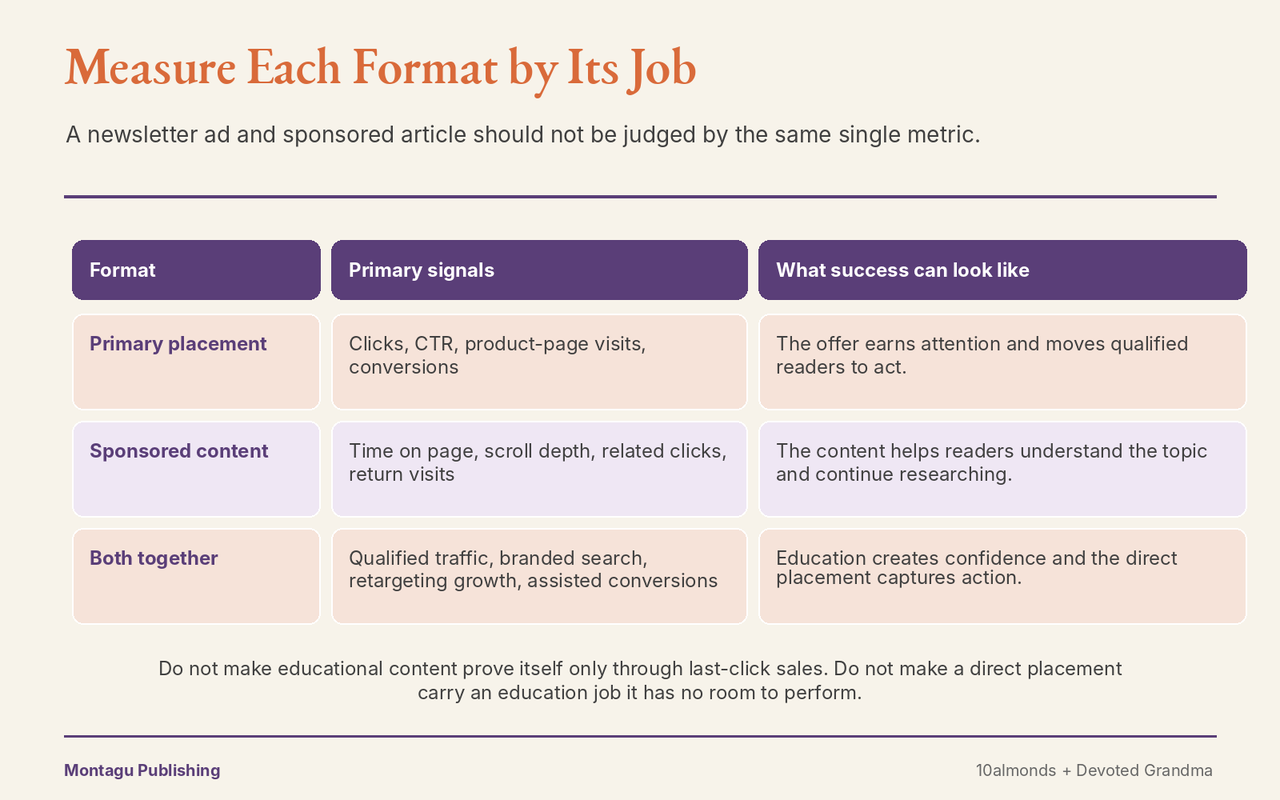
One of the fastest ways to make a sensible campaign look unsuccessful is to measure every format against the same KPI — the same case made in how brands should measure sponsored content beyond clicks.
A primary placement can reasonably be judged on clicks, click-through rate, qualified product-page visits, leads and sales where attribution is available.
Sponsored educational content may also need to be judged on time spent, scroll depth, related-content clicks, product-page exploration, returning visitors, branded search and assisted conversions.
Neither set of metrics is automatically better. They reflect different jobs in the customer journey.
A Mistake We Often See
The brand chooses educational content because it sounds more premium, then writes it like a long advertisement.
Or it chooses a primary placement because it is easy to measure, then tries to fit six product benefits, three proof points and a complex explanation into a few lines.
Both approaches waste the format.
Use the space you bought for the job it is designed to perform.
What We Would Do
Imagine we were launching a new sleep supplement aimed at women over 50.
If the audience already understood the ingredient and the product had a simple, differentiated offer, we might begin with a primary newsletter placement and measure qualified traffic and conversion behaviour.
If the ingredient was unfamiliar or the buyer first needed to understand the sleep problem it was designed to address, we would start with educational content. The article would answer the buyer question first, use only supportable claims and explain where the product fits after enough context had been established.
If the budget allowed both, we would use the educational piece to create understanding and then follow it with a primary placement or retargeting message that made the next step obvious — the same sequencing behind what a brand should include in a newsletter sponsorship brief.
Where 10almonds and Devoted Grandma Fit
At Montagu Publishing, both 10almonds and Devoted Grandma can support direct placements and educational sponsored content, but the buying context differs.
10almonds is a natural environment for brands that need to explain health, nutrition, healthy ageing, sleep, mobility or other wellness topics to readers making decisions about their own wellbeing.
Devoted Grandma can be a better fit when the decision sits within family life, household needs, gifting, travel, financial planning or products a reader may consider for herself and the people she cares about.
The format should follow the same rule in either publication. Use a primary placement when the offer can stand on its own. Use educational content when the reader needs understanding before the offer becomes useful — the same clarity test explained in what makes educational content more effective than traditional ads. Use both when the campaign needs to do both jobs.
Frequently Asked Questions
The Bottom Line
A newsletter ad and sponsored educational content are not competing versions of the same thing.
One is designed to make a proposition visible and actionable. The other gives the reader room to understand why the proposition matters in the first place.
For a marketing manager with a tight budget, the smartest choice is the format that removes the biggest obstacle between the consumer and the next decision.
If the obstacle is lack of awareness or a weak CTA, use the primary placement. If the obstacle is uncertainty, complexity or trust, use education. If both obstacles exist, sequence the two rather than forcing one format to do everything — the same test-before-you-commit discipline behind how brands should test newsletter sponsorships for the first time.
Planning a Newsletter Campaign?
If you are deciding between a primary newsletter placement, sponsored educational content or a combination of the two, Montagu Publishing can help you work backwards from the campaign objective and reader question.
Through 10almonds and Devoted Grandma, we work with brands to reach engaged female audiences through direct placements and brand-supported educational content without treating the two formats as interchangeable — the same discipline covered in how many newsletter sponsorships a brand should book before judging results.
Reach out to sales@10almonds.com to discuss an upcoming campaign.