


Direct Answer
Brands should measure sponsored content beyond clicks by looking at the role the content was meant to play in the buying journey. Clicks are useful, but they do not tell the full story. A sponsored article, newsletter placement or education-led campaign may also create qualified attention, improve understanding, increase branded search, grow a retargeting pool, support product-page visits or assist a later conversion.
The right measurement approach starts with one question: what decision should this content help the reader make? Once that is clear, the campaign can be measured against attention, understanding, intent, follow-up quality and eventual action rather than one isolated click-through rate.
Quick Summary
- Clicks matter, but they are not the only measure of sponsored content performance.
- A campaign created for education should not be judged in the same way as a paid search campaign created to capture existing demand.
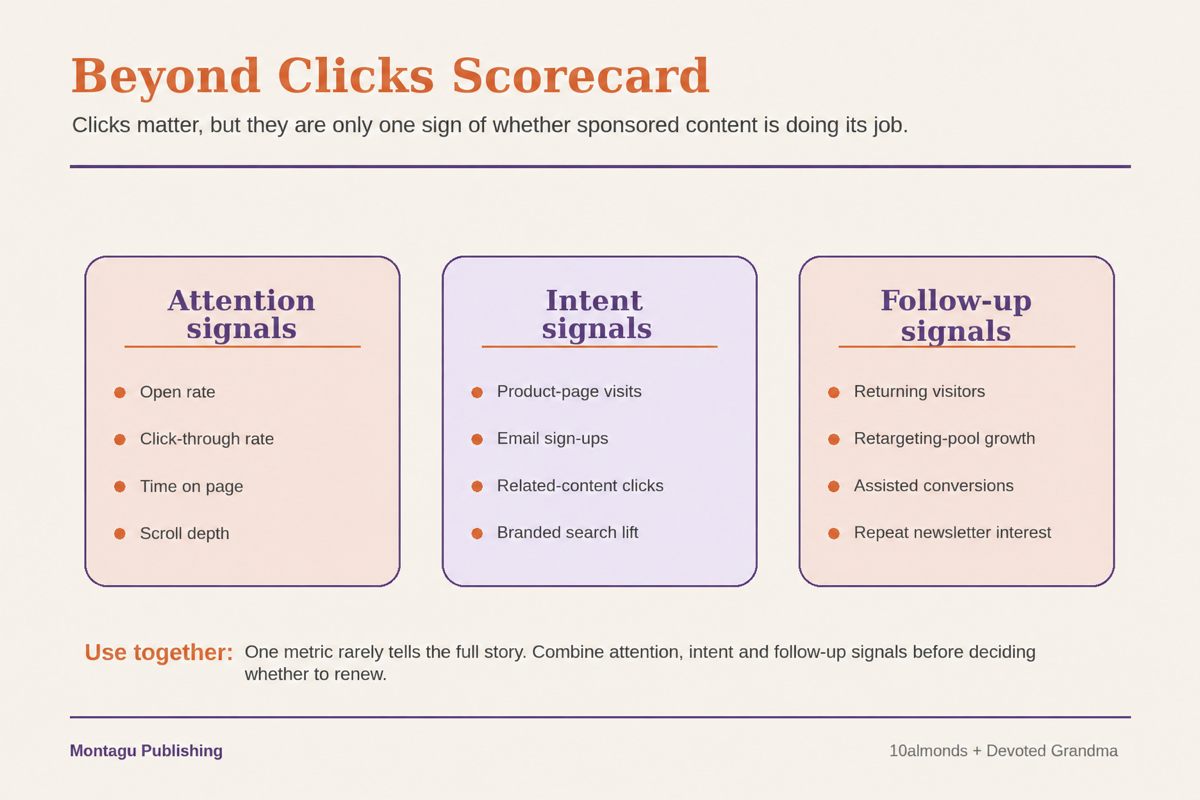
- Useful metrics include time on page, scroll depth, product-page visits, branded search, returning visitors, assisted conversions and retargeting-pool growth.
- The first send should reduce uncertainty: does this audience care, does the message work and is there a sensible path to follow-up?
- Newsletter partnerships work best when reporting looks at reader quality as well as immediate response.
Why This Question Matters
Sponsored content often gets judged too quickly.
A marketing manager books a placement, watches the first wave of clicks, compares it to a paid search campaign and decides whether the channel worked. That can be useful when the objective is immediate traffic, but it can be misleading when the content was created to explain a product, introduce a health topic or help the reader compare options.
Educational campaigns do not always create instant action. Sometimes their job is to make a future action more likely. That difference matters, especially for wellness brands, supplements, skincare, healthy ageing products and other categories where consumers often want context before buying.
The commercial mistake is not measuring. The mistake is measuring the wrong job.
Start With the Job of the Content
Before looking at reports, define what the content was hired to do.
If the sponsored placement exists to introduce the brand to a new audience, awareness and qualified attention matter. If it exists to explain a complex ingredient, time spent with the article and movement to related content may matter more. If it exists to support consideration, product-page visits, returning visitors and search behaviour become more useful signals.
A sponsored article cannot be expected to do every job at once. It can introduce, explain, reassure, compare or invite action. It becomes easier to measure once the primary job is clear.
Why Clicks Alone Can Mislead
Clicks are easy to understand, which is why they often dominate campaign reporting. They show that a reader took an action. They also help compare one placement against another.
The problem is that clicks do not show what happened before the click or after it. They do not tell you whether the reader understood the product, trusted the claim, came back later or searched for the brand the next day.
A campaign with fewer clicks but stronger time on page, better product-page behaviour and more returning visitors may be doing more valuable work than a campaign that produced cheap, low-intent traffic. This is particularly true when the product requires explanation before purchase.
The Sponsored Content Measurement Ladder
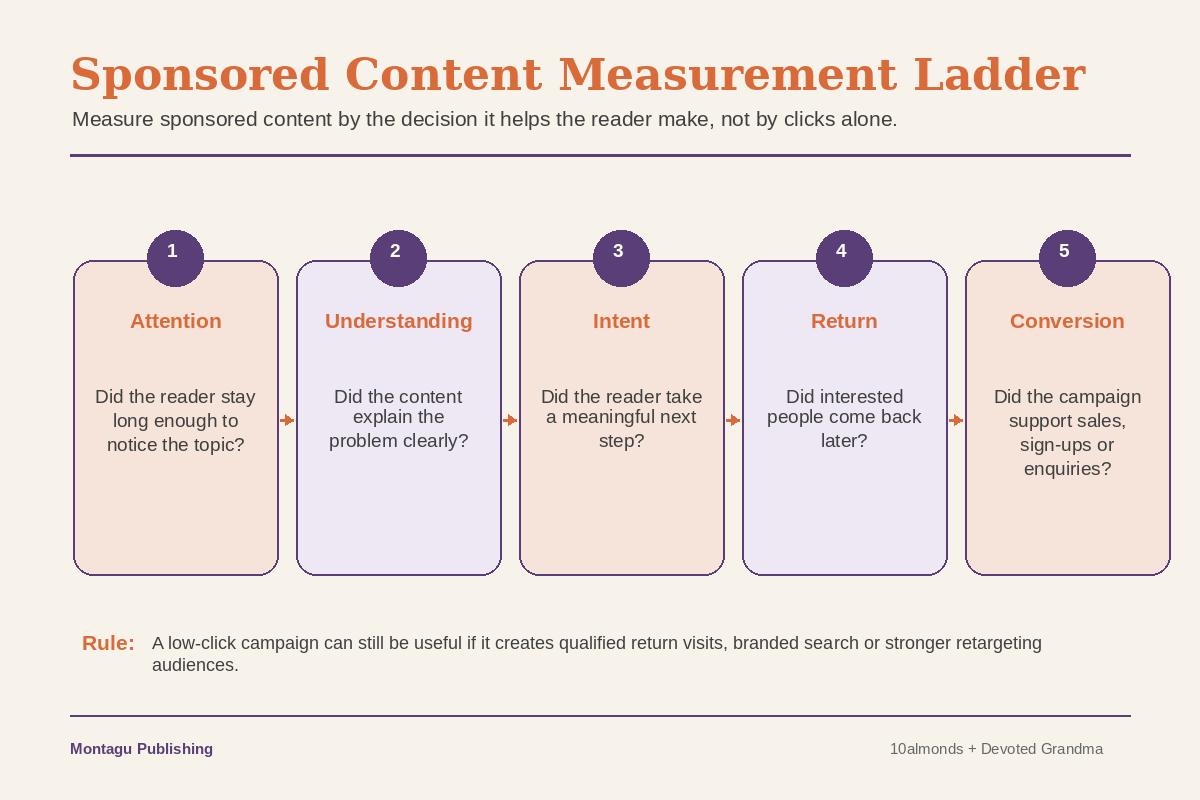
A better way to measure sponsored content is to look at five layers.
First, attention. Did the reader notice the content and spend enough time with it to understand the topic?
Second, understanding. Did the content answer the questions that would otherwise block the buying decision?
Third, intent. Did readers move to a product page, sign up, search for the brand or click to related content?
Fourth, return. Did interested readers come back through retargeting, direct visits, branded search or email follow-up?
Fifth, conversion. Did the campaign contribute to sales, sign-ups, enquiries or trials?
The closer the content sits to the top of the funnel, the more important it is to consider the early layers. Judging every sponsored campaign only by conversion often undervalues the work done before the sale.
Measure by Campaign Objective
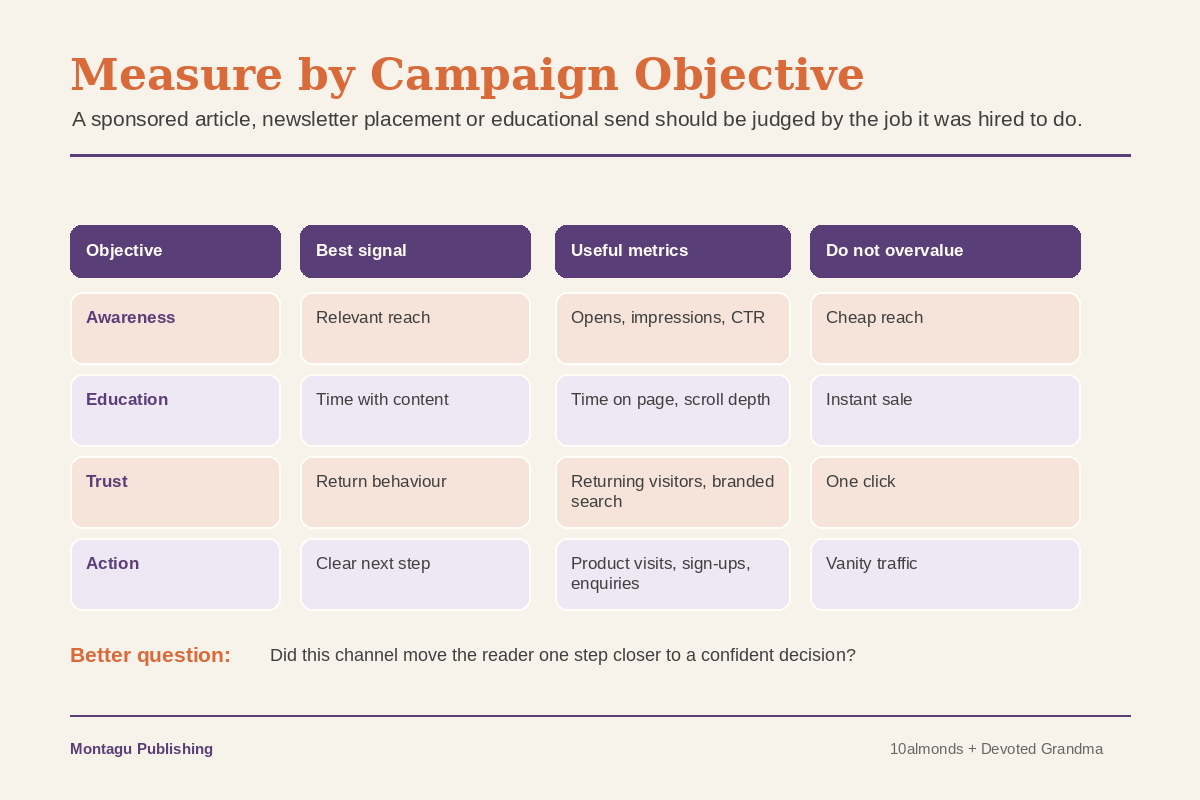
A campaign designed for awareness should not be measured the same way as a campaign designed for conversion.
| Objective | Best signal | Useful metrics | Do not overvalue |
|---|---|---|---|
| Awareness | Relevant reach | Opens, impressions, CTR | Cheap reach |
| Education | Time with content | Time on page, scroll depth | Instant sale |
| Trust | Return behaviour | Returning visitors, branded search | One click |
| Action | Clear next step | Product visits, sign-ups, enquiries | Vanity traffic |
The point is not to create a long reporting dashboard. It is to choose the small number of metrics that match the job of the campaign.
What We Would Ask Before the Campaign Runs
Before launching a sponsored content campaign, we would ask five questions.
What does the reader need to understand before they are likely to care? What claim needs support? What is the most useful next step after reading? Which follow-up channel will bring interested readers back? How will we know whether this audience is worth another send?
Those questions make the reporting cleaner. They also prevent the common problem of agreeing an educational campaign and then judging it as though it were a discount-led search ad — the same category error we described in how brands build trust before asking consumers to buy.
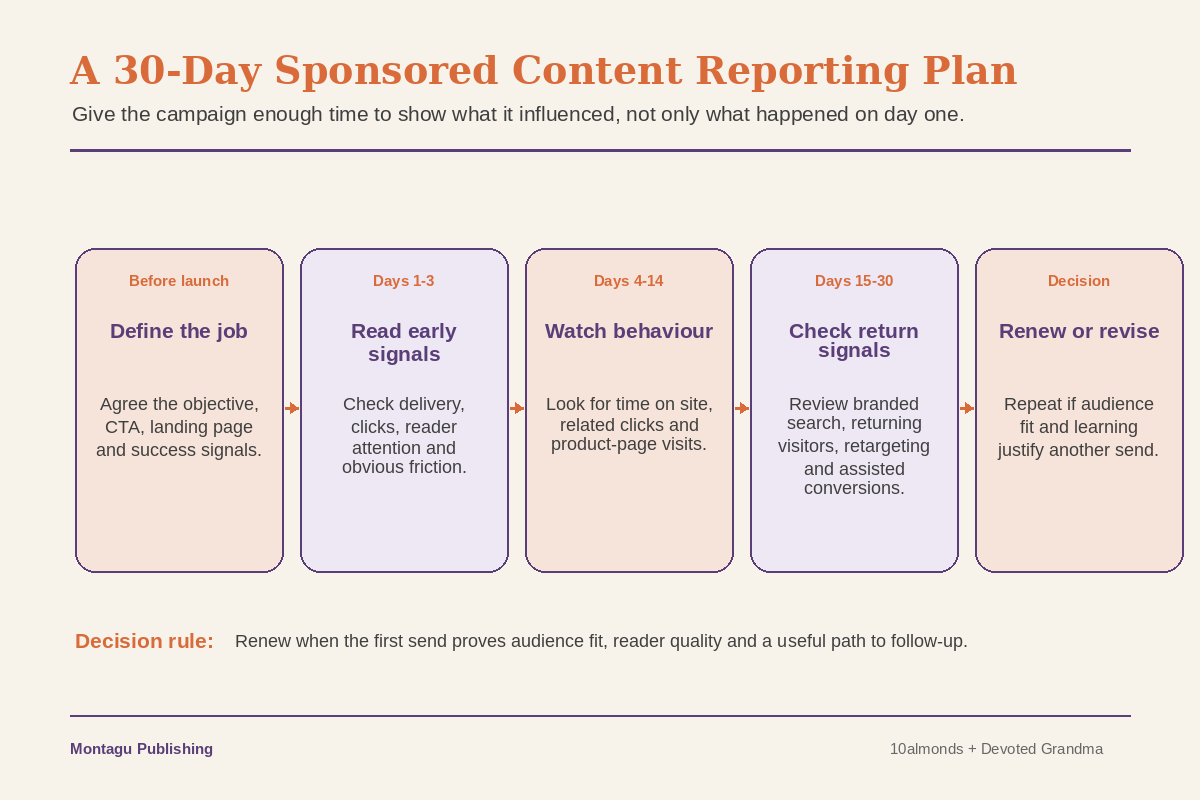
How to Judge the First Send
The first send should not be treated as the final verdict on the channel. It should be treated as a structured test — the same discipline behind how brands should test newsletter sponsorships for the first time.
A useful first send tells you whether the audience is aligned with the product, whether the message creates interest, whether the landing page supports the promise and whether there is enough quality traffic to justify follow-up.
If the campaign receives healthy attention but weak product-page behaviour, the next step may be to improve the CTA or landing page. If the content receives little attention, the issue may be the topic, headline or audience fit. If readers click but do not return, the follow-up plan may be too weak.
The goal of the first send is not only to produce a result. It is to show what should be improved before the next placement.
What to Include in a Sponsored Content Report
A useful report should be short enough for a busy marketing manager to understand quickly, but detailed enough to guide the next decision.
At minimum, it should include delivery, clicks, click-through rate, reader engagement, traffic quality, top links, product-page movement and any early follow-up signals available to the brand. Google Analytics’ attribution reporting is a useful reference here, since it lets marketers look beyond a single last-click signal when reviewing how a channel contributed to a conversion. If possible, the report should also include a short editorial note explaining what may have helped or limited performance.
That last point matters. A spreadsheet can show what happened. A good publisher should also help interpret why it happened.
A Mistake We Often See
A common mistake is treating sponsored content like a one-day performance ad.
The placement goes live, the first click report arrives, and the campaign is judged before the brand has looked at returning visitors, retargeting performance, branded search or assisted conversions.
That approach can lead brands to walk away from audiences that were interested but not yet ready. For products that require education, the follow-up is often where the commercial value appears.
Where Newsletter Partnerships Fit
Newsletter partnerships are useful because the audience has chosen to spend time with the content. That does not guarantee a sale, but it does create a better environment for explanation than a short ad unit can usually provide — the same channel-role thinking behind how brands should diversify their channel mix.
For 10almonds, measurement is most useful when a brand wants to reach health-conscious readers who are already open to practical, evidence-informed wellness information — the same scaled-education approach covered in how wellness brands can educate consumers at scale. For Devoted Grandma, measurement should consider family and household decision-making, not only individual purchase intent.
In both cases, the best campaigns give the reader a clear path: learn something useful, understand where the product fits and know what to do next — the same clarity test explained in what makes educational content more effective than traditional ads. The measurement plan should follow that same path.
Frequently Asked Questions
The Bottom Line
Sponsored content should not be measured by clicks alone.
Clicks are important, but they are only one signal. The better question is whether the content helped the right reader understand the problem, believe the message, take a useful next step and become easier to reach again later. Health-related sponsored content also carries an added responsibility here: any objective claims should stay truthful, not misleading and appropriately supported, regardless of how the campaign performs.
For brands with limited budgets, this matters because every campaign should create learning as well as performance. A first placement that reveals audience fit, message clarity and follow-up potential can be more valuable than a placement that only produces a one-day traffic spike.
The strongest measurement plans do not ask whether sponsored content worked in the abstract. They ask what job it was meant to do, what signals prove it did that job and what should happen next.
Considering a Sponsored Content Campaign?
If your product benefits from explanation before purchase, a sponsored article or newsletter placement can help readers understand the category before they are asked to act.
Through 10almonds and Devoted Grandma, Montagu Publishing works with brands on sponsored content and newsletter placements designed to educate, build trust and support follow-up across the wider media plan.
If this approach might fit an upcoming campaign, reach out to sales@10almonds.com.