


Direct Answer
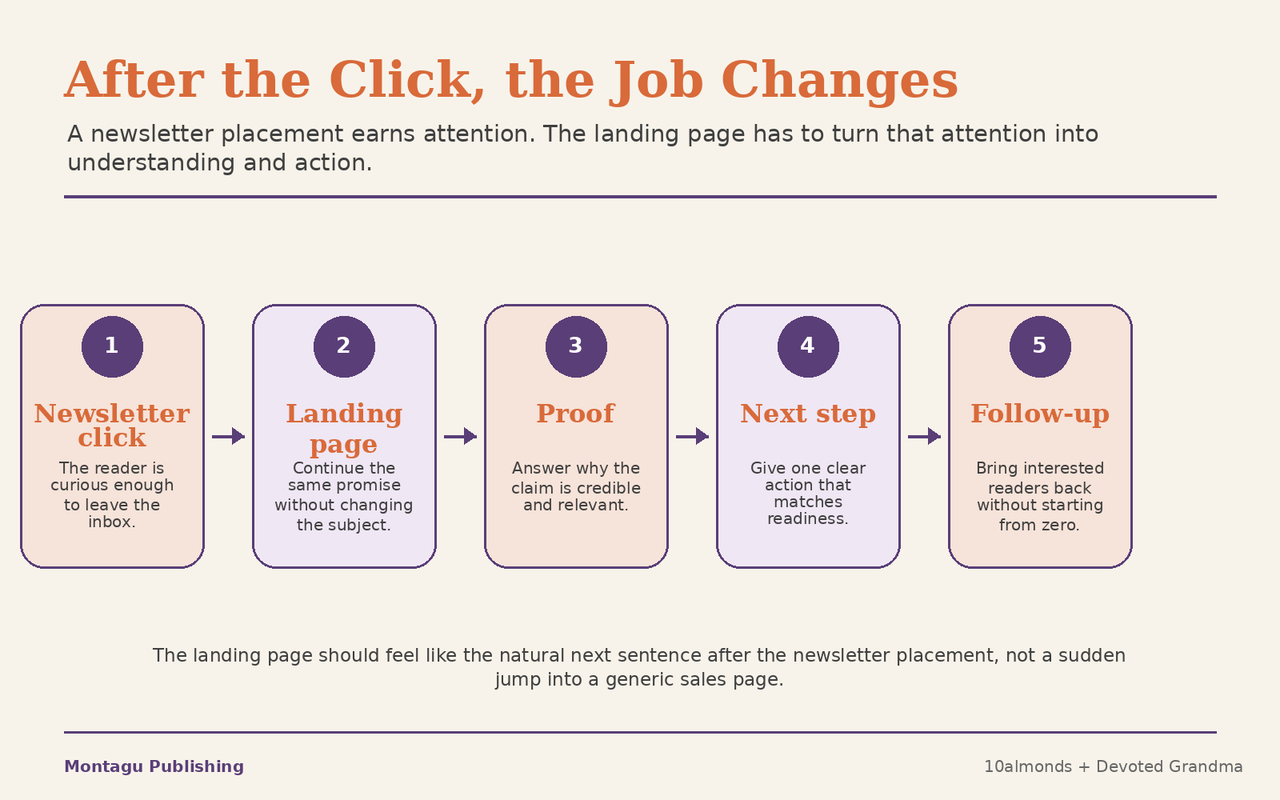
A newsletter sponsorship landing page should continue the conversation that began in the inbox. If the newsletter placement creates curiosity about a problem, the landing page should not immediately switch into a generic sales pitch. It should answer the question that earned the click, add enough context to make the product relevant, provide supportable proof and give one clear next step.
For brands with limited budgets, this matters because a weak landing page can make a good newsletter placement look ineffective. The audience may be right. The message may have earned interest. But if the landing page does not match the promise, readers leave before the campaign has a fair chance.
The page does not need to be long. It needs to be specific, credible and aligned with the reader’s stage of decision.
Quick Summary
- The landing page should match the promise, topic and tone of the newsletter placement.
- Do not send sponsored traffic to a generic homepage unless the campaign is purely brand awareness.
- A strong page answers the reader’s next question before asking for action.
- One clear call to action usually works better than several competing options.
- Measure the page by attention, understanding, intent and return behaviour, not only final conversion.
Why the Landing Page Matters
A newsletter sponsorship often reaches people in a different mindset from paid search or retargeting. They may not be actively shopping. They may be reading because the topic feels relevant, helpful or interesting.
That makes the landing page especially important. It has to bridge the gap between curiosity and consideration.
If the newsletter explains a problem and the landing page immediately shouts about a product, the reader can feel pushed too soon. If the newsletter promises practical information and the landing page offers only a checkout button, the journey breaks.
The click is not the finish line. It is the handoff.
The First Job: Match the Promise
A reader clicks because something in the newsletter gave her a reason to continue. The landing page should make it obvious that she has arrived in the right place.
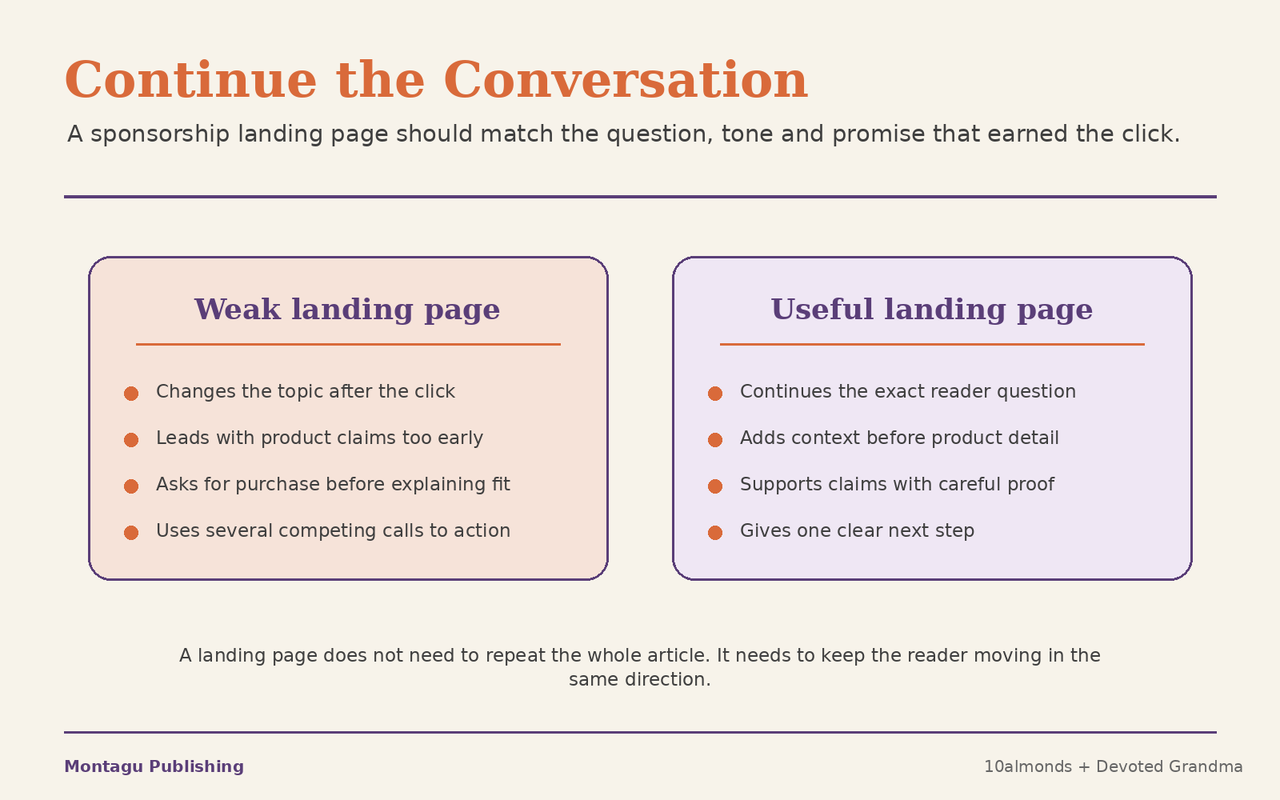
That means the headline, opening copy and first screen should reflect the same topic that appeared in the newsletter. If the placement was about sleep quality, the landing page should not begin with a full company history. If the placement was about joint comfort, the landing page should not open with a discount code before explaining the issue.
The page should answer the reader’s first unspoken question: “Is this what I clicked for?”
The Second Job: Reduce Uncertainty
Sponsored traffic often needs reassurance before action. That is especially true for health, wellness, supplements, ageing, family decisions and household products where readers may want to understand what a product does, whether it is relevant and why they should trust it.
The page should remove uncertainty in a clear order: what the problem is, why it matters, how the product fits and what the reader can do next.
A useful page does not answer every possible question. It answers the most important next question.
| Reader uncertainty | Landing-page job | Example |
|---|---|---|
| What problem is this solving? | Name the issue clearly | “Many people start by looking for better sleep, but the real question is what is interrupting rest.” |
| Why should I care now? | Explain the consequence or opportunity | “Small changes in sleep quality can affect energy, mood and daily routines.” |
| Can I believe this? | Use supportable proof | Ingredient facts, expert involvement, testing standards or careful examples. |
| What should I do next? | Give one next step | Read more, compare options, claim an offer or join the brand’s email list. |
The Third Job: Keep the CTA Honest
The call to action should match how ready the reader is likely to be.
If the sponsorship is introducing a new product for the first time, “Buy now” may be too abrupt as the only option. A better next step may be reading product details, comparing ingredients, taking a quiz, signing up for more information or using a trial offer.
That does not mean the page should hide the sale. It means the page should not ask for a decision before giving the reader enough reason to make one.
Do Not Send Everyone to the Homepage
A homepage is usually built for many audiences at once. A sponsorship landing page is built for one context.
If a reader arrives from a newsletter about healthy ageing, the page should not make her search for the relevant product, article or offer. Every extra decision creates friction.
A dedicated landing page gives the marketer more control. It can match the message, keep the path simple and make performance easier to measure.
What a Strong Sponsorship Landing Page Includes
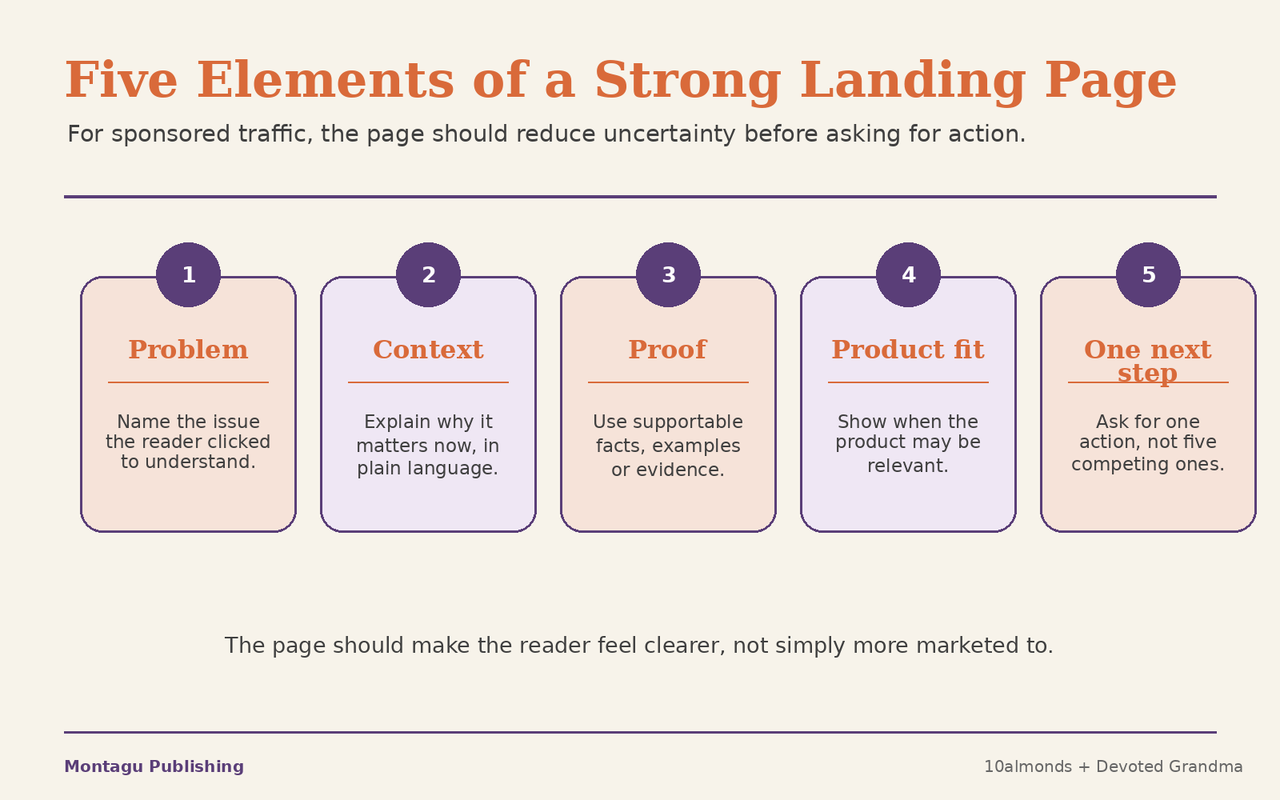
A strong page usually includes five things.
- A headline that continues the newsletter topic.
- A short explanation of the problem or opportunity.
- Proof the brand is allowed to support.
- A clear explanation of product fit.
- One primary next step.
For sponsored or native advertising, the commercial nature of the content should not be hidden. FTC guidance says native advertising should not mislead consumers about its commercial nature, and disclosures should be clear and prominent when needed to prevent deception.
Measure the Page, Not Only the Placement
If a campaign gets clicks but few conversions, the newsletter is not always the problem. The landing page may be losing people after the handoff — the same distinction covered in how brands should measure sponsored content beyond clicks.
Look at the full path. Did readers stay? Did they scroll? Did they click to product details, FAQs or related content? Did they return later? Did they enter a retargeting audience or sign up for more information?
These signals help separate a weak audience from a weak page.
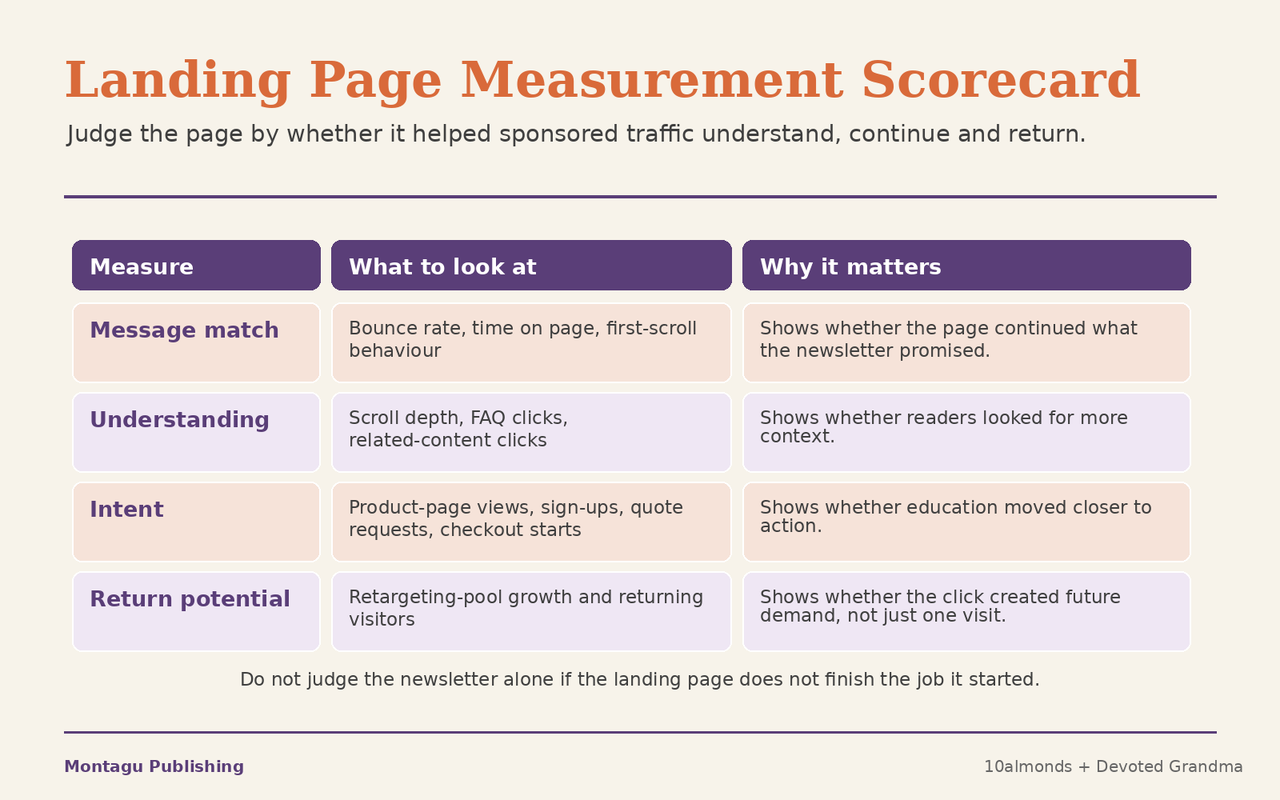
| Measure | What to look at | What it tells you |
|---|---|---|
| Message match | Bounce rate, time on page and first-scroll behaviour | Whether the page continued the newsletter promise. |
| Understanding | Scroll depth, FAQ clicks and related-content clicks | Whether readers wanted more context. |
| Intent | Product-page views, sign-ups, quote requests or checkout starts | Whether education moved closer to action. |
| Return potential | Returning visitors and retargeting-pool growth | Whether the click created future demand. |
What We Would Do
If we were planning a newsletter sponsorship for a wellness brand, we would build the landing page before the placement goes live, not after.
First, we would identify the reader question the newsletter is answering — the same starting point behind what a brand should include in a newsletter sponsorship brief. Then we would make sure the landing page opens with that same question. We would include only the proof the brand can support, keep the next step simple and set up tracking so the campaign can be judged beyond clicks.
For a complex product, we might use the first section of the page to educate, the middle section to explain product fit and the final section to invite the reader to compare, sign up or claim an offer. The point is to keep the reader moving without making the experience feel like a hard sell.
Where 10almonds and Devoted Grandma Fit
For Montagu Publishing campaigns, the landing page should also reflect the publication context.
A 10almonds reader may arrive in a health, wellbeing, nutrition, mobility, sleep or healthy-ageing mindset. The landing page should usually continue that practical, evidence-informed context.
A Devoted Grandma reader may be thinking about family, household decisions, gifting, lifestyle or intergenerational needs. The same product may need a different landing-page angle because the buying context is different.
The publication can earn the click. The landing page has to respect the reason the reader clicked.
Frequently Asked Questions
The Bottom Line
A newsletter sponsorship does not end at the click.
The landing page decides whether that click becomes understanding, intent or a lost visitor. For brands with limited budgets, this is one of the easiest places to waste money and one of the most practical places to improve performance — the same follow-through logic covered in how brands can get more value from sponsored content after it runs.
The best landing pages do not simply repeat the product pitch. They continue the reader’s question, reduce uncertainty, support claims carefully and make the next step obvious.
If the landing page cannot do that, even a good newsletter placement may look weaker than it really is — a distinction worth keeping in mind alongside newsletter ad vs sponsored content: which should a brand choose.
Planning a Newsletter Sponsorship?
If you are considering a campaign with 10almonds or Devoted Grandma, the landing page should be part of the plan from the beginning.
Montagu Publishing works with brands on primary newsletter placements and sponsored educational content — the same testing discipline behind how brands should test newsletter sponsorships for the first time. A useful starting point is the reader question, the next step and the page that will carry the click after the newsletter does its job.
Reach out to sales@10almonds.com to discuss an upcoming campaign.