


Direct Answer
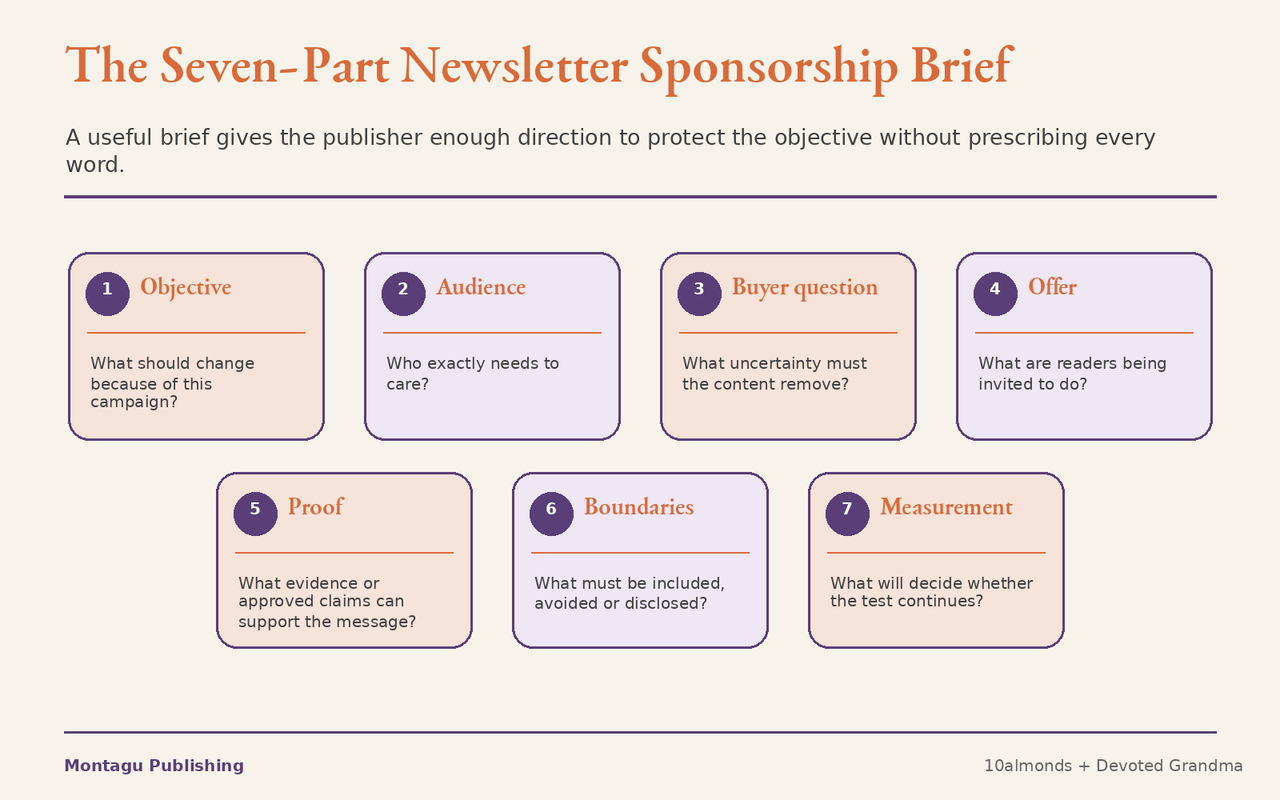
A useful newsletter sponsorship brief should tell the publisher seven things: the business objective, the specific audience, the buyer question or problem, the offer, the proof the brand can support, the boundaries that cannot change, and the way success will be measured.
The brief should not try to write the entire placement in advance. The publisher knows its readers, its tone and the kinds of explanations that tend to feel natural in that environment. A stronger brief protects what matters while leaving room for the publisher to advise on framing, placement and wording.
For a marketing manager with a tight budget, that matters. A clear brief reduces wasted revisions, helps the publisher spot weak assumptions before launch and gives the campaign a cleaner chance to prove whether the audience is a fit.
Quick Summary
- Start with the decision you want the campaign to influence, not with the ad format.
- Define the audience more narrowly than age and gender.
- Give the publisher the buyer question the content needs to answer.
- Separate approved claims and non-negotiables from areas where the publisher can use its audience knowledge.
- Make the landing page, tracking and renewal criteria part of the brief, not an afterthought.
Why the Brief Matters More Than It Looks
A newsletter placement can fail before a single reader sees it. The problem is often not the audience or the channel. It is that the brand and publisher are working from different definitions of what the campaign is supposed to do.
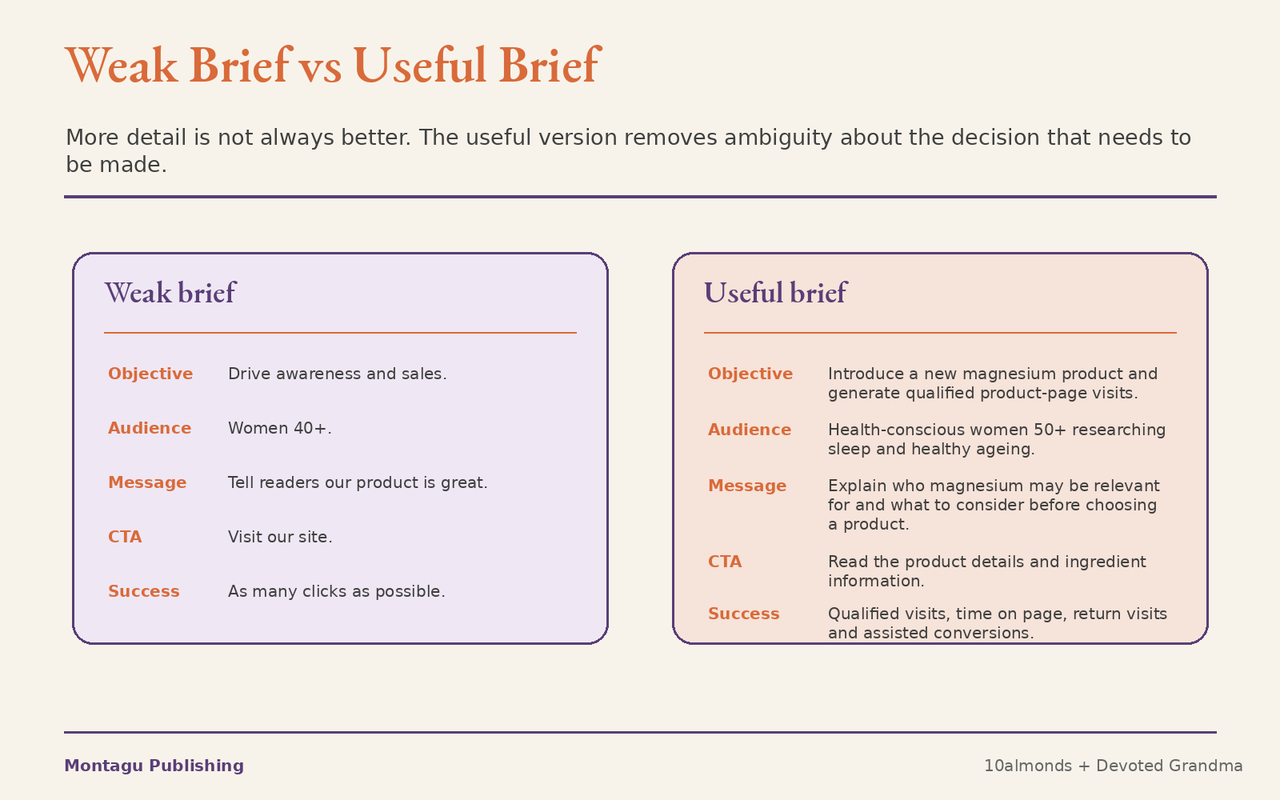
“Build awareness.” “Drive engagement.” “Promote the product.” None of these gives a publisher enough direction to make useful decisions. Awareness of what? Engagement with what? What should the reader understand, believe or do differently after seeing the placement?
A strong newsletter sponsorship brief removes that ambiguity. It gives both sides a shared decision to work towards.
1. Start With the Business Objective
The first line of the brief should explain what the campaign needs to change.
For example: “Introduce our new magnesium supplement to health-conscious women over 50 and generate qualified visits to the product page.” That is more useful than “increase awareness” because it tells the publisher what the campaign is introducing, who it is for and what a useful next step looks like.
Try to keep one primary objective. A small campaign asked to build awareness, educate, generate leads, drive purchases and grow social followers at the same time is difficult to design and almost impossible to judge fairly.
2. Define the Audience Beyond Demographics
Age and gender may be part of the audience definition, but they are rarely enough to shape useful content.
Add the situation the reader is in. What is she trying to solve? What does she already understand? What is likely to make her hesitate?
“Women 50+” is broad. “Women 50+ actively researching sleep, healthy ageing and nutrition, but unfamiliar with our ingredient” gives the publisher something it can actually use.
3. Give the Publisher the Buyer Question
This is one of the most useful parts of the brief and one of the easiest to overlook.
Ask: what uncertainty needs to disappear before the product becomes relevant?
For a supplement, that might be “Why would someone consider this ingredient at all?” For a financial product, it might be “What problem does this solve that my existing account does not?” For a family product, it might be “Is this genuinely useful or simply another thing I will buy and forget?”
Once the buyer question is clear, educational content becomes much easier to shape — the same starting point behind how to educate consumers about complex products without sounding salesy.
4. Be Precise About the Offer and Next Step
The publisher should know what the reader is being asked to do after the placement.
That might be visiting a product page, reading a longer guide, using a discount code, booking a consultation or joining an email list. Pick the next step that matches the stage of the customer journey.
If the content is introducing a complex product for the first time, asking immediately for a purchase may be too aggressive. A product-details page or educational landing page may be a more realistic next step.
5. Supply Proof, Not Marketing Adjectives
A publisher can work with evidence. It cannot do much with “premium,” “revolutionary,” “best-in-class” or “game-changing.”
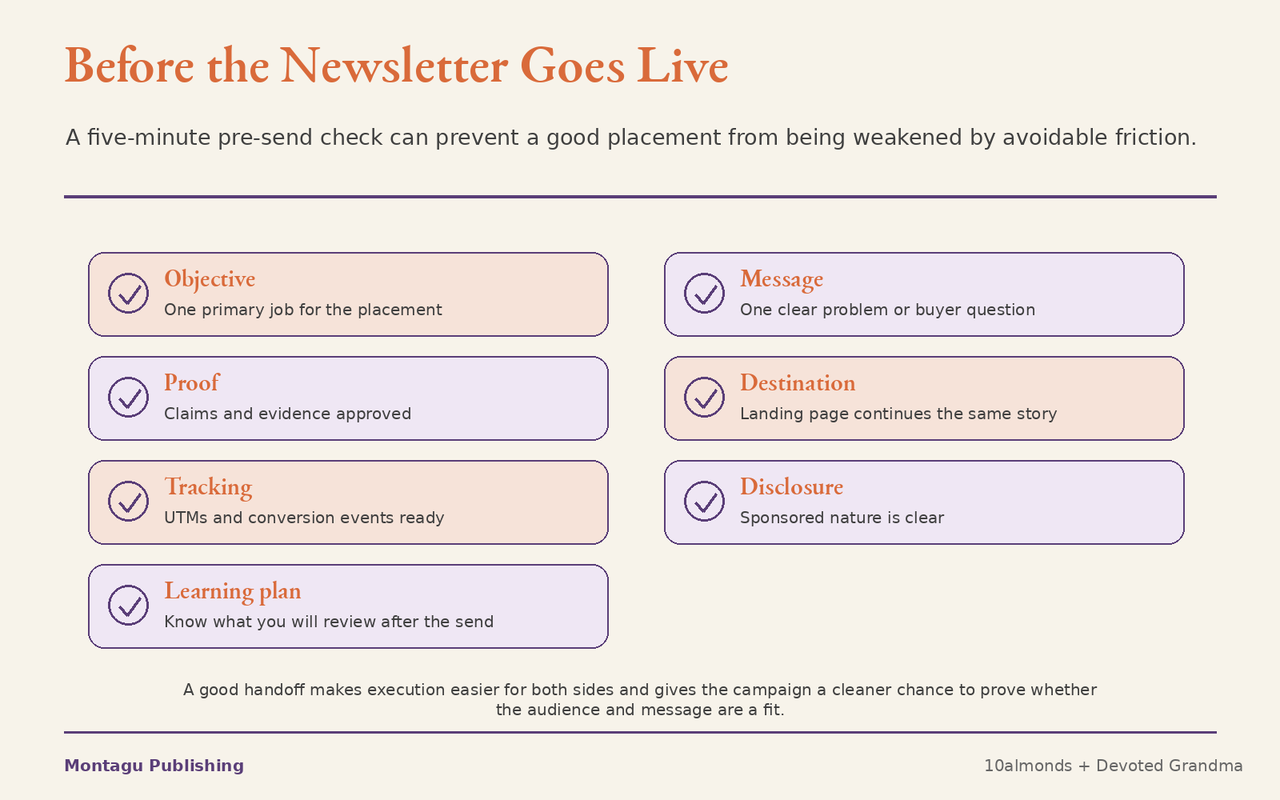
Include the evidence the campaign is allowed to use: approved product facts, ingredient information, research the brand can substantiate, certifications, relevant expert involvement, or clearly supported customer proof.
For health and wellness advertising, claims need particular care. The FTC says advertising claims should not mislead consumers and, when native or sponsored content could otherwise look independent, the commercial nature of the content may need a clear and prominent disclosure. That is one reason the brief should identify approved claims and disclosure requirements before writing begins.
6. Separate Non-Negotiables From Areas That Can Flex
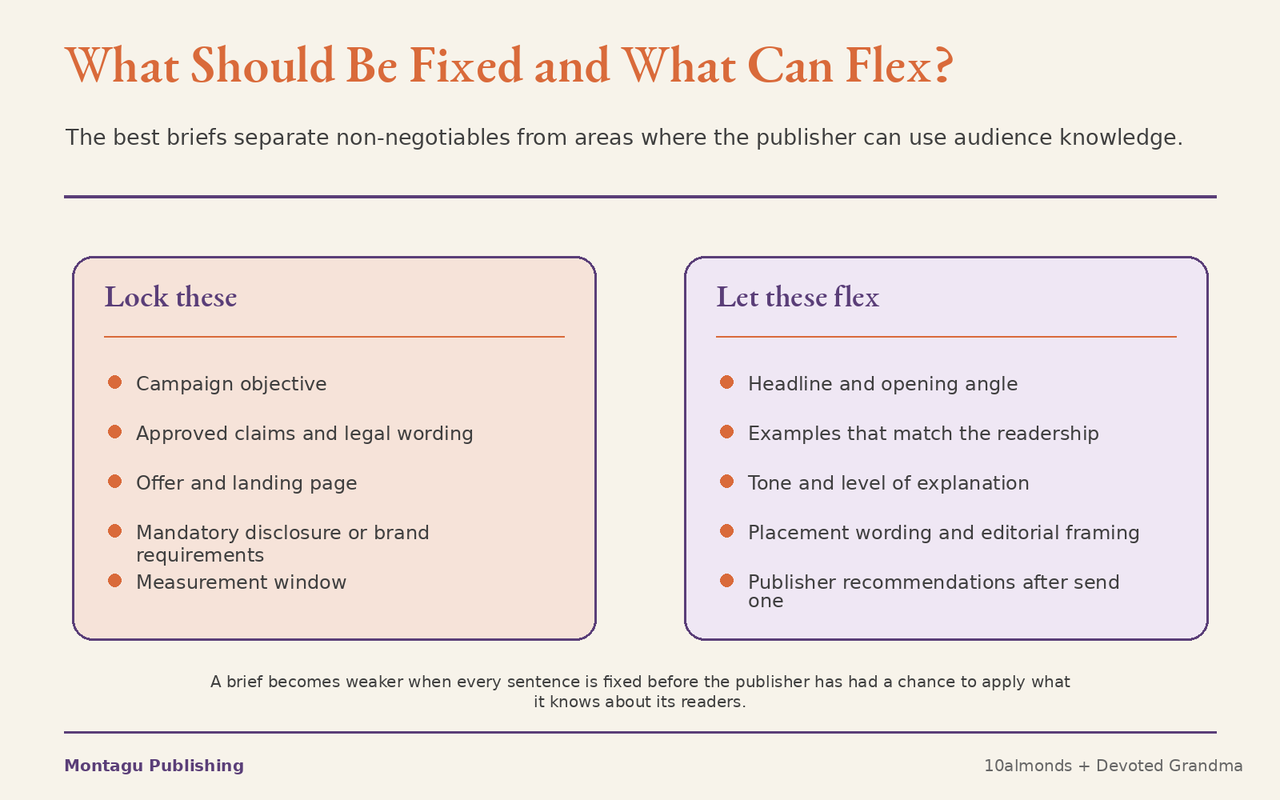
A good brief should clearly distinguish between what cannot change and where the publisher can use judgement.
Non-negotiables might include the campaign objective, approved claims, legal language, offer, product facts, landing page and disclosure requirements.
The publisher may be better placed to recommend the headline, opening angle, examples, tone and level of explanation. Those decisions depend heavily on how its audience normally reads and responds.
Over-prescribing every sentence can remove exactly the audience knowledge the brand is paying to access.
7. Define Measurement Before the Send
The brief should say how the campaign will be judged before anyone sees the results — the same discipline behind how brands should measure sponsored content beyond clicks.
For a direct-response placement, the key measure may be purchases or leads. For educational sponsored content, the brand may also need to look at time on page, scroll depth, product-page visits, sign-ups, returning visitors, retargeting-pool growth and assisted conversions.
It also helps to agree when the results will be reviewed. Some signals appear on send day. Others, such as return visits or assisted conversions, need a longer window — the same pacing discussed in how many newsletter sponsorships a brand should book before judging results.
The Seven-Part Brief at a Glance
| Brief element | Question to answer | Example |
|---|---|---|
| Objective | What should change? | Generate qualified product-page visits from women 50+. |
| Audience | Who needs to care? | Health-conscious women researching sleep and healthy ageing. |
| Buyer question | What uncertainty must disappear? | Why might magnesium be relevant to me? |
| Offer | What is the next step? | Read product and ingredient information. |
| Proof | What can support the message? | Approved ingredient facts and substantiated claims. |
| Boundaries | What cannot change? | Disclosure, legal wording, approved product facts. |
| Measurement | What decides renewal? | Qualified visits, time on page, return behaviour and assisted conversion. |
What Should Not Be in the Brief
A long brand history is rarely useful unless it directly affects why the reader should trust the offer. Neither is a page of adjectives copied from the website.
Avoid giving the publisher six competing CTAs, ten messages that all have to appear, or a rigid script that leaves no room to match the publication. Those requirements often turn a sponsorship into a crowded advertisement rather than useful content.
The brief should make the decision easier, not make the placement heavier.
Give the Publisher Enough Room to Advise
One of the immediate advantages of working with a newsletter publisher is that the brand is not only buying distribution. It is also buying access to an audience environment the publisher understands better than the advertiser does.
That knowledge is useful before launch. Ask whether the topic is likely to resonate. Ask whether the CTA is asking too much. Ask whether a primary placement, educational article or combination is more appropriate. Ask what the publisher would change if it were trying to make the campaign work for its own readers — the same collaborative approach we recommend in how brands should test newsletter sponsorships for the first time.
The answer may save more budget than another round of media optimisation.
What We Would Do
If we were briefing a campaign for a new supplement aimed at women over 50, we would begin with the reader problem rather than the product description.
The brief might say: “We want to reach health-conscious women 50+ who are actively reading about sleep and healthy ageing. The audience does not need to be convinced that sleep matters. They need help understanding where magnesium fits, what it can and cannot reasonably be expected to do, and what to consider when comparing products.”
We would then provide the approved product facts, identify claims that cannot be made, choose one next step and agree how the first placement will be measured.
That gives the publisher a clear job without forcing the article to read like the brand website.
Where 10almonds and Devoted Grandma Fit
For Montagu Publishing, the brief also helps determine which publication and format are the better fit.
10almonds is typically more relevant when the campaign centres on the reader’s own health, wellbeing, nutrition, healthy ageing or evidence-informed decision-making — the same scaled-education approach covered in how wellness brands can educate consumers at scale. Devoted Grandma is more relevant when the product sits in a family, household, lifestyle, travel, gifting or intergenerational context.
The same brand may fit both publications, but the buyer question can be different. That is why a useful brief should describe the decision the reader is making, not only the demographic the brand wants to reach.
Frequently Asked Questions
The Bottom Line
A newsletter sponsorship brief is not an instruction sheet for writing an ad. It is a decision document.
It should tell the publisher what the campaign needs to achieve, who needs to care, what the reader needs to understand, what evidence is available, what cannot change and how the result will be judged.
For a marketing manager with a limited budget, clarity here is valuable because it reduces waste before the media spend begins.
The better the brief, the easier it becomes for the publisher to do the job the brand hired it to do: translate a commercial objective into something the audience will actually find worth reading.
Planning a Newsletter Sponsorship?
If you are exploring a campaign with 10almonds or Devoted Grandma, a useful starting point is the objective and the reader question rather than a finished piece of ad copy.
Montagu Publishing works with brands across primary newsletter placements and sponsored educational content. The aim is to find the format and message that make sense for the audience before asking the campaign to perform.
Reach out to sales@10almonds.com to discuss an upcoming campaign.