


Direct Answer
A brand should not judge a newsletter sponsorship only by one send unless the audience fit is clearly wrong or the campaign was designed as a very small exploratory test. One placement can reveal whether the audience is broadly relevant, whether the message earns attention and whether the landing page is ready. It rarely gives the full picture.
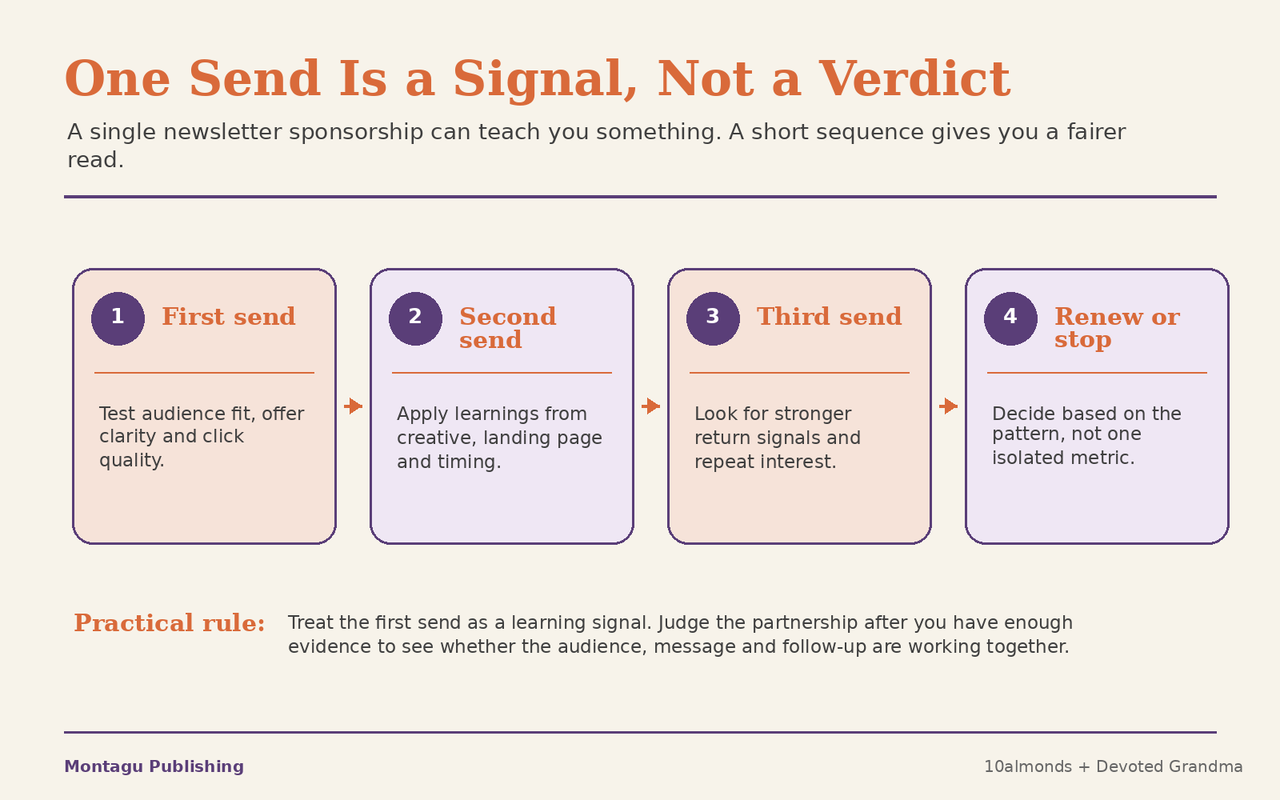
For many first-time advertisers, two or three sends create a more useful test. The first send gives a baseline. The second applies what was learned. The third helps show whether the audience response is consistent enough to justify renewal.
The right number depends on the product, the budget, the buying cycle and the level of education required before purchase. The goal is not to book more sends for the sake of frequency. The goal is to gather enough evidence to make a better decision.
Quick Summary
- One newsletter placement is a signal, not always a verdict.
- Two or three sends usually create a clearer read because the brand can improve creative, offer and follow-up.
- Products that need education may require more than one exposure before readers act.
- The renewal decision should include click quality, landing-page behaviour, return visits and assisted conversions, not only click-through rate.
- A good newsletter test should reduce uncertainty about audience fit, message clarity and future campaign potential.
Why This Question Matters
Most marketing managers are not short of channels. They are short of certainty.
A newsletter sponsorship can look promising on paper: relevant audience, clear topic fit and a trusted editorial environment. But once the first send goes out, the uncomfortable question arrives quickly.
Was that enough to judge the channel?
The answer is usually no. A first send is useful, but it can be distorted by timing, creative, landing-page quality, offer strength, seasonality and how familiar the audience already is with the category.
A weak first send may reveal a poor fit. It may also reveal that the sponsor asked for action too quickly, gave readers too little context or sent traffic to a page that did not continue the education started in the newsletter.
The First Send Has One Job
The first newsletter sponsorship should be treated as a diagnostic.
It should answer a few simple questions. Did the audience notice the message? Did the subject or placement create enough curiosity to click? Did readers spend meaningful time on the destination page? Did any of them return, search for the brand or move deeper into the site?
If the first send does none of these things, the brand may have a fit problem. But if it shows partial promise, the smarter move is often to improve the next placement rather than walk away immediately — the same test-not-verdict framing behind how brands should test newsletter sponsorships for the first time.
This is especially true for wellness, supplement, healthy ageing and household products where consumers often need explanation before they feel ready to act.
Do Not Treat Every Product the Same
A simple discount-led offer may be easier to evaluate after one placement. A complex supplement, new ingredient, menopause-support product or financial-planning service usually needs a different standard.
The more explanation a product needs, the less fair it is to judge the entire channel by immediate conversion from one send.
That does not mean every campaign deserves endless patience. It means the test design should match the buying decision.
| Product or offer type | Likely test need | Why |
|---|---|---|
| Simple, familiar product | One to two sends | Readers already understand the category, so response can be judged faster. |
| New or complex wellness product | Two to three sends | Readers may need context before the product feels relevant. |
| High-consideration product | Three or more sends | The decision may involve research, comparison and repeat exposure. |
| Short promotional offer | One send may be enough | The objective is immediate response rather than education. |
A Practical Way to Structure the Test
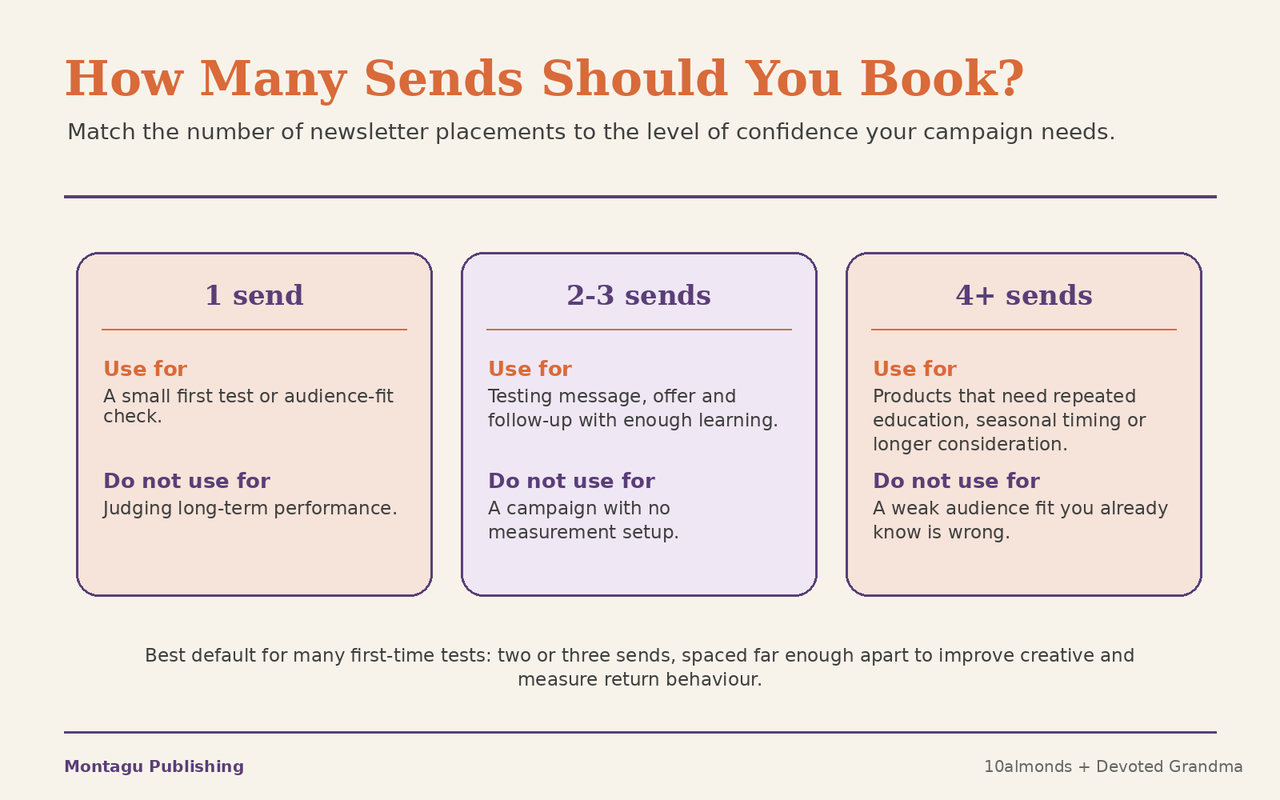
Instead of asking how many newsletter sponsorships to buy, ask how many learning moments the brand needs.
A practical test might work like this.
| Send | Purpose | What to learn |
|---|---|---|
| Send 1 | Baseline | Does this audience show interest in the topic, offer or problem? |
| Send 2 | Improvement | Does a stronger headline, clearer CTA or better landing page improve response? |
| Send 3 | Confirmation | Is the response consistent enough to justify renewal or a larger package? |
What Should Change Between Sends?
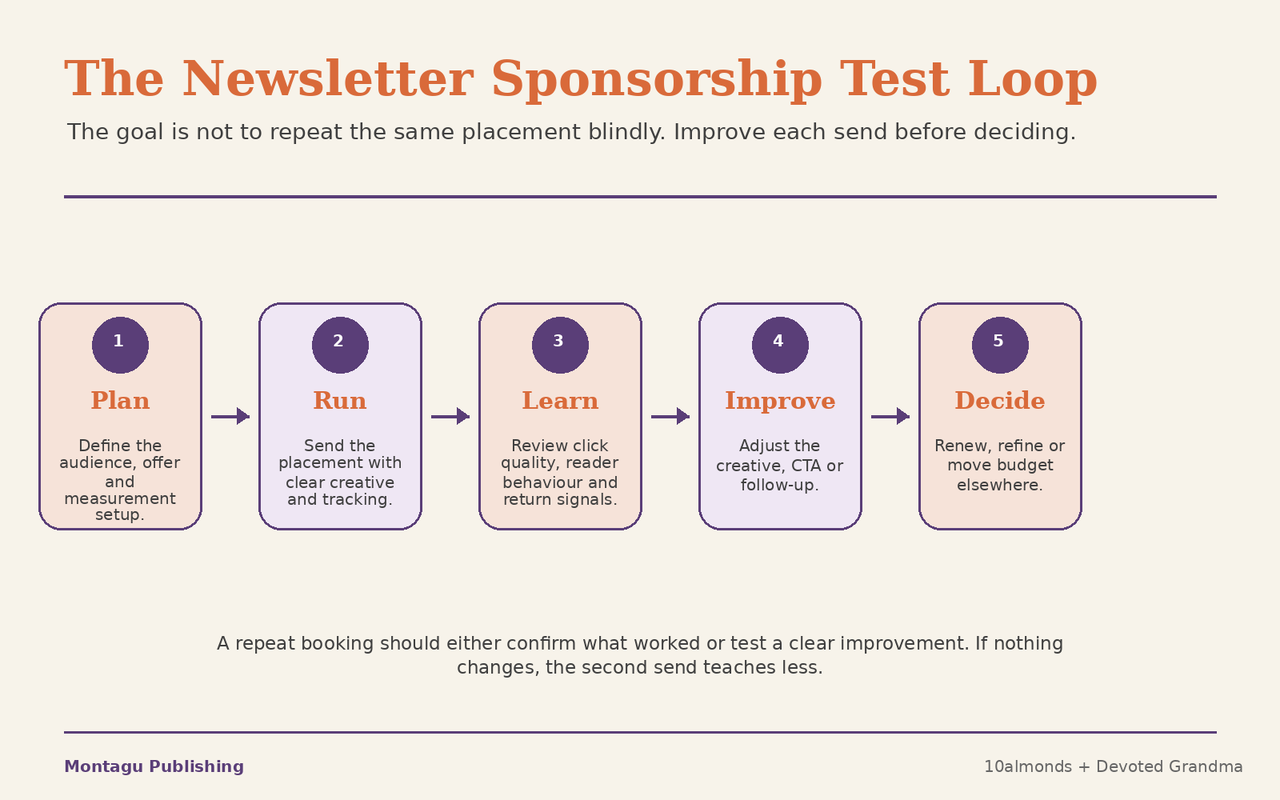
A repeat placement should not simply repeat the same creative unless the first send performed strongly and the brand wants to confirm consistency.
If the first send showed weak click-through but decent time on page, the message may need to be sharper. If clicks were strong but conversions were weak, the landing page or offer may be the problem. If both clicks and engagement were weak, audience fit or topic fit may need to be questioned.
The second send should test a clear improvement. That might mean changing the headline, leading with a more specific customer problem, improving the landing page, adding stronger proof or simplifying the next step.
Measure the Pattern, Not One Number
Click-through rate is useful, but it should not carry the entire renewal decision.
Sponsored content and newsletter placements often play a role earlier in the customer journey — the same case made in how brands should measure sponsored content beyond clicks. They can create attention, increase understanding and bring more qualified visitors into the brand’s own marketing system. Google Analytics’ attribution and traffic-source reports can help marketers look beyond a single last-click view when reviewing performance.
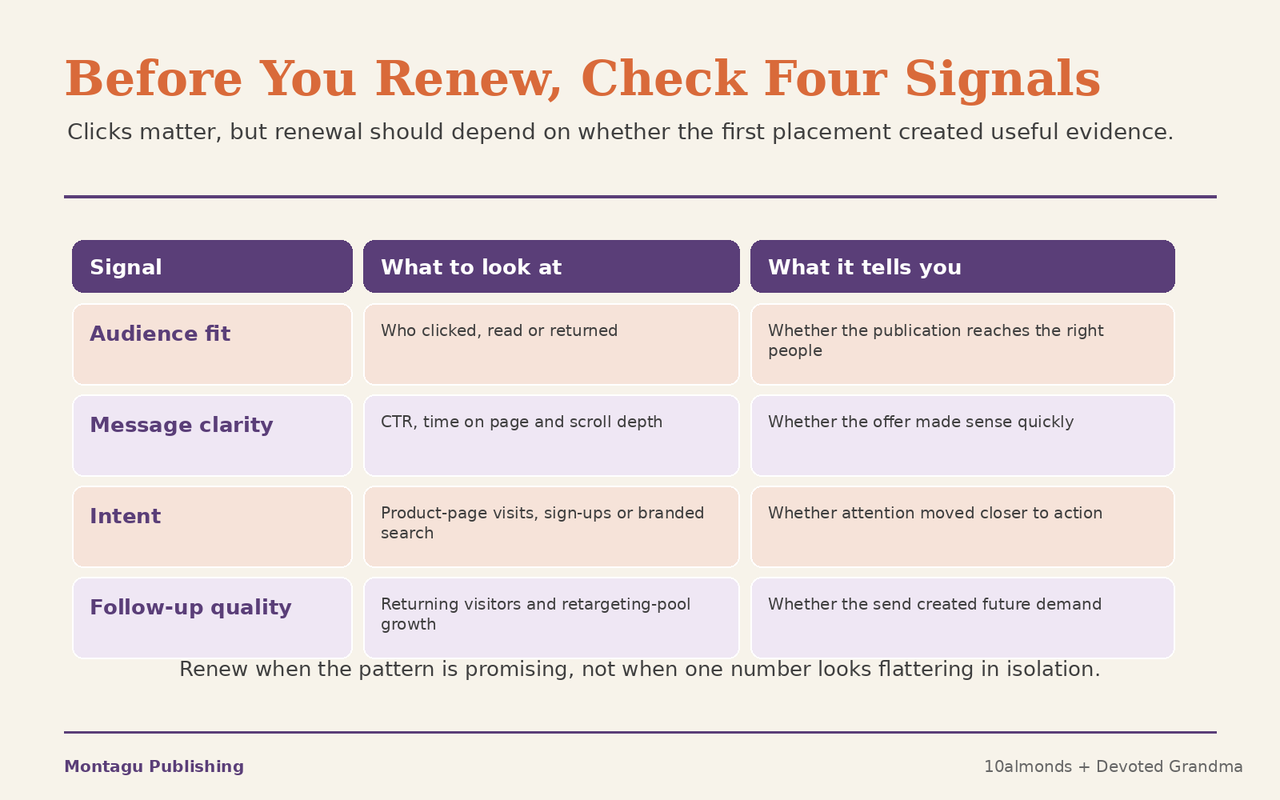
A better renewal decision looks at several signals together.
| Signal | What to check | Why it matters |
|---|---|---|
| Attention | Open rate, click-through rate, time on page, scroll depth | Shows whether the placement earned enough interest. |
| Intent | Product-page visits, sign-ups, related-content clicks, branded search | Shows whether readers moved closer to action. |
| Follow-up | Returning visitors, retargeting-pool growth, assisted conversions | Shows whether the send created future demand. |
| Fit | Reader comments, publisher feedback, audience context | Shows whether the message matched the publication’s audience. |
When One Send Is Enough
One send may be enough when the brand is running a very small exploratory test, the budget cannot support more, or the first result clearly shows poor audience fit.
For example, if the placement receives almost no meaningful engagement, visitors leave immediately and there is no sign of qualified behaviour, it may be sensible to stop and test another newsletter or channel.
One send may also be enough for a short-term promotion where the brand only needs to know whether a specific offer moved quickly.
When Two or Three Sends Are Smarter
Two or three sends are often more useful when the product needs context, the audience is promising but unfamiliar with the brand, or the first send produces partial signals that deserve a cleaner follow-up.
This approach gives the marketer room to learn. The first placement introduces the problem or product. The second improves the message. The third helps confirm whether the response was real enough to renew.
For brands with tight budgets, this does not have to mean buying a large package immediately. It can mean planning a small sequence with clear decision points.
When a Longer Run Makes Sense
A longer run can make sense when the campaign objective is education, brand familiarity or repeated consideration rather than immediate sales.
This is common for categories where consumers may read, compare, pause and return later — the same pattern behind how wellness brands can educate consumers at scale. Wellness products, supplements, healthy ageing offers, financial-planning services and family-related purchases often sit in this space.
The risk is buying frequency without learning. A longer run should still include measurement checkpoints, creative refinement and a clear renewal decision.
What We Would Do
If we were testing a newsletter sponsorship for a wellness brand targeting women over 50, we would not begin with the biggest possible package.
We would start with a clearly defined question. Are we testing audience fit, message clarity, educational content or direct response — the same starting question behind how brands build trust before asking consumers to buy?
If the product is familiar and the offer is simple, one or two sends may be enough. If the product needs explanation before purchase, we would usually plan a short sequence of two or three placements. The first would introduce the problem. The second would answer the strongest buying question. The third would bring interested readers back with a clearer next step.
That sequence gives the brand more than traffic. It gives the brand a better understanding of what the audience needs before it is ready to buy.
Where Newsletter Partnerships Fit
Newsletter partnerships are not only media placements. Used well, they are learning environments — the same clarity-first approach explained in what makes educational content more effective than traditional ads.
For brands working with 10almonds or Devoted Grandma, the value is not simply that a message appears in front of readers. It is that the message can be matched to the way readers already engage with health, wellbeing, family life, lifestyle decisions and practical information.
10almonds is better suited to campaigns where the reader is making health and wellness decisions for herself. Devoted Grandma is better suited to campaigns where the reader may also be thinking about family, household needs, grandchildren or shared decisions.
In both cases, a repeat placement should have a purpose. It should either deepen understanding, improve the offer or bring interested readers back. Per FTC native advertising guidance, sponsored placements should also stay clearly identifiable as such throughout a repeat run.
Frequently Asked Questions
The Bottom Line
Newsletter sponsorship frequency should be planned around learning, not repetition.
One send can tell a brand whether there is an early signal. Two or three sends can show whether the message improves, whether the audience responds consistently and whether the campaign deserves renewal.
The better question is not how many placements a brand can afford. It is how many placements are needed to make a confident decision.
For marketers with tight budgets, that distinction matters. The goal is not to spend more. The goal is to spend long enough, and carefully enough, to know what is actually working.
Considering a Newsletter Sponsorship Test?
If you are planning a campaign and want to understand whether newsletter sponsorships could support your objective, Montagu Publishing can help you think through the right starting point.
Through 10almonds and Devoted Grandma, we work with brands on newsletter placements and sponsored educational content designed to reach engaged female audiences in the right context.
The most useful test is rarely the biggest one. It is the one that answers the right question. Reach out to sales@10almonds.com.