


Direct Answer
Wellness brands can educate consumers at scale by building a repeatable system around the questions consumers already ask before buying. The goal is not to create endless content. It is to answer the same important questions clearly across the channels where consumers discover, research, compare and return.
For most wellness brands, that means creating a strong core article or explainer, adapting it into shorter channel-specific versions, supporting it with search and retargeting, and using trusted newsletter partnerships when the topic needs more context than an advertisement can provide.
Scale should not mean saying more. It should mean making the right explanation easier to find, easier to trust and easier to act on.
Quick Summary
- Start with buyer questions, not content formats.
- Create one strong educational asset before cutting it into smaller channel versions.
- Give every channel a specific education job.
- Measure understanding and return signals, not clicks alone.
- Use newsletter partnerships when the product needs time, context and trust before purchase.
Why Education Becomes Harder as Brands Grow
At a small scale, consumer education is often handled manually. A founder answers questions on calls, customer service explains the product in detail, and early buyers get a more personal explanation of what the product does and why it matters.
That approach breaks down as the brand grows. More people discover the product through ads, search, influencers, reviews and newsletters. They arrive with different levels of awareness. Some already know the category. Others barely understand the problem.
If the brand does not have a clear education system, each channel begins telling a slightly different story. Paid social says one thing. The website says another. The product page assumes too much. The email campaign pushes the sale before the consumer understands the value.
This is where many wellness campaigns start to leak interest. The problem is not that people do not care. It is that the explanation has not travelled with them through the journey.
Do Not Start by Making More Content
The common answer to scaling education is to create more content. More blogs, more posts, more emails, more landing pages.
That is not always useful. A larger content library can still fail if it does not answer the questions consumers actually ask before buying.
A better starting point is a question bank. List the questions that repeatedly come up before purchase: What is the problem? Why does it matter now? What options exist? What proof supports this? Is it right for someone like me? What should I do next?
Once those questions are clear, content planning becomes simpler. Each article, ad, email or newsletter placement has a job. It either removes uncertainty or it does not deserve budget.
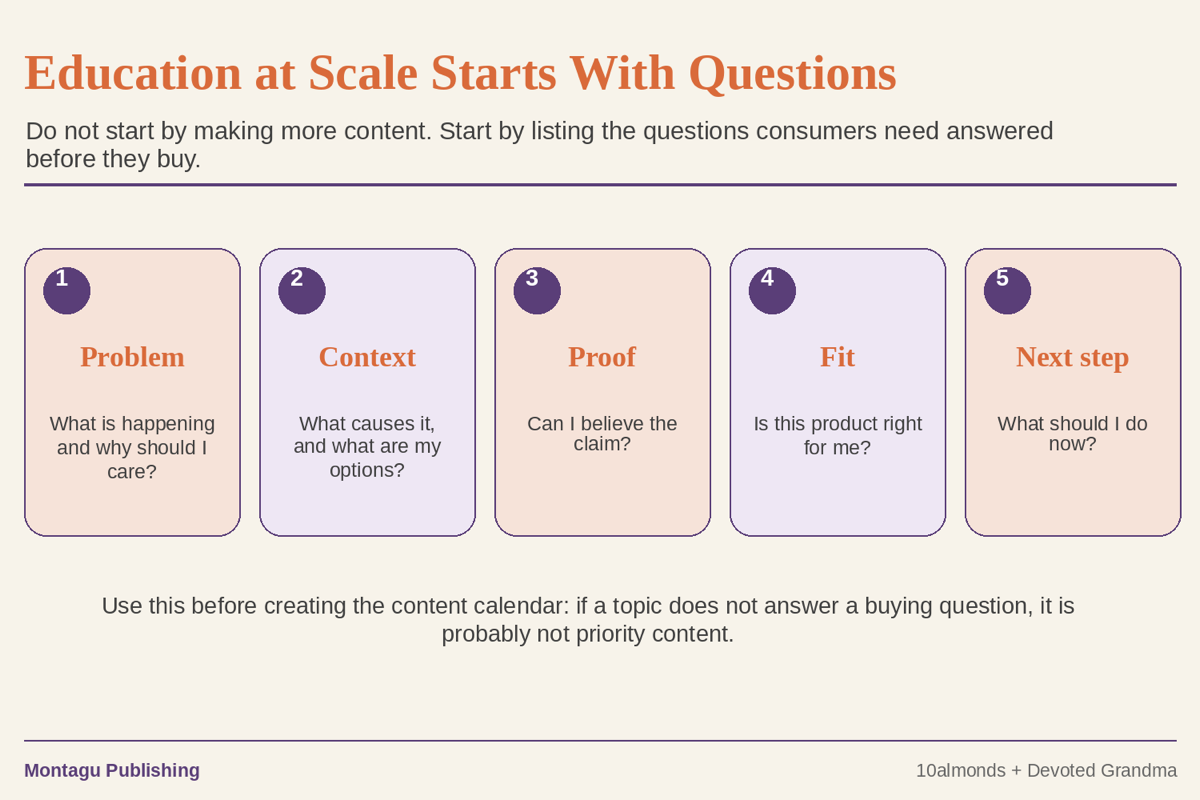
The Five Questions That Should Shape Wellness Education
| Buyer question | What the content should do |
|---|---|
| What is the problem? | Name the issue in plain language without exaggerating it. |
| Why does it matter? | Explain the consequence, opportunity or reason to pay attention. |
| What options exist? | Help the consumer understand the category before choosing a product. |
| Can I believe this? | Use proof, careful claims, examples and transparent wording. |
| What should I do next? | Give one clear next step rather than several competing asks. |
Build One Strong Core Asset First
Before scaling across channels, create one strong educational asset that explains the topic properly. This might be a long-form article, guide, landing page or sponsored educational piece.
The core asset should not begin with the product. It should begin with the consumer’s question. For example, a magnesium brand should not start by saying, Buy our magnesium supplement. It may be more useful to explain why people are asking about sleep, muscle tension or energy, what magnesium does in the body, what it does not do, and what consumers should consider before choosing a supplement.
That core explanation then becomes the source material for everything else. Paid social can introduce one part of the problem. Search can answer active queries. Email can bring people back to the topic. Retargeting can remind interested visitors of the product fit. Newsletter partnerships can carry the fuller explanation to a reading audience.
Give Every Channel an Education Job
Wellness brands often struggle when every channel is expected to educate, persuade and convert at the same time.
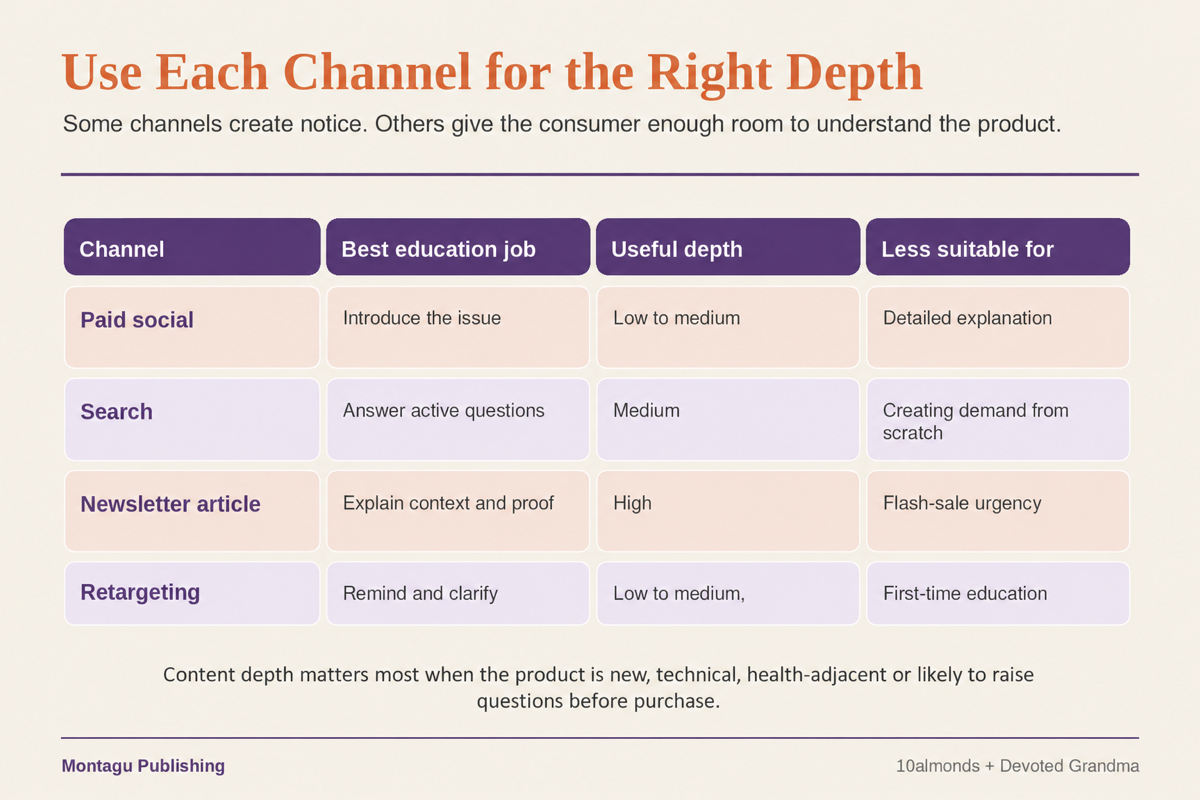
A better approach is to assign one primary job to each channel. Paid social can create notice. Search can answer active questions. Educational articles can explain context and proof. Newsletter partnerships can build understanding in a trusted environment. Retargeting can bring interested people back after they have engaged with the topic.
This prevents a common mistake: trying to make a short ad do the work of a full explanation. It also stops brands from judging every channel by the same metric. A newsletter article should not be measured exactly like a bottom-of-funnel search ad. The first is often reducing uncertainty. The second is capturing demand that already exists.
Where Claims and Proof Matter
Wellness education needs particular care because many products sit close to health, nutrition or supplementation. A useful article should not exaggerate the product’s role or imply outcomes the brand cannot support.
The safer approach is to explain the problem, describe the category honestly, use careful wording, and ensure claims are backed by appropriate support. In the United States, the FTC says advertising claims for health-related products must be truthful, not misleading and supported by science. For dietary supplements, FDA guidance also distinguishes structure/function claims from disease claims. Where content is sponsored, the FTC’s native advertising guidance is a useful reference for keeping the commercial relationship clear.
This does not mean wellness content should become legalistic or dull. It means the explanation should earn trust by being precise. A cautious, well-supported claim is often more persuasive than a dramatic one that creates doubt.
How to Scale Without Losing Clarity
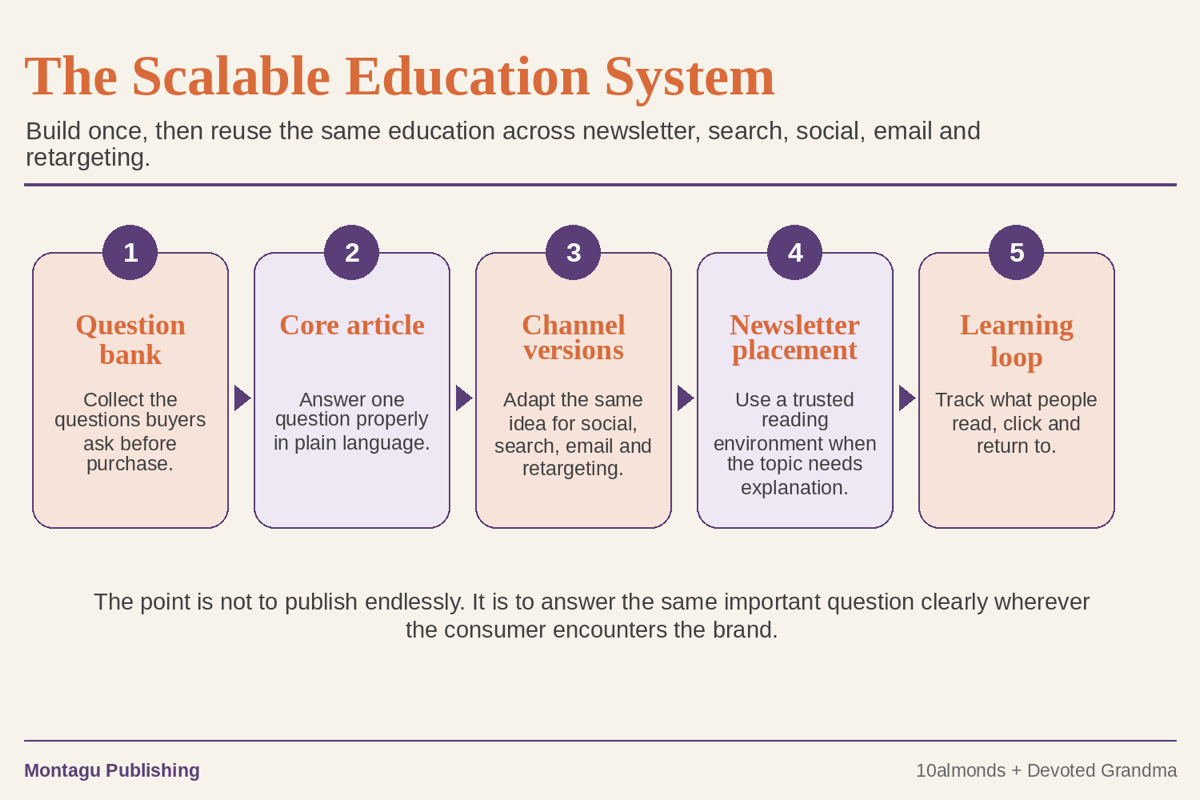
The simplest way to scale education is to reuse the same core explanation in different levels of depth.
A 1,500-word article can become a short newsletter placement, three paid social angles, a search landing page, a retargeting message, a sales enablement note and a follow-up email sequence. The idea remains the same, but the depth changes by channel.
This gives the consumer a more consistent experience. They may first see a short ad, then read an article, then visit the product page, then receive a follow-up message. Each step should feel connected rather than repetitive or contradictory.
The benefit for the marketing team is efficiency. You are no longer starting from scratch every time a new channel needs copy. You are adapting a tested explanation to fit the channel.
What We Would Do
If we were helping a wellness brand educate consumers at scale, we would not begin with a large content calendar. We would begin with the five most commercially important questions buyers need answered before purchase.
Then we would choose one question and create a strong educational article around it — the same core-asset-first approach behind how supplement brands can launch new products more effectively. Only after that would we adapt the message into other formats: paid social for awareness, search for active demand, email and retargeting for follow-up, and a newsletter partnership if the subject needs more context than a short ad can carry.
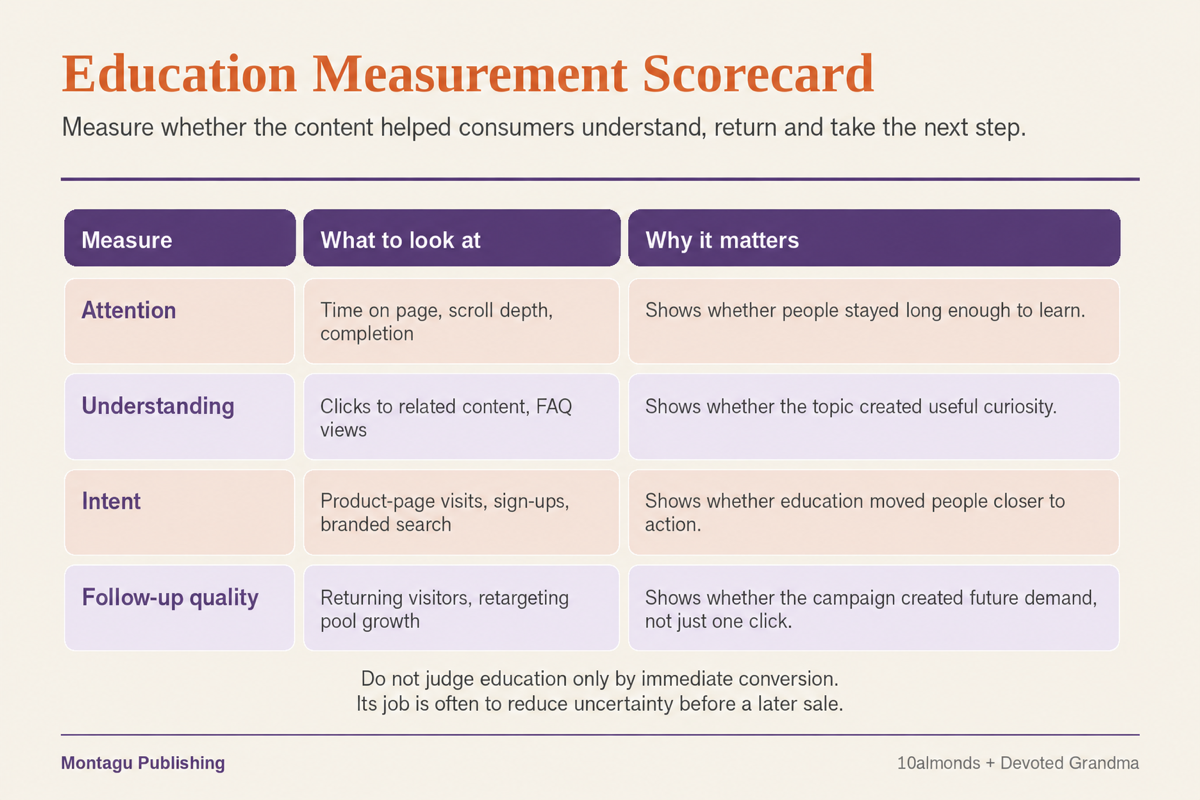
The campaign would be judged by whether it helped consumers move from curiosity to confidence, not simply by whether the first interaction produced a sale.
Where Newsletter Partnerships Fit
Newsletter partnerships are useful when a wellness brand needs consumers to spend time with an idea before they are ready to consider the product — the same channel-trust logic mapped out in which channels women over 50 actually trust.
For example, 10almonds can support brands that want to reach health-conscious readers who already spend time with practical wellness and healthy ageing content. Devoted Grandma can be useful when the buying context is broader, such as family wellbeing, household decisions, healthy ageing, travel, gifting or everyday lifestyle choices.
The value is not just the placement. It is the environment. A reader who has chosen to open a newsletter and read an explanation is in a different mindset from someone scrolling past a short ad. That does not make newsletters a replacement for paid media. It makes them a useful part of a media plan when understanding needs to come before conversion.
Frequently Asked Questions
The Bottom Line
Wellness brands do not educate consumers at scale by publishing more for the sake of publishing more.
They scale education by making the right explanation repeatable. That means identifying the buying questions, creating strong core assets, adapting the message by channel, using proof carefully and measuring whether consumers are becoming more confident over time — the same discipline that has run through educational content vs traditional ads and educating consumers without sounding salesy.
The better question is not how much content the brand can produce. It is whether the content is removing the uncertainty that stands between curiosity and purchase.
Considering a Newsletter Partnership?
If your wellness product needs explanation before purchase, a trusted newsletter partnership can help you reach readers in a context where they are already open to learning.
Through 10almonds and Devoted Grandma, Montagu Publishing works with brands on newsletter placements and sponsored educational content designed to complement existing paid media, not replace it — the same approach we outlined in how a wellness brand should spend its next $10,000 to reach women over 50.
If this approach might fit an upcoming campaign, reach out to sales@10almonds.com.