


Direct Answer
A more effective supplement product launch does not start with launch-day ads. It starts by reducing the uncertainty that prevents a consumer from buying. For a new supplement, that usually means explaining the problem first, showing why the product may be relevant, using careful evidence for any objective claims, and then following up with people who have shown interest.
For a smaller brand, the goal is not to appear everywhere. It is to give a small number of channels clear jobs. Educational content can create understanding, search can capture active demand, paid social can introduce the product, and retargeting can bring interested people back. The launch becomes a sequence rather than a burst of spend.
Quick Summary
- Start with the consumer problem, not the supplement bottle.
- Use launch content to answer the questions that stand between interest and purchase.
- Give each channel one job instead of asking every placement to sell immediately.
- Treat evidence and claim wording as part of the marketing plan, not a final legal check.
- Measure whether people are learning, returning and moving closer to purchase, not only whether they bought on the first click.
A Product Launch Is Not a Launch-Day Problem
A common launch plan looks like this: finalise the product, build the landing page, switch on paid social, send traffic to the offer and wait for conversion data. That approach can work when the audience already understands the product category. It becomes much harder when the supplement contains an unfamiliar ingredient, addresses a problem people do not fully understand, or asks consumers to believe a claim before they have seen enough context.
The better question is not, “How do we make launch week louder?” It is, “What does the consumer need to understand before launch week can work?”
Start With the Question the Consumer Needs Answered
A magnesium product may enter a conversation about sleep, muscle function or everyday nutrition. A joint-support product may enter a conversation about mobility and ageing. A protein product may enter a conversation about maintaining strength or meeting daily protein needs. The marketing job is to connect the product to a real consumer question without turning that connection into a claim the evidence cannot support.
This is why the first piece of launch content should often explain the issue rather than introduce the product. If the reader understands the problem, she has a reason to keep reading when the product appears later.
Build the Launch Around Five Jobs
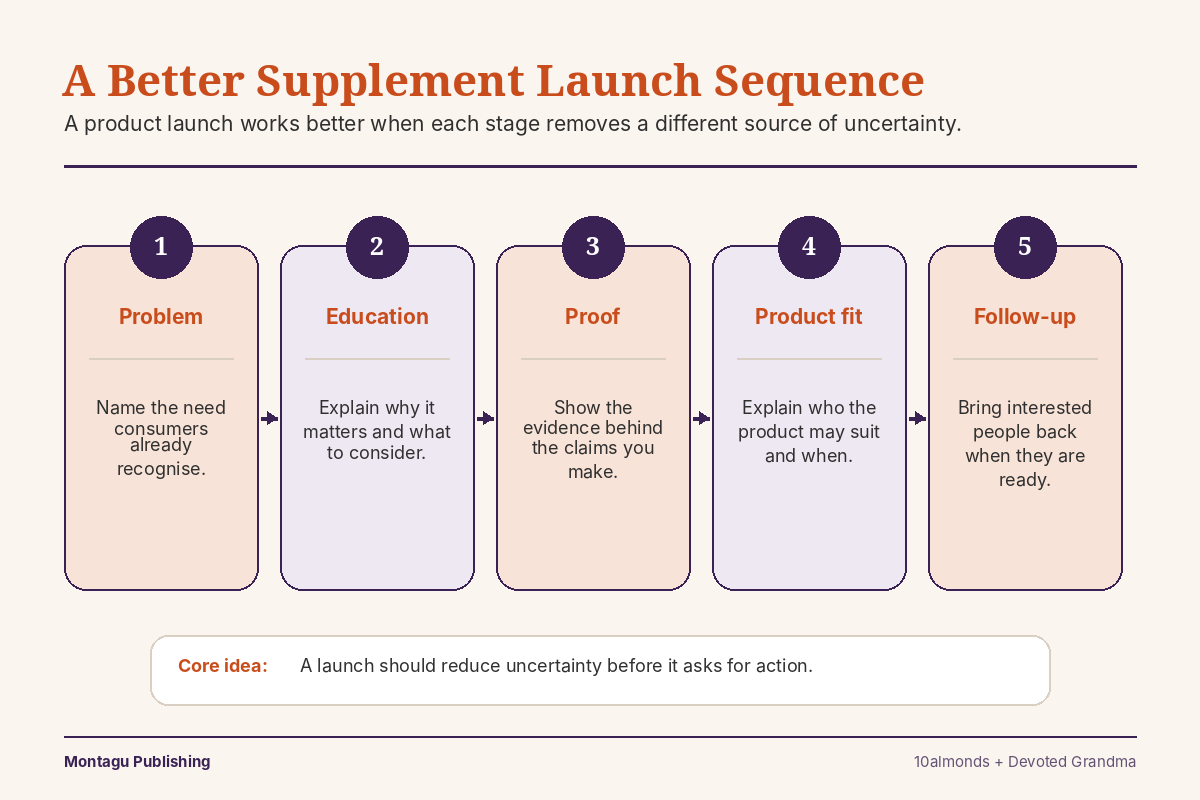
A useful supplement launch can be organised around five jobs:
- Problem: Name the need or question the audience already recognises.
- Education: Explain why the topic matters and what a consumer should consider.
- Proof: Show the evidence behind the claims the brand is making.
- Product fit: Explain where the product fits, who it may be relevant for and what it does not promise.
- Follow-up: Give interested consumers a reason and a route to return.
This structure prevents one of the most common launch mistakes: asking a short ad to carry all five jobs at once.
Do Not Ask Paid Media to Carry the Education Alone
Paid social is useful for discovery, but a short creative unit has limited room to explain a complex product. Search captures demand that already exists, while retargeting works only after someone has shown interest. None of these channels can replace the context a new category may need.
Educational content fills a different gap. It gives the brand space to answer questions, explain trade-offs and introduce the product after the reader has enough context to evaluate it. That does not make educational content a replacement for performance media. It makes it a support layer that can improve the quality of the traffic performance media later receives.
Claim Discipline Is Part of the Launch Strategy
For supplement marketing in the United States, claim wording deserves attention before creative is produced. The Federal Trade Commission says advertising for health-related products must be truthful, not misleading and appropriately substantiated. The Food and Drug Administration also distinguishes between permitted structure/function claims and disease claims in dietary supplement labeling.
For campaign teams, this means the creative brief should include a claims check from the beginning. See the FTC Health Products Compliance Guidance and the FDA guidance on structure/function claims before publishing US health-product claims.
It is also worth avoiding language that implies a dietary supplement is “FDA approved”. FDA explains that dietary supplements are not approved by the agency before they are marketed in the way approved drugs are. Regulatory or legal review should therefore happen before the campaign is built around a claim, not after the assets are finished.
A Practical Six-Week Launch Sequence
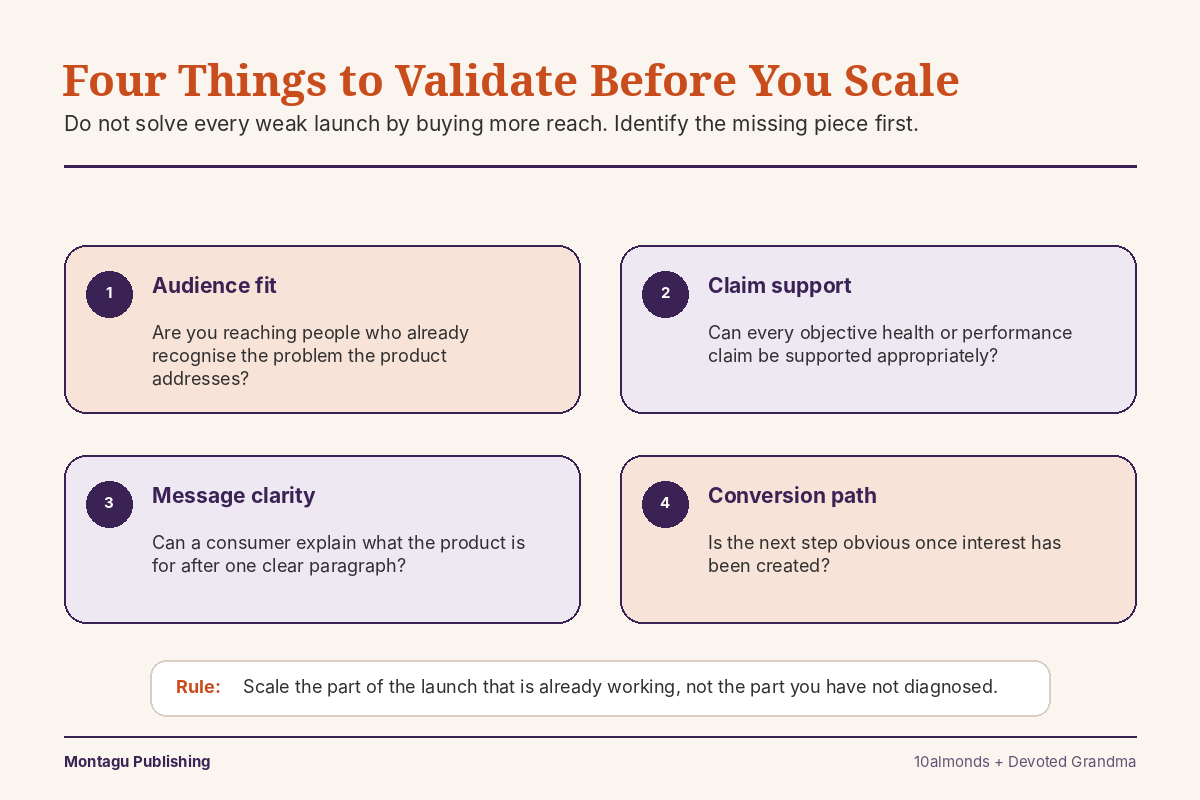
For a smaller brand, a six-week sequence can be more useful than concentrating the entire budget into launch week.
| Timing | Job | What happens |
|---|---|---|
| Weeks 1-2 | Education | Answer the problem-level questions consumers ask before they compare products. |
| Week 3 | Proof | Explain ingredients, evidence and what the product can reasonably claim. |
| Week 4 | Launch | Introduce the product, offer and next step clearly. |
| Week 5 | Follow-up | Retarget interested visitors and capture active search demand. |
| Week 6 | Learn | Review qualified traffic, repeat visits, assisted conversions and sales signals. |
The exact timing can change. The principle should not. Education should arrive before the hardest sales ask, and follow-up should continue after launch day rather than disappearing once the first burst of media ends.
What We Would Measure
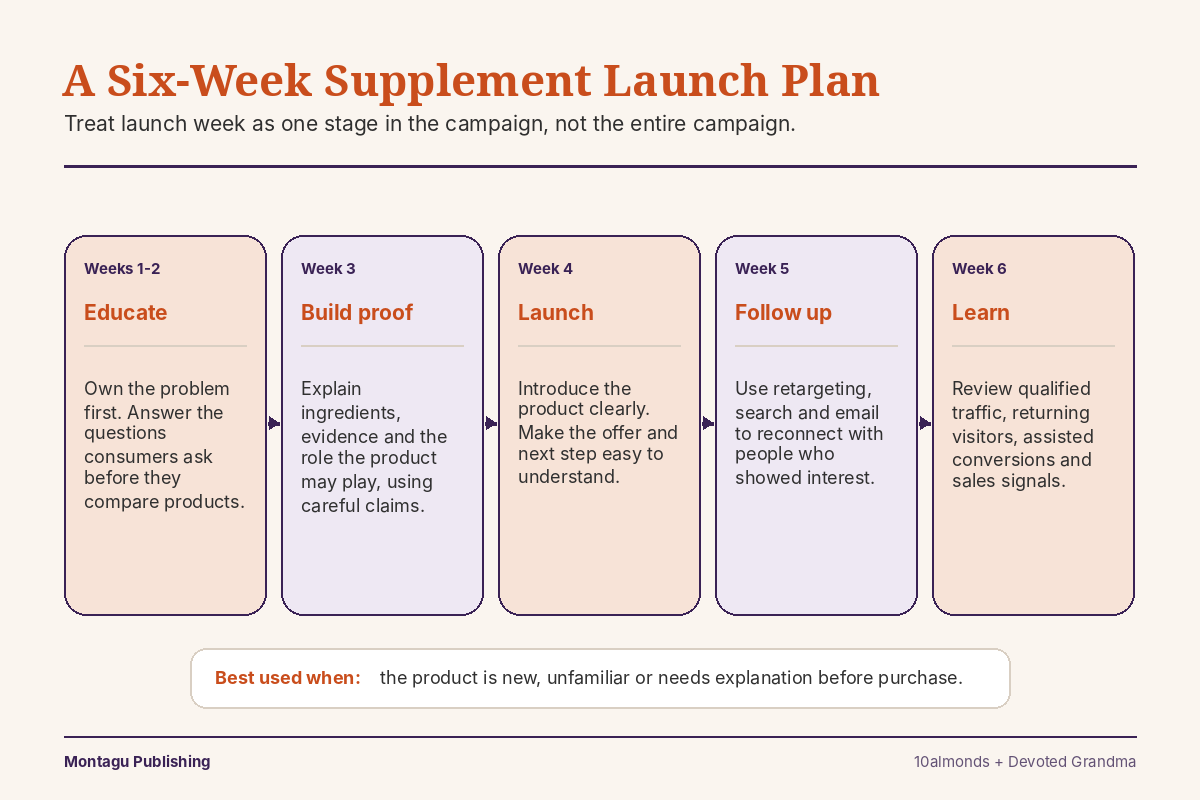
A supplement launch should not be judged by one number. Each stage has a different job, so the measurement should change with it.
- Education: time spent, article completion, scroll depth and qualified clicks.
- Demand: product searches, high-intent search traffic and visits to relevant product pages.
- Consideration: returning visitors, retargeting-pool growth and deeper product-page engagement.
- Conversion: sales, subscriptions, sign-ups and assisted conversions where attribution is available.
A Mistake We Often See
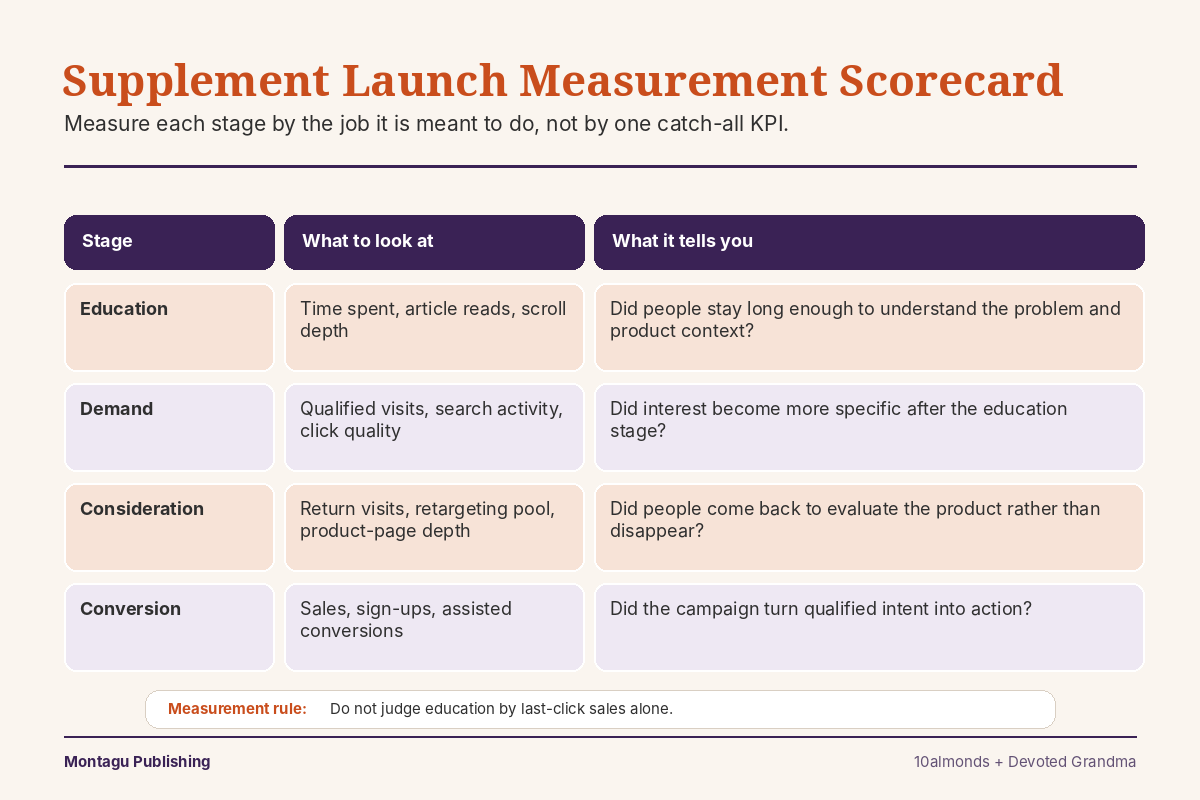
The launch message is often written backwards. The brand starts with everything it wants to say about the product, then tries to squeeze those points into ads, emails and sponsored content. The consumer question comes second — the same backwards ordering we described in how to educate consumers about complex products without sounding salesy.
Reverse that order. List the questions a cautious buyer is likely to ask first. Which problem is this for? Why should I care? What is the evidence? How is this different? Who is it for? What should I expect? Then decide which channel is best suited to answer each question.
Where Newsletter Partnerships Fit
Newsletter partnerships become particularly useful when a supplement needs explanation before purchase — the same trust-building role covered in how brands build trust before asking consumers to buy. A primary placement can introduce the product, while sponsored educational content can answer the question that makes the product relevant in the first place. Search and retargeting can then capture the people who want to investigate further or return later.
For 10almonds, that can mean placing a supplement within evidence-informed conversations about nutrition, healthy ageing, sleep, mobility or other relevant wellness topics — the kind of channel fit mapped out in which channels women over 50 actually trust. Devoted Grandma can be a better environment when the buying context is broader and the reader may be making health, lifestyle or household decisions for herself and her family.
The objective is not to disguise promotion as editorial — the same clarity-of-purpose test explained in what makes educational content more effective than traditional ads. Sponsored content should be clearly presented as brand-supported content and still be genuinely useful on its own.
Frequently Asked Questions
The Bottom Line
A stronger supplement product launch is not necessarily a bigger launch. It is a better-sequenced one.
Teach before you ask for the sale. Support claims before you amplify them. Give search, social, sponsored content and retargeting different jobs. Keep following up after launch day. Then scale the parts of the journey that are actually working.
For a marketing manager with a limited budget, that approach does something more useful than creating a temporary spike in impressions. It gives every dollar a specific role in helping a consumer move from a question to a confident decision.
Considering a Newsletter Partnership?
If you are planning a supplement product launch and the product needs explanation before purchase, Montagu Publishing can help you explore whether 10almonds or Devoted Grandma fits the audience and the job your campaign needs done.
Partnerships can combine primary newsletter placements with brand-supported educational content, allowing the product to be introduced after the reader has enough context to understand why it may be relevant.
To discuss an upcoming campaign, contact sales@10almonds.com.