


Direct Answer
Brands should diversify their channel mix by giving each channel a clear job, not by adding more platforms for the sake of it.
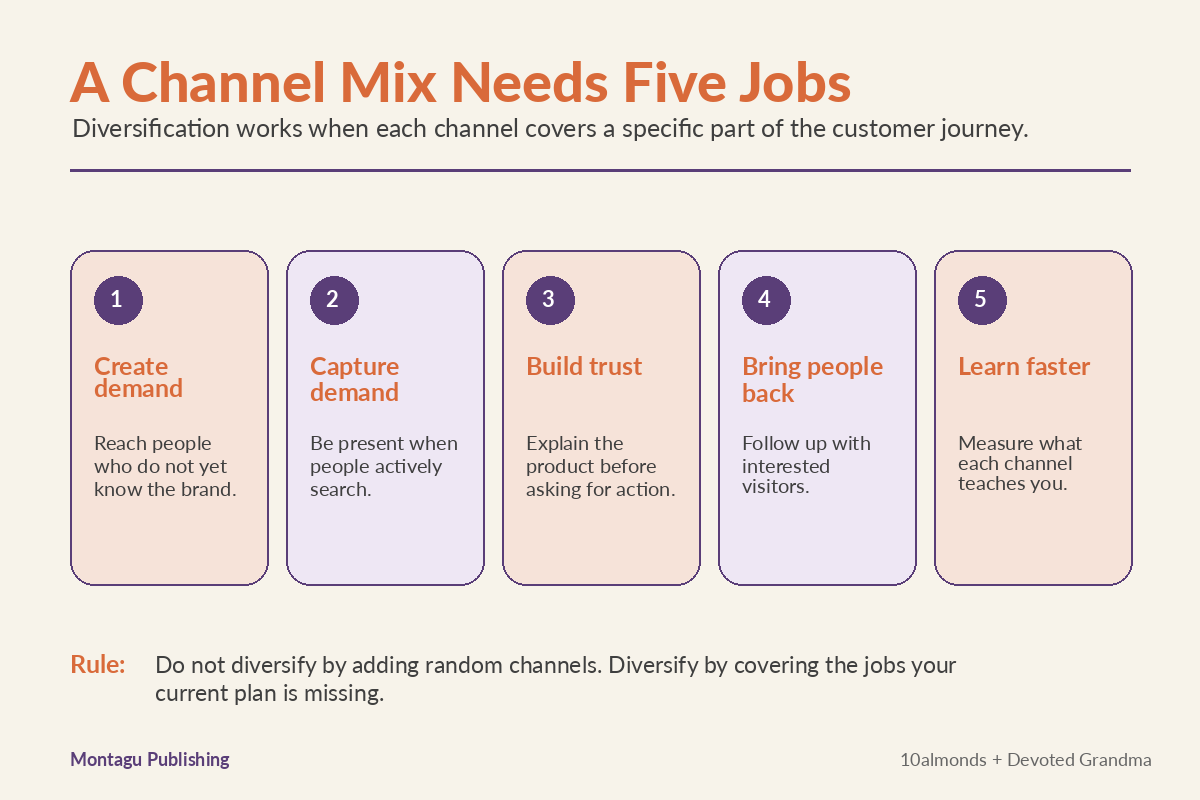
A strong media plan usually needs five jobs covered: creating demand, capturing demand, building trust, bringing interested people back and learning what to improve next. Paid social can create awareness, search can capture existing intent, educational content can build understanding, newsletter partnerships can add trust and audience fit, and retargeting can bring interested visitors back once they are ready to act.
The objective is not to be everywhere. It is to reduce the risk of relying too heavily on one channel while making sure each stage of the customer journey is supported.
Quick Summary
- Channel diversification is not the same as spreading money thinly across more platforms.
- Every channel should have one clear job in the plan.
- A brand that relies too heavily on one platform carries pricing, algorithm and measurement risk.
- For products that need explanation before purchase, the media mix should include an education and trust layer, not only ads.
- The safest way to diversify is to test one new channel at a time and judge it against the job it was meant to do.
Why Channel Diversification Matters
Most marketing managers understand the risk of relying on one channel. They see it when paid social costs rise, search competition increases, influencer results are hard to predict or attribution becomes harder to read — the same pressure we described in where brands should invest when Meta performance starts declining.
The problem is that diversification is often treated as a simple instruction: add another channel. That is not enough. Adding a channel without knowing what job it is meant to perform usually creates more reporting, more coordination and more uncertainty.
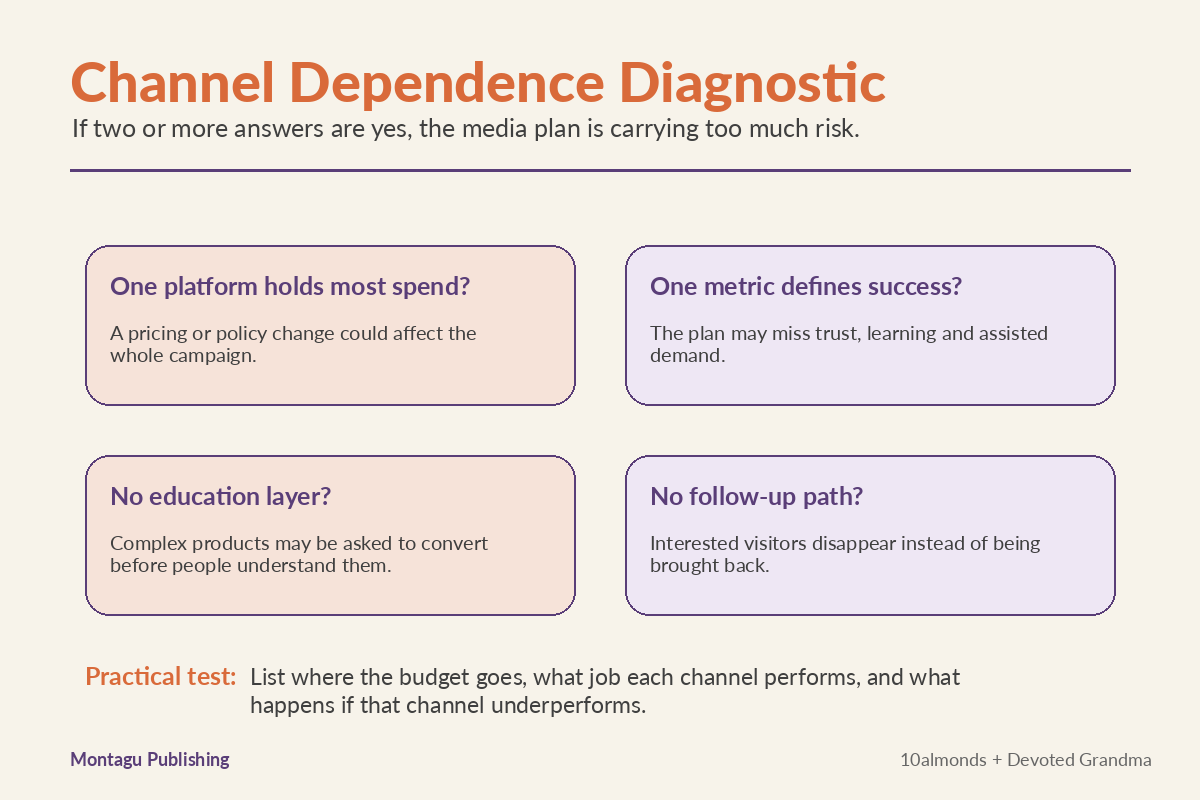
A better approach is to ask where the current media plan is weak. Is the brand failing to reach new people? Is it missing people who are already searching? Are consumers clicking but not understanding the product? Are interested visitors disappearing without follow-up?
Once the weakness is clear, the next channel becomes easier to choose.
Do Not Diversify by Platform Name
One of the easiest mistakes to make is to diversify by adding a platform simply because it is available.
A brand might say it is diversifying because it is now using Meta, Google, TikTok, influencers and email. But if all of those channels are being used only to push short promotional messages, the plan is not truly diversified. It is repeating the same job in different places.
Real diversification means different channels carry different responsibilities.
Paid social can introduce the brand to new people. Search can capture people already looking for a solution. Educational content can explain why the product matters. Newsletter partnerships can place that explanation in front of a reader who has chosen to spend time with trusted content. Retargeting can bring back people who have already shown interest.
The brand has not just added channels. It has added stages to the customer journey.
The Five Jobs Every Channel Mix Should Cover
A practical channel mix should be able to answer five questions.
First, how will we create demand among people who do not yet know us? Paid social, PR, creator content and partnerships can all help here, depending on the audience and message.
Second, how will we capture demand from people who are already looking? Paid search, organic search and brand search matter here because the consumer is already showing intent.
Third, how will we build enough trust for people to take us seriously? This is especially important in wellness, healthcare, financial services and products aimed at older consumers. A short ad may create interest, but it often cannot answer the questions that make someone comfortable enough to act.
Fourth, how will we bring interested people back? Retargeting, email capture and follow-up content help make sure awareness does not disappear after one visit.
Fifth, what will we learn from this test? A good media plan should not only produce results. It should also teach the team which messages, audiences and channels deserve more investment next time.
A Simple Channel Dependence Audit
Before adding any new channel, audit the current plan.
Write down every channel currently receiving budget. Next to each one, write its job. Then write the main metric used to judge it. If several channels have the same job and the same metric, the plan may be more concentrated than it looks.
For example, a brand might be spending across paid social, influencer content and display ads. On paper, that looks diversified. In practice, if all three are being used only for awareness, the brand may still be missing search capture, education, trust-building and follow-up.
Channel diversification should fill gaps. It should not duplicate what is already happening.
A Sample Diversified Media Mix
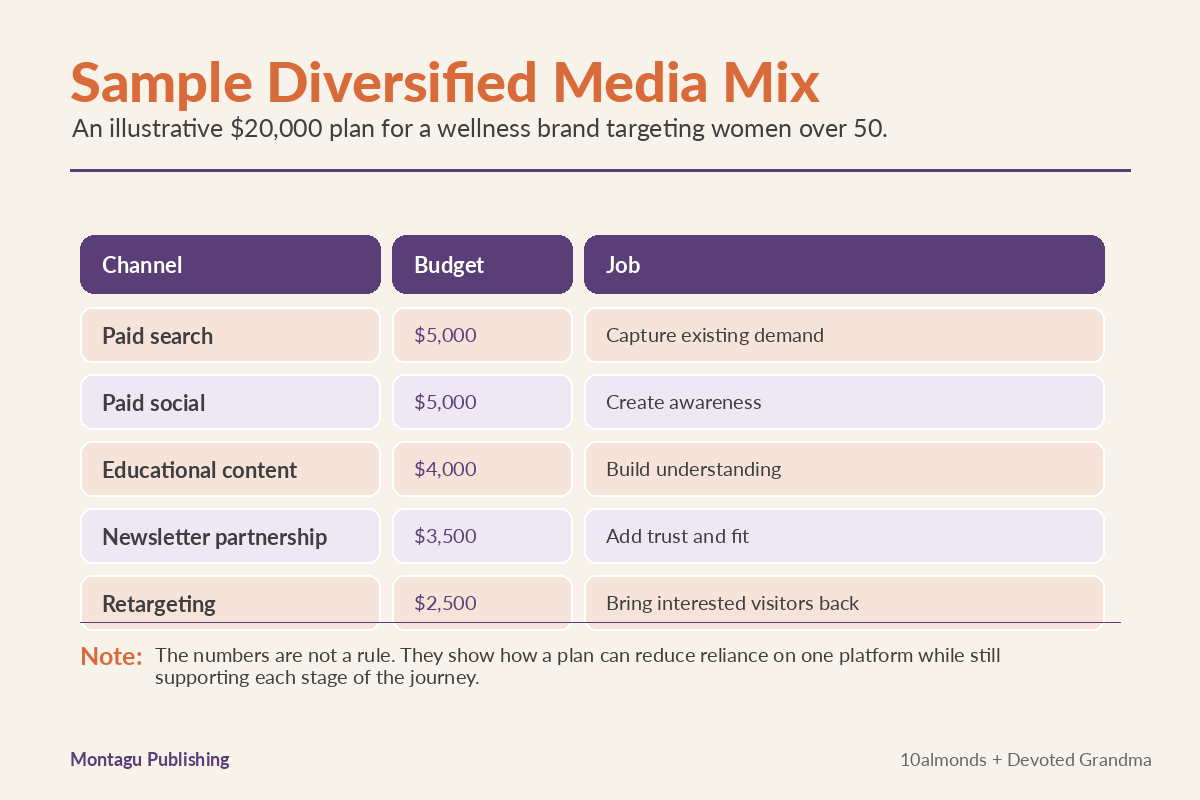
Imagine a wellness brand with a $20,000 campaign budget aimed at women over 50.
An undiversified plan might put most of that money into paid social because it feels familiar and easy to activate. A more balanced plan would still use paid social, but it would not ask paid social to carry the whole customer journey.
One illustrative split could look like this:
| Channel | Budget | Job |
|---|---|---|
| Paid search | $5,000 | Capture people already searching for the product category or related symptoms |
| Paid social | $5,000 | Introduce the product to new audiences |
| Educational content | $4,000 | Explain the health topic before asking for a purchase |
| Newsletter partnership | $3,500 | Place that education within a trusted reader environment |
| Retargeting | $2,500 | Bring back people who have already shown interest |
The exact numbers would change by product, price point and past performance. What matters is the logic. Each channel has a role, and no single channel is being asked to do everything.
When to Add Search, Content, Newsletters or Retargeting
If people are already searching for the category, search deserves a stronger role. This is especially true when the product sits in a category people already understand, such as magnesium, collagen, probiotics or skincare.
If people do not yet understand the problem or the product, educational content deserves more space. This is often the case with newer ingredients, unfamiliar formulations or health topics where trust matters.
If the audience is highly specific and trust is important, newsletter partnerships may be worth testing. They are useful when a brand needs to reach people in a setting where they are already reading, learning and evaluating information.
If traffic exists but conversion is weak, retargeting and follow-up should be reviewed before buying more cold reach — the same audience-quality question raised in choosing the most cost-effective way to reach women over 50. Sometimes the issue is not that too few people saw the brand. It is that interested people were not brought back at the right moment.
Where Newsletter Partnerships Fit
Newsletter partnerships are not the answer to every channel problem. They are not built to replace search, social or retargeting — the same nuance covered in how brands should test newsletter sponsorships for the first time.
They become useful when a brand needs attention that is deeper than a passing impression. This is particularly relevant when the product requires explanation, comparison or reassurance before purchase.
For brands targeting women over 50, this can matter more than many marketers expect. A consumer considering a wellness, health, travel or financial product may not act after one short ad. She may want to understand the topic, compare options and feel that the brand is credible before she clicks through.
That is where a trusted editorial environment can strengthen the wider media plan. It gives the brand a place to educate rather than only promote.
Where 10almonds and Devoted Grandma Fit
10almonds and Devoted Grandma serve different roles within this kind of channel mix.
10almonds is best suited to brands that need to reach women who are actively thinking about their own health and wellbeing. It can fit campaigns around supplements, healthy ageing, sleep, nutrition, mobility, gut health, skincare and preventative wellness.
Devoted Grandma is better suited to brands where the buying decision is connected to family, household choices, grandchildren, travel, safety, gifting or shared experiences. The reader is not only considering herself. She may be considering the people around her as well.
For a marketing manager, the decision should not be which publication is bigger. The better question is which reader context matches the campaign objective.
What We Would Do
If we were helping a smaller wellness brand diversify its channel mix, we would not start by adding three new channels at once — the same discipline behind how to build awareness without increasing spend.
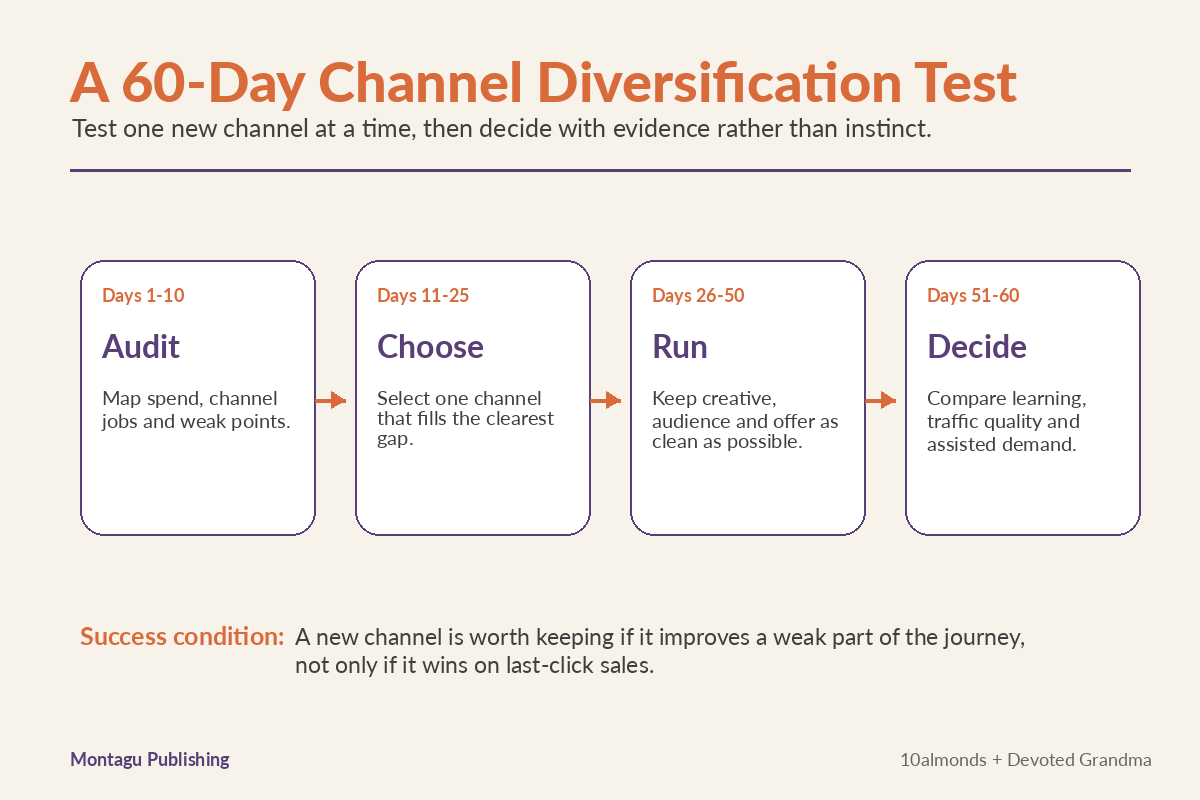
We would first identify the biggest gap. If the brand has traffic but weak conversion, we would improve retargeting and follow-up. If the brand has awareness but poor understanding, we would add educational content or a newsletter partnership. If the brand has a strong explanation but not enough demand capture, we would strengthen search.
We would then run one clean test for 60 days — the same test window discussed in what is a smarter alternative to increasing your Meta budget. One new channel, one clear job, one primary success measure and a simple comparison against the current plan.
That is slower than adding everything at once, but it gives the marketing manager something more useful: a decision they can defend.
Mistakes to Avoid
- Diversifying too quickly. Adding several new channels at once makes it difficult to know what worked and what did not.
- Using the same creative everywhere. A short paid social ad, an educational article and a retargeting message should not all say the same thing. They are speaking to consumers at different stages.
- Measuring every channel by last-click sales. Some channels create demand, some build trust and some close the loop. They should not all be judged by the same metric.
- Keeping spend in familiar places because reporting feels easy. Familiar reporting does not always mean better performance.
- Forgetting the customer journey. A media plan is not diversified if it only reaches people once and then disappears.
Frequently Asked Questions
The Bottom Line
A diversified channel mix is not about being present everywhere. It is about reducing dependency and making sure every stage of the customer journey has support.
For brands with limited budgets, this matters because every dollar has to do a specific job. Some budget should create demand. Some should capture it. Some should educate. Some should follow up. Some should help the team learn what to do next.
The best question is not how many channels should we use. The better question is this: which part of the customer journey is weakest, and which channel is best placed to strengthen it?
That is where channel diversification becomes practical rather than theoretical.
Considering a Newsletter Partnership?
If your current media plan reaches people but does not give them enough context to understand your product, a newsletter partnership may be worth testing.
Through 10almonds and Devoted Grandma, Montagu Publishing helps brands reach engaged female audiences through newsletter placements and brand-supported educational content.
The goal is not to replace your existing channels. It is to strengthen the part of the plan where education, trust and audience fit matter most.
If this approach might support an upcoming campaign, reach out to sales@10almonds.com.