


Direct Answer
You can build awareness without increasing spend by making your existing budget work harder. That usually means reducing wasted reach, narrowing the audience, matching each channel to one clear job, improving the message and adding follow-up for people who already showed interest.
For brands targeting women over 50, awareness should not be treated as a visibility problem alone. It is also an understanding problem. A consumer may see a product several times and still ignore it if she does not understand why it matters, what problem it solves, or why the brand is credible.
The smarter move is not always to spend more. Often, it is to move budget away from low-quality exposure and towards channels that help the right people notice, understand and remember the brand.
Quick Summary
- More awareness does not always require more budget.
- Before increasing spend, check whether the current budget is reaching the wrong audience, carrying the wrong message, or being measured by the wrong metric.
- Awareness is strongest when every channel has one job: discovery, education, demand capture or follow-up.
- For wellness, health, lifestyle and family-focused brands, educational content can make awareness more useful because it explains the reason to care.
- A newsletter partnership can strengthen awareness when the product needs trust and context before purchase.
The Problem With Asking for More Awareness Budget
A marketing manager can often feel the pressure before anyone says it out loud. The campaign is running, the spend is going out, and the brand still does not feel visible enough. The quick answer is tempting: increase the budget.
Sometimes that is the right answer. If the campaign is working, the audience is relevant and the numbers show healthy demand, adding spend can make sense.
But when awareness is not translating into qualified traffic, branded search, returning visitors or useful conversations, more budget may simply amplify the weakness already inside the plan — the same trap we described in where brands should invest when Meta performance starts declining. The brand becomes more visible, but not necessarily more understood.
That distinction matters. Visibility is not the same as awareness. A person can see a brand and forget it instantly. Awareness begins when the right person understands enough to remember the brand, consider it relevant and take a next step later.
Start by Finding the Waste
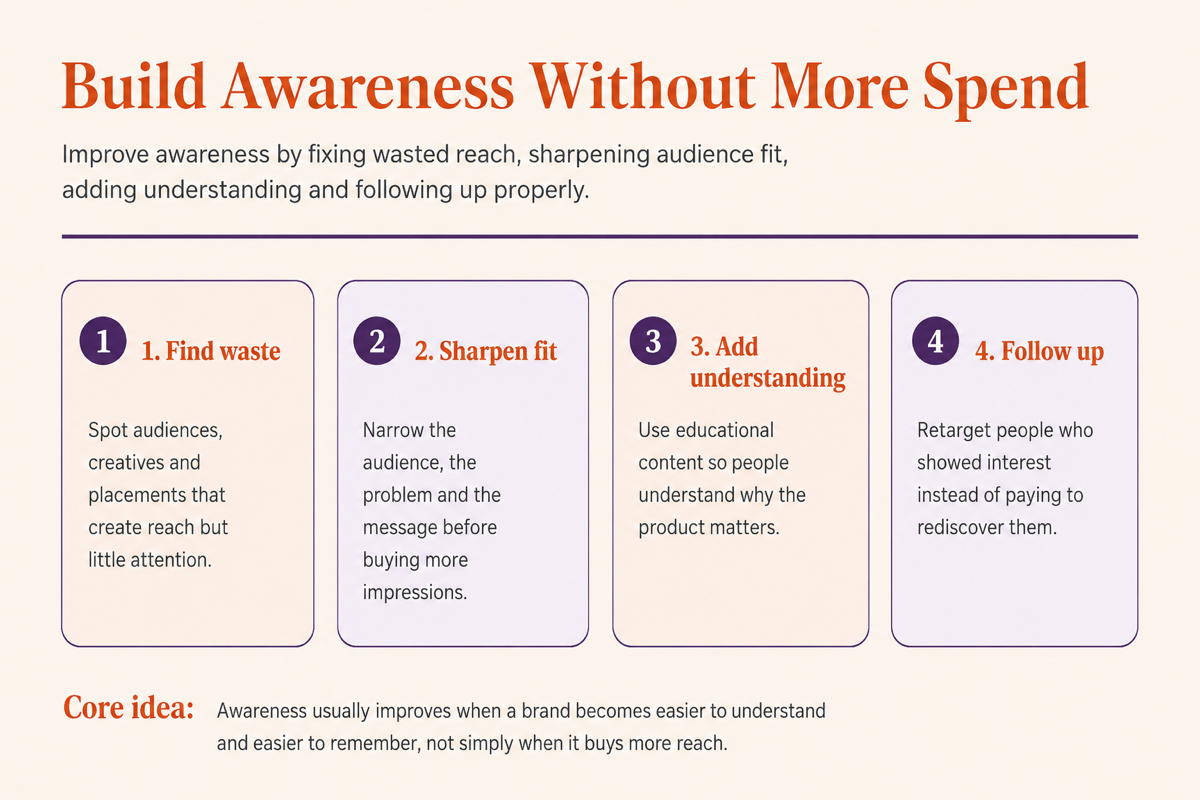
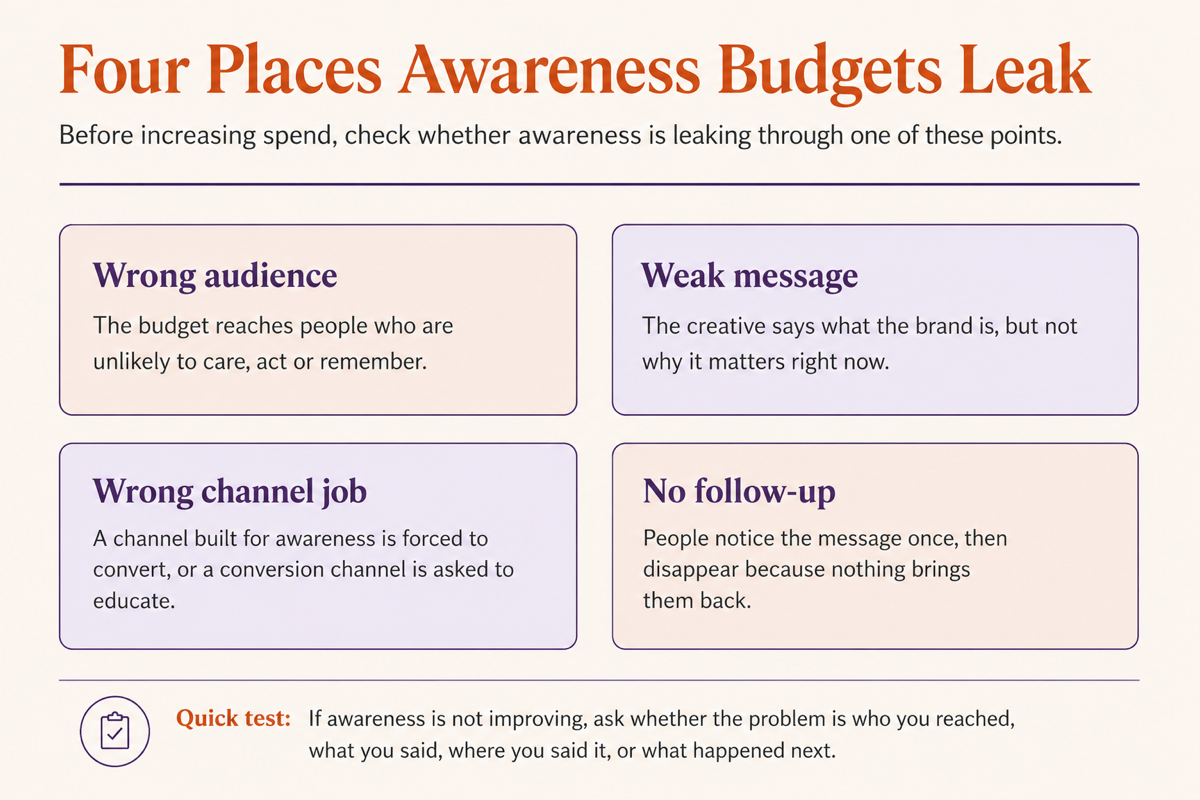
Before asking for more money, look for the places where the current budget is leaking. Most awareness plans waste money in one of four ways.
The first is audience waste. The campaign reaches people who are unlikely to buy, recommend or remember the product. Large reach numbers can hide poor audience fit.
The second is message waste. The creative may explain what the product is before explaining why the audience should care. This is especially common in wellness, supplements, healthcare and financial services, where consumers often need context before they pay attention.
The third is channel waste. A brand might use paid social to do detailed education, or expect a short ad to build trust for a complex product. The channel is not necessarily wrong; it is just being asked to do the wrong job.
The fourth is follow-up waste. The campaign pays to attract attention once, but does not have a clear plan to bring interested people back. That means the brand keeps paying for new attention instead of using the attention it has already earned.
Give Awareness a Clearer Job
Awareness is often treated too broadly. A team says it wants more awareness, but that can mean several different things.
It might mean more people need to know the brand exists. It might mean the audience needs to understand a product category. It might mean the brand needs to be remembered when a buying moment arrives. It might mean leadership wants to see more branded search, social proof or traffic from relevant audiences.
Those are different jobs, and they need different channel choices — the same one-job-per-channel principle behind what a low-risk media plan looks like in 2026.
If people do not know the brand exists, paid social and partnerships can help with discovery. If people do not understand the product, educational content is more important. If people know the brand but are not returning, retargeting and email follow-up may be the missing layer. If demand already exists, search may deserve more attention.
Do Not Buy the Whole Market
Smaller and mid-sized brands often waste awareness budget by trying to reach the whole market too early. That is rarely necessary — the same discipline that helps smaller brands compete without bigger budgets.
A wellness brand targeting women over 50 does not need every adult woman in the country to notice it. It needs the segment most likely to care about the problem it solves.
For example, a sleep supplement does not need to start with everyone interested in wellness. It may be better to focus on women over 50 who are already reading about sleep quality, healthy ageing, stress, routine or energy — the same targeting logic behind choosing the most cost-effective way to reach women over 50. A family travel brand does not need every traveller. It may need grandmothers planning multi-generational trips or women looking for safe, easy experiences with family.
The narrower the audience definition, the harder each impression works. The campaign spends less time explaining itself to people who were never likely to care.
Use Content to Make Awareness More Useful
Awareness often fails because people see the brand before they understand the reason to care.
This is where educational content can improve the performance of the entire plan. It gives the brand room to explain the problem, the category and the decision criteria before asking for a sale.
For a wellness brand, that might mean explaining why magnesium matters for sleep or muscle function before introducing a specific supplement. For a financial services brand, it might mean explaining a retirement concern before presenting a planning tool. For a home safety product, it might mean explaining the risk before introducing the solution.
Educational content does not replace advertising. It gives advertising something stronger to point towards. Instead of sending people directly from a short ad to a product page, the brand can guide them through a piece of content that answers the questions they are likely to have before buying.
Reallocate Before You Increase
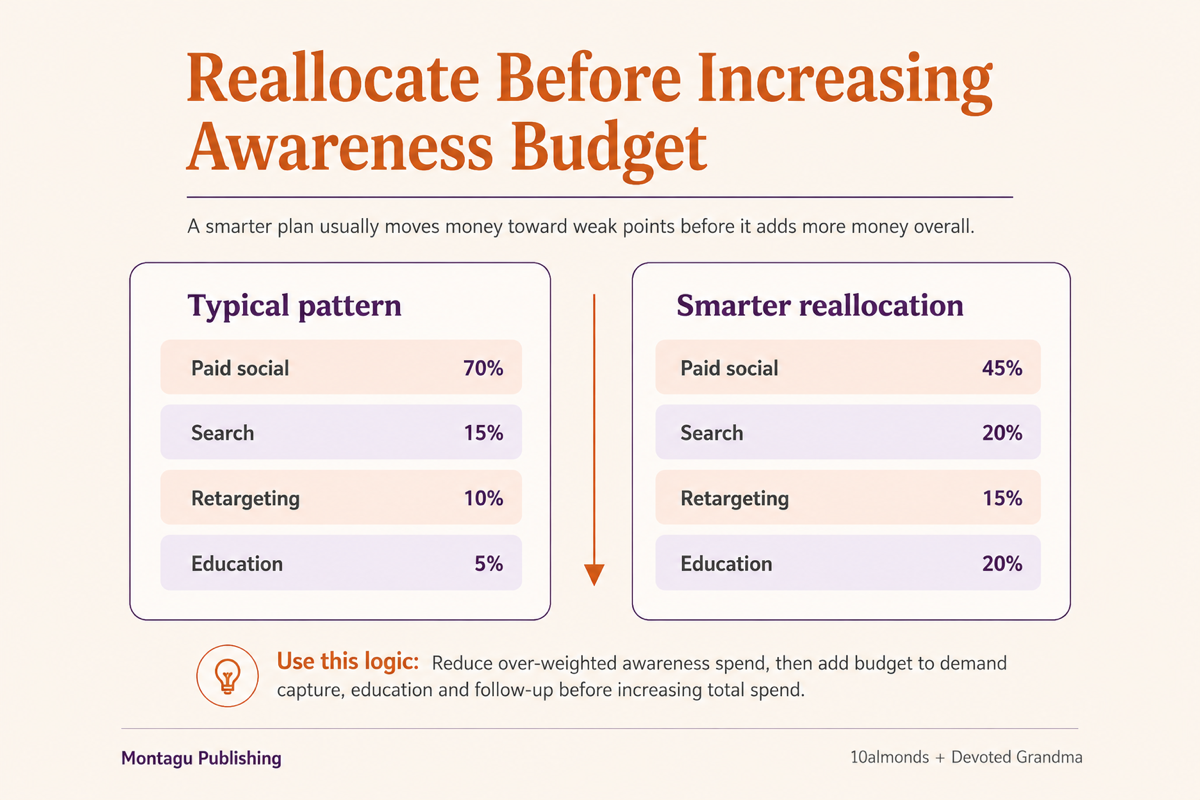
If awareness is weak, the first move should not always be adding money. A more useful exercise is to reallocate the existing budget by job — the same principle behind what is a smarter alternative to increasing your Meta budget, applied to the whole plan rather than one platform.
Ask which part of the journey is missing. If the brand is not being discovered, shift some spend towards awareness channels. If people are discovering the brand but not understanding it, invest in education. If they understand it but are not returning, strengthen retargeting. If they are ready to buy but not finding the brand, increase search.
This approach prevents a common mistake: asking one platform to carry the entire customer journey, the same mistake we flagged in how a wellness brand should spend its next $10,000 to reach women over 50. Paid social can introduce the brand, but it may not be the best place to explain a complex health topic in detail. Search can capture demand, but it cannot create demand that does not yet exist. Retargeting can bring back interest, but it cannot build the first layer of trust by itself.
A better awareness plan gives each channel one job and funds it accordingly.
What We Would Do
If we were helping a wellness brand build awareness without increasing spend, we would not begin by asking which channel to add. We would begin by auditing the existing plan.
First, we would ask whether the campaign is reaching the right audience. Second, we would check whether the message explains why the product matters, not only what the product is. Third, we would look at whether each channel has a clear job. Fourth, we would examine what happens after the first click or first read.
If the brand is targeting women over 50 with a product that needs explanation, we would likely move some budget away from broad reach and towards an education layer. That could be a sponsored article, a newsletter partnership, a useful guide or a landing page built around the questions consumers ask before buying.
Only after that layer is in place would we use paid social, search and retargeting to reinforce the message. The aim would not be to make the brand louder. It would be to make the brand easier to understand and remember.
Where Newsletter Partnerships Fit
Newsletter partnerships can help build awareness when the objective is not only to be seen, but to be understood by the right audience — the same test-before-you-commit thinking behind how brands should test newsletter sponsorships for the first time.
That is particularly relevant for products that require trust, explanation or timing. A short ad can introduce a product, but a newsletter article can explain the problem behind it. A primary newsletter placement can then reinforce the brand in an environment where readers have already chosen to spend time with content.
This is why newsletter partnerships often work best as part of a broader plan rather than as a replacement for paid media. Search captures existing demand. Paid social creates discovery. Retargeting brings back people who showed interest. Newsletter content can help build the understanding that makes those other channels more effective.
For brands targeting health-conscious women, 10almonds can support campaigns where the reader is making decisions about her own wellbeing, from sleep and nutrition to healthy ageing and preventative health. Devoted Grandma can support campaigns where the reader may also be thinking about her family, household, grandchildren, travel, safety or shared experiences.
The point is not that every awareness campaign needs a newsletter partnership. The point is that campaigns aimed at women over 50 often need more than repeated exposure. They need context.
A Mistake We Often See
A common mistake is treating awareness as a top-of-funnel metric only.
That usually leads to questions such as how many impressions did we buy, how many people saw the ad and how low was the CPM. Those questions are not useless, but they are incomplete.
A better question is whether the campaign made the right people more likely to understand, remember and revisit the brand. If the answer is no, the campaign may have created exposure, but not meaningful awareness.
This matters because many purchases, especially in wellness and family-related categories, happen later. The value of awareness is often seen in what happens next: more branded searches, better retargeting performance, stronger engagement, more qualified traffic and higher trust when the consumer finally reaches the product page.
How to Measure Awareness Without Guessing
Awareness can be hard to measure, but it should not be treated as impossible to measure.
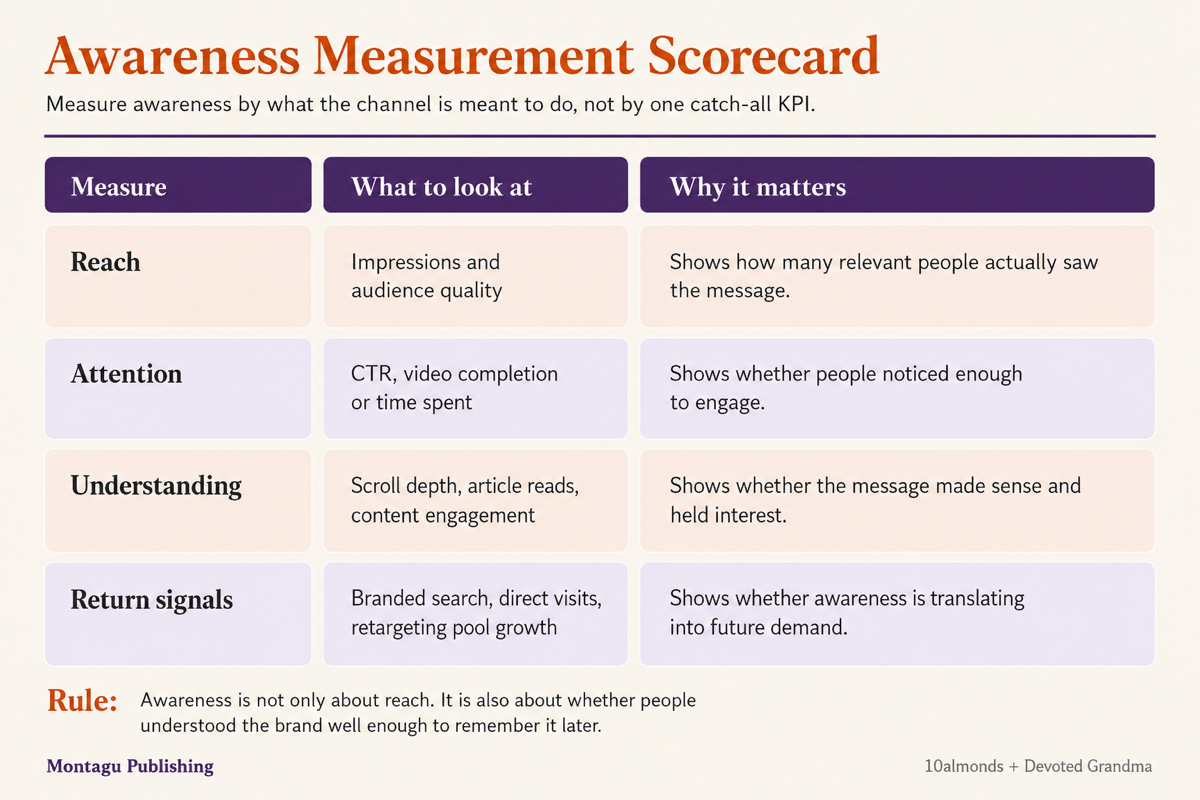
Instead of relying on one metric, look for a pattern of signals. Useful indicators include qualified website traffic, time spent with educational content, returning visitors, branded search activity, email sign-ups, product page visits and assisted conversions.
No single metric will prove everything. But together, these signals show whether awareness is doing more than creating a passing impression.
The measurement should match the job. If the channel was meant to educate, measure whether people spent time with the content. If it was meant to create discovery, measure relevant reach and click quality. If it was meant to bring people back, measure returning visitors and assisted conversions.
Five Questions to Ask Before Increasing Spend
- Are we reaching the audience most likely to care, or simply buying more reach?
- Does our message explain why the product matters before asking people to act?
- Is each channel doing one clear job?
- Do we have a follow-up plan for people who already showed interest?
- Are we measuring attention, understanding and return signals, not only impressions and clicks?
If the answer to most of these questions is no, increasing spend is unlikely to fix the problem. The existing plan needs to become sharper first.
Frequently Asked Questions
The Bottom Line
Building awareness without increasing spend is not about doing more with nothing. It is about asking whether the current budget is being used in the right way.
If a campaign is reaching the wrong people, carrying the wrong message or relying on one channel to do every job, more budget will not solve the core problem. It will only make that problem more expensive.
The stronger approach is to make the plan sharper. Define the audience more clearly. Give every channel one job. Add education where the product needs explanation. Follow up with people who already showed interest. Measure whether the right people are understanding and returning, not only whether they saw an ad once.
For brands targeting women over 50, awareness should be built around confidence, not noise. The brands that win are not always the ones that spend the most. They are often the ones that help the right people understand why they matter.
Considering a Newsletter Partnership?
If your awareness campaign needs to do more than generate impressions, a newsletter partnership may be worth testing alongside your existing paid media.
Through 10almonds and Devoted Grandma, Montagu Publishing works with brands to reach engaged female audiences through newsletter placements and brand-supported educational content.
The aim is not to replace search, social or retargeting. It is to add a trusted environment where readers can understand the topic before they are asked to consider the product.
If this approach might fit an upcoming campaign, reach out to sales@10almonds.com.