


Direct Answer
A low-risk media plan in 2026 is not a cautious plan. It is a plan that prevents the whole budget from depending on one channel, one audience assumption or one measurement method.
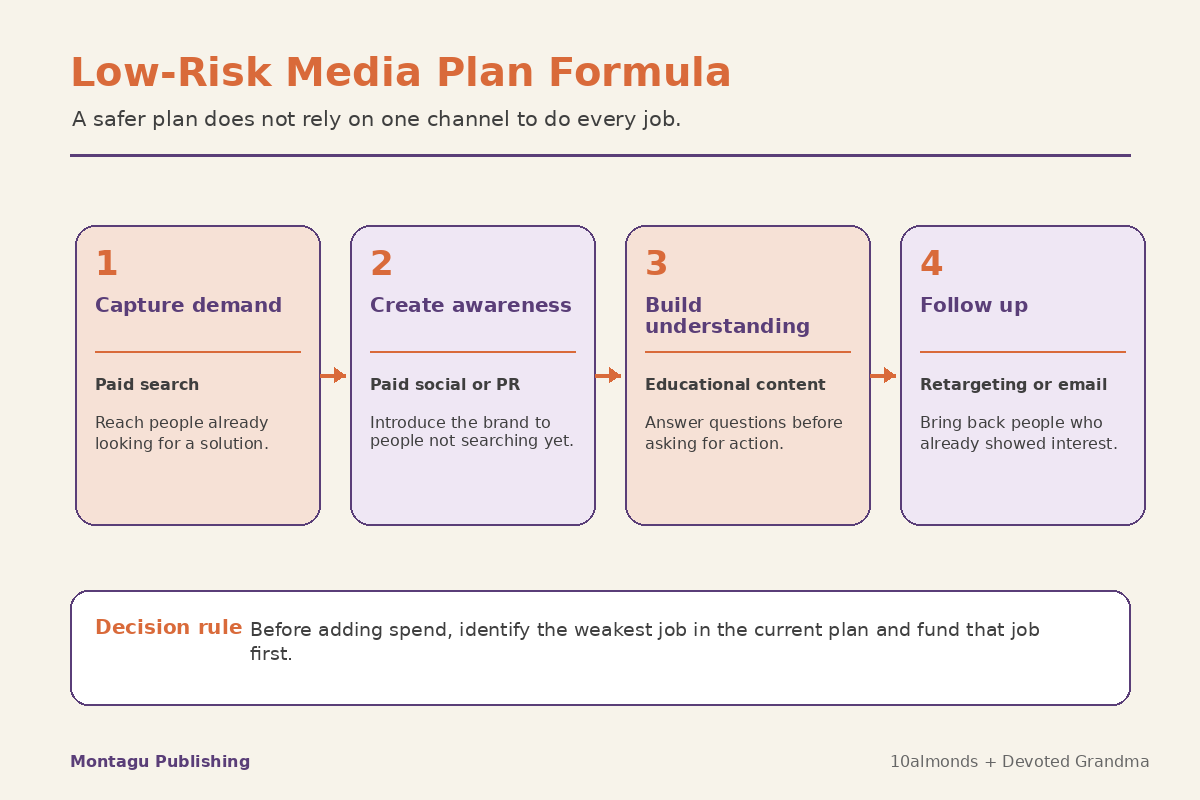
For brands with limited budgets, the safest approach is usually a balanced mix: one channel to capture existing demand, one to create awareness, one to educate consumers, and one to bring interested people back. The point is not to avoid testing. It is to test in a way that produces useful learning even if one part of the campaign underperforms.
For brands trying to reach women over 50, this matters because many buying decisions, especially in wellness, health, travel and household categories, depend on trust and understanding before conversion. A media plan that only chases cheap attention can look efficient on paper while leaving the customer unconvinced.
Quick Summary
- A low-risk media plan spreads risk across different jobs, not just different platforms.
- The main risks to manage are audience risk, message risk, channel risk and measurement risk.
- Paid search is useful for capturing demand that already exists.
- Paid social is useful for creating awareness, but should not be expected to educate deeply on its own.
- Educational content and newsletter partnerships can reduce understanding and trust risk when a product needs explanation before purchase.
- Retargeting helps bring back people who showed interest but did not act immediately.
The Planning Problem Most Marketing Managers Face
A low-risk media plan usually becomes important when pressure is rising from both sides.
Leadership wants growth. Finance wants discipline. The marketing team wants room to test, but does not want to be blamed for wasting budget on a channel that did not work.
That tension often pushes teams into one of two mistakes. Some put almost everything into the channel that feels most familiar, usually because reporting is immediate and easy to explain. Others spread a small budget so thinly across too many platforms that no channel receives enough investment to teach them anything useful.
Both approaches create risk. One makes the brand too dependent on a single platform. The other creates activity without clarity. A better plan starts by naming the risks before spending the money.
A Low-Risk Media Plan Is Not the Same as a Safe Plan
The word low-risk can sound conservative, as though the brand should avoid new channels and only spend where there is a proven history.
That is not what it should mean.
A truly low-risk plan allows the brand to test, but protects the budget from being judged by one narrow outcome. It gives each channel a clear role, defines what success looks like for that role, and creates enough learning to improve the next campaign.
In other words, low risk does not mean doing less. It means reducing avoidable uncertainty.
Start With Risk, Not Channels
Before choosing between search, social, influencers, newsletters or retargeting, ask what could go wrong with the campaign.
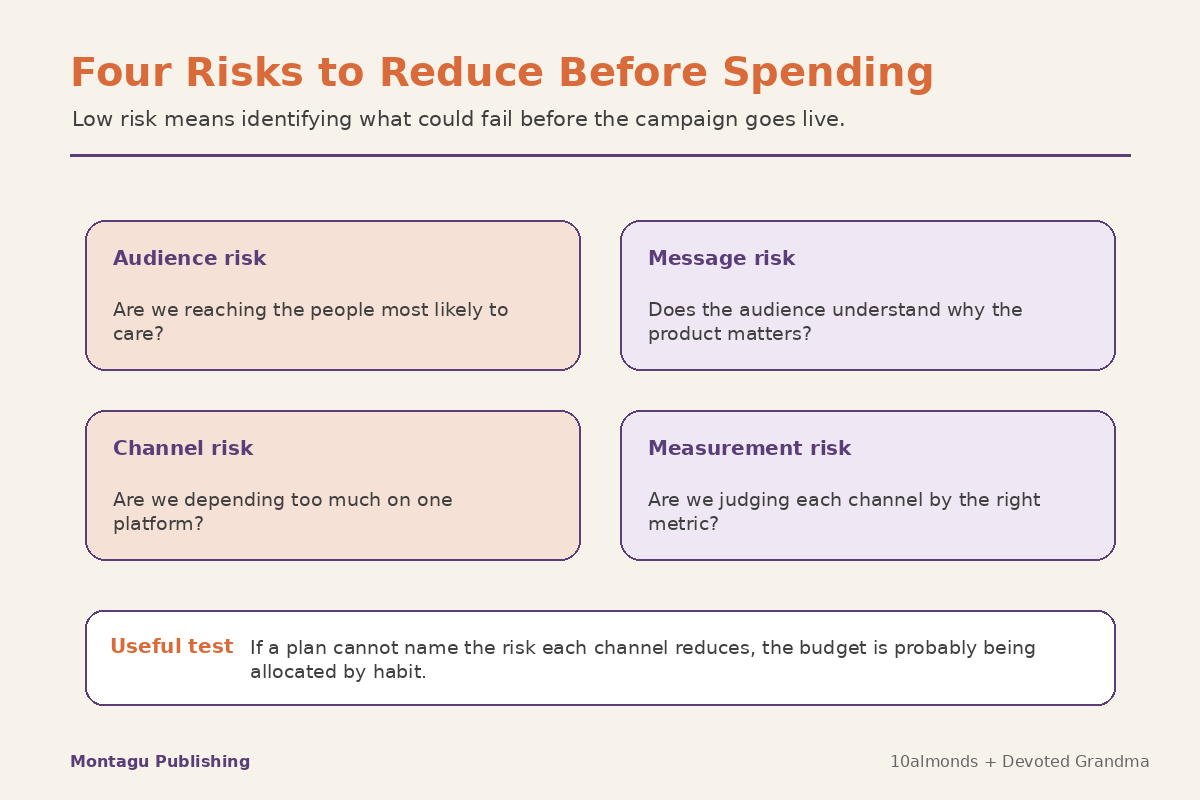
Most media plans carry four kinds of risk.
1. Audience Risk
Audience risk is the chance that your message reaches people who are technically targetable but not commercially useful.
For example, a wellness brand may be able to reach millions of women over 50 through a large social platform. That does not mean all of them are interested in sleep, mobility, nutrition or healthy ageing — the same distinction we drew in choosing the most cost-effective way to reach women over 50. Reach only matters when the audience has a reasonable chance of caring.
2. Message Risk
Message risk is the chance that the audience sees the campaign but does not understand why the product matters.
This is especially important for wellness, healthcare, financial services and travel brands. If the product requires explanation, the campaign needs space to answer questions before it asks for action.
3. Channel Risk
Channel risk is the danger of depending too heavily on one platform — the exact failure mode we walked through in where brands should invest when Meta performance starts declining.
If one channel carries most of the budget, any change in cost, targeting, creative performance or reporting can affect the entire plan. Channel diversification is not only a growth tactic. It is also a form of risk management.
4. Measurement Risk
Measurement risk is the chance that a campaign is judged by the wrong metric.
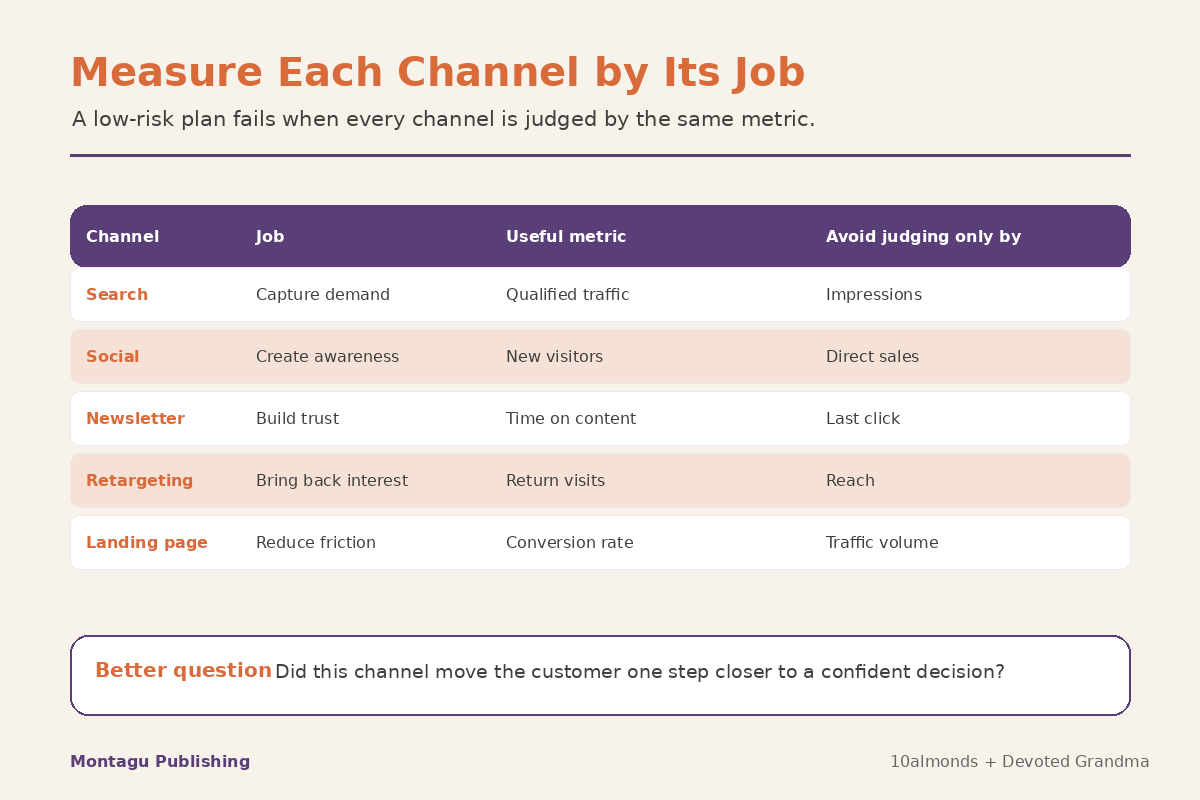
A paid search campaign can reasonably be judged by qualified traffic and conversion intent. An educational article should not be judged only by immediate sales. Its job may be to increase understanding, improve click quality, support retargeting or influence later conversion. Measuring every channel the same way often makes good channels look weak and weak channels look better than they are.
Give Every Budget Line a Job
Once the risks are clear, the media plan becomes easier to build — the same discipline that helps smaller brands compete without bigger budgets.
Instead of asking where the money should go, ask what job each part of the budget needs to do.
| Campaign job | Useful channel | Risk it reduces | How to measure it |
|---|---|---|---|
| Capture existing demand | Paid search | Demand risk | Qualified traffic, search terms, conversion intent |
| Create awareness | Paid social or PR | Reach risk | New visitors, engagement quality, audience response |
| Build understanding | Educational content or newsletters | Message and trust risk | Time on content, click quality, returning visitors |
| Follow up | Retargeting or email | Conversion timing risk | Return visits, assisted conversions, repeat engagement |
| Reduce friction | Landing page and creative improvements | Experience risk | Conversion rate, bounce rate, clarity of next step |
A Sample Low-Risk Media Plan for a $15,000 Budget
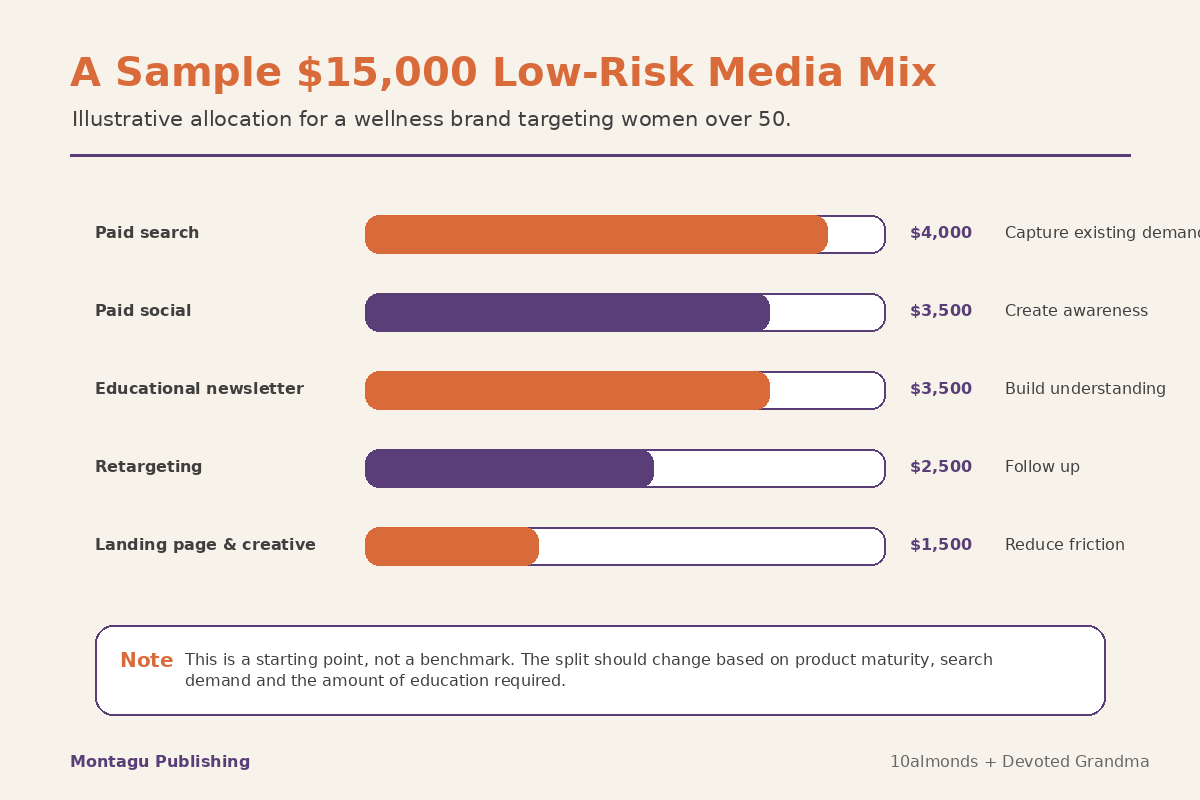
The allocation below is not a benchmark. It is an example of how a brand might structure a modest campaign when targeting women over 50 with a wellness product that needs some explanation before purchase, in the same spirit as how a wellness brand should spend its next $10,000 to reach women over 50.
The important point is not the exact split. The important point is that each line of spend has a role.
| Activity | Illustrative budget | Purpose |
|---|---|---|
| Paid search | $4,000 | Capture people already searching for the problem or product category. |
| Paid social | $3,500 | Introduce the brand to a relevant audience and test which message attracts attention. |
| Educational newsletter partnership | $3,500 | Give consumers the context they need before deciding whether the product is relevant. |
| Retargeting | $2,500 | Bring back people who engaged but were not ready to buy immediately. |
| Landing page and creative refinement | $1,500 | Improve clarity so traffic from every channel has a better chance of converting. |
When Should You Change This Split?
A low-risk plan should still be flexible. The allocation should change depending on the brand, product and market conditions.
If the Product Is Already Well Known
Increase the share going to search and retargeting. If people already understand the category and are actively looking for solutions, the campaign should focus more heavily on capturing and converting that intent.
If the Product Is New or Misunderstood
Increase the share going to education. If consumers do not yet understand why the product matters, spending too much on conversion channels too early can waste budget. The campaign first needs to make the problem and solution clear.
If the Brand Has Strong Awareness but Weak Conversion
Invest in landing page clarity, retargeting and proof points. More reach may not solve the problem if the existing traffic is not being given enough confidence to take the next step.
If One Platform Currently Owns Most of the Budget
Move a small but meaningful portion into a second and third channel for 60 to 90 days — the same test window discussed in what is a smarter alternative to increasing your Meta budget. The goal is not to abandon the main channel. The goal is to find out whether the plan can perform without depending on one source of traffic.
What We Would Do
If we were planning a campaign for a healthy ageing brand with a limited budget, we would not start by asking how to get the cheapest clicks. We would start by asking where the customer is most likely to hesitate.
If the hesitation is awareness, we would use paid social or PR to introduce the brand. If the hesitation is understanding, we would use educational content or a newsletter partnership to explain the topic properly. If the hesitation is trust, we would look for environments where the reader already expects practical guidance. If the hesitation is timing, we would use retargeting to bring interested people back once they have had time to consider the decision.
That is what makes a plan lower risk. It does not assume one message, one platform or one interaction will do all the work.
Where Newsletter Partnerships Fit
Newsletter partnerships are not the lowest-risk choice for every campaign. They are not ideal when a brand needs fast nationwide reach in a few days or when the product is already widely understood and the goal is simply to capture existing demand — the same nuance covered when deciding how brands should test newsletter sponsorships for the first time.
They become more useful when the campaign needs to reduce message risk and trust risk. This is particularly true for products that require explanation before purchase, such as supplements, healthy ageing products, skincare, preventative health, financial planning, travel and household decision categories.
A trusted newsletter environment gives a brand space to answer the questions a consumer might ask before visiting the product page. The immediate click still matters, but it is not the whole value. The placement can also improve understanding, support retargeting and make later interactions feel more familiar.
Where 10almonds and Devoted Grandma Fit
10almonds and Devoted Grandma should not be treated as interchangeable newsletters. They support different campaign objectives.
10almonds is best suited to brands that want to reach women making decisions about their own health and wellbeing. It is a natural fit for campaigns around nutrition, supplements, sleep, mobility, brain health, gut health, heart health, menopause support, skincare and healthy ageing.
Devoted Grandma is better suited to campaigns where the reader is making decisions for herself and often for her family or household. That can include family travel, financial services, home safety, gifts, shared experiences, household products and health products with broader family relevance.
For a low-risk media plan, the question is not which publication is bigger. The question is which reader context is more relevant to the decision your customer is making.
A Mistake We Often See
A common mistake is calling a campaign low risk simply because it uses familiar channels.
Familiar does not always mean safer. If one familiar platform carries most of the spend, the plan may actually be more fragile than it looks. A more resilient plan usually has fewer assumptions built into it. It does not assume that one audience will respond, one platform will stay efficient, one message will be enough or one metric will explain the whole customer journey.
The safer plan is the one that gives the brand more ways to learn and fewer ways to be surprised.
Five Questions to Ask Before Approving a Low-Risk Media Plan
- What is the weakest part of our current customer journey?
- Which channel is being used to fix that weakness?
- Are we asking any channel to do more than it is built to do?
- Have we defined success differently for awareness, education, retargeting and conversion?
- Will this plan teach us enough to make the next campaign better?
Frequently Asked Questions
The Bottom Line
A low-risk media plan in 2026 is not about avoiding new channels or keeping every dollar in familiar places.
It is about building a plan that does not collapse if one assumption is wrong. The audience might need more education than expected. A social campaign might create awareness but not immediate conversion. Search might capture demand but fail to build trust. A newsletter partnership might attract fewer clicks than a broad platform but produce more considered visitors.
None of those outcomes is automatically good or bad. They only become useful when each channel has a clear job and a fair way to measure success.
The better question is not how to remove all risk from the media plan. That is impossible. The better question is how to make sure the money spent produces either a result or a useful lesson. That is what gives a marketing manager more control over the next decision.
Considering a Newsletter Partnership?
If your campaign needs to educate women over 50 before asking them to buy, a newsletter partnership may be worth testing alongside your existing paid channels.
Through 10almonds and Devoted Grandma, Montagu Publishing works with brands on newsletter placements and brand-supported educational content designed to reach readers in moments when they are actively reading, learning and comparing options.
If this approach might fit an upcoming campaign, reach out to sales@10almonds.com.