


Direct Answer
Brands build familiarity without annoying consumers by making each exposure useful. Repetition becomes irritating when the same sales message follows people around without adding anything new. It becomes valuable when each touchpoint helps the consumer understand the problem, compare options or take the next sensible step.
For a marketing manager with a limited budget, the aim should not be to appear everywhere. The aim should be to appear in the right sequence, with enough context, and with a message that earns its place each time it shows up.
That is where community-based marketing can help. A trusted reader community gives the brand a more natural setting for education, familiarity and follow-up than a campaign built only around repeated ads.
Quick Summary
- Familiarity is not built by frequency alone. It is built by repeated relevance.
- The same message repeated too often can feel like pressure rather than trust.
- Each exposure should have a different job: notice, explain, prove, remind or convert.
- Newsletter sponsorships and sponsored content can help brands add context between short-form ads and direct response.
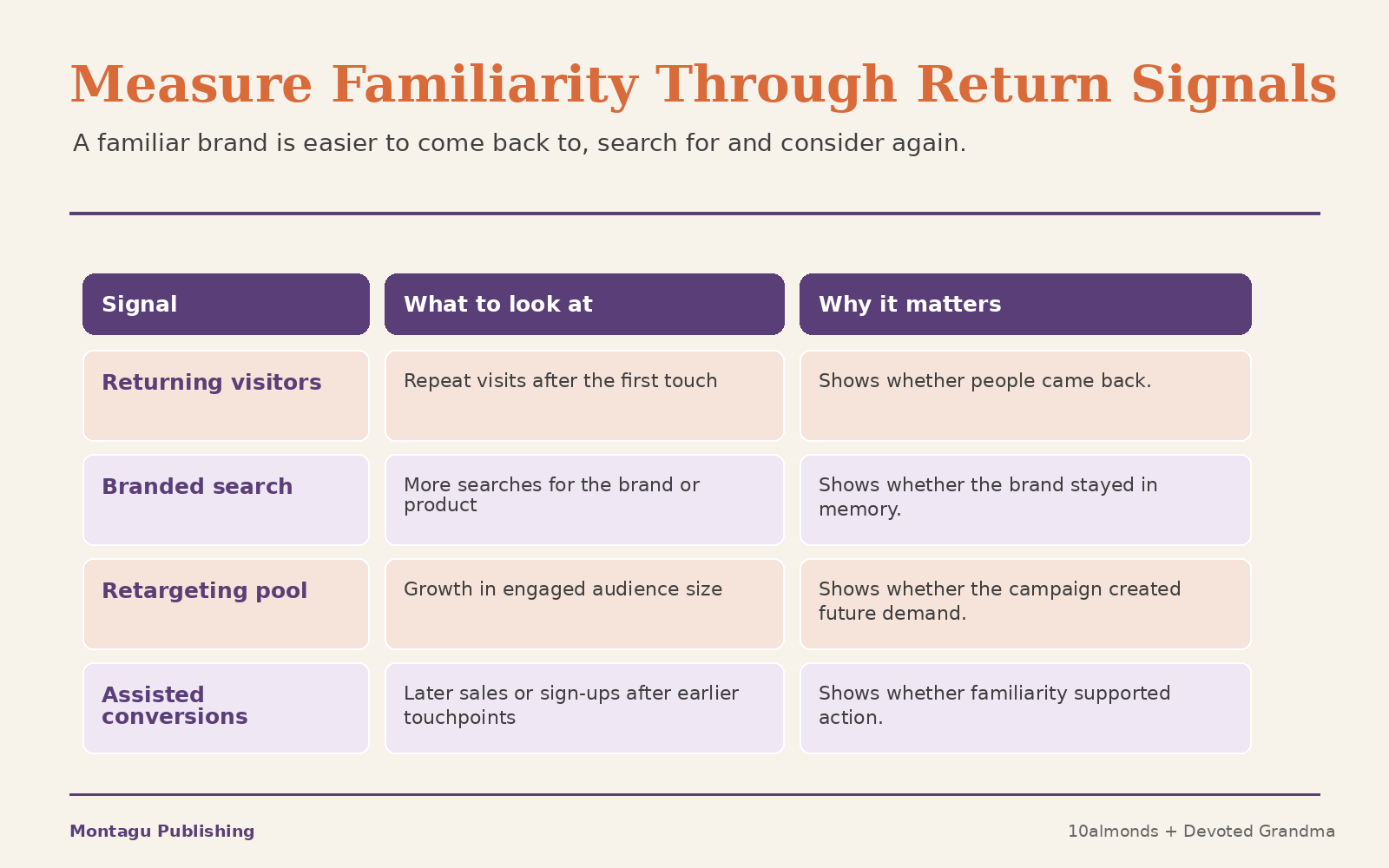
- Measure familiarity by return behaviour, branded search, repeat visits and stronger conversion quality, not only by impressions.
Why Familiarity Matters
Many purchases do not happen the first time someone sees a brand. This is especially true when the product is new, health-adjacent, higher priced or linked to a personal decision.
The consumer may need to notice the brand, understand the problem, compare the claim, discuss it with someone else or come back later. That process takes time.
The mistake is assuming that more impressions automatically solve the problem. They can help, but only when the message is still useful. If the consumer keeps seeing the same unexplained claim, the campaign may be creating irritation rather than confidence.
The Difference Between Familiarity and Fatigue
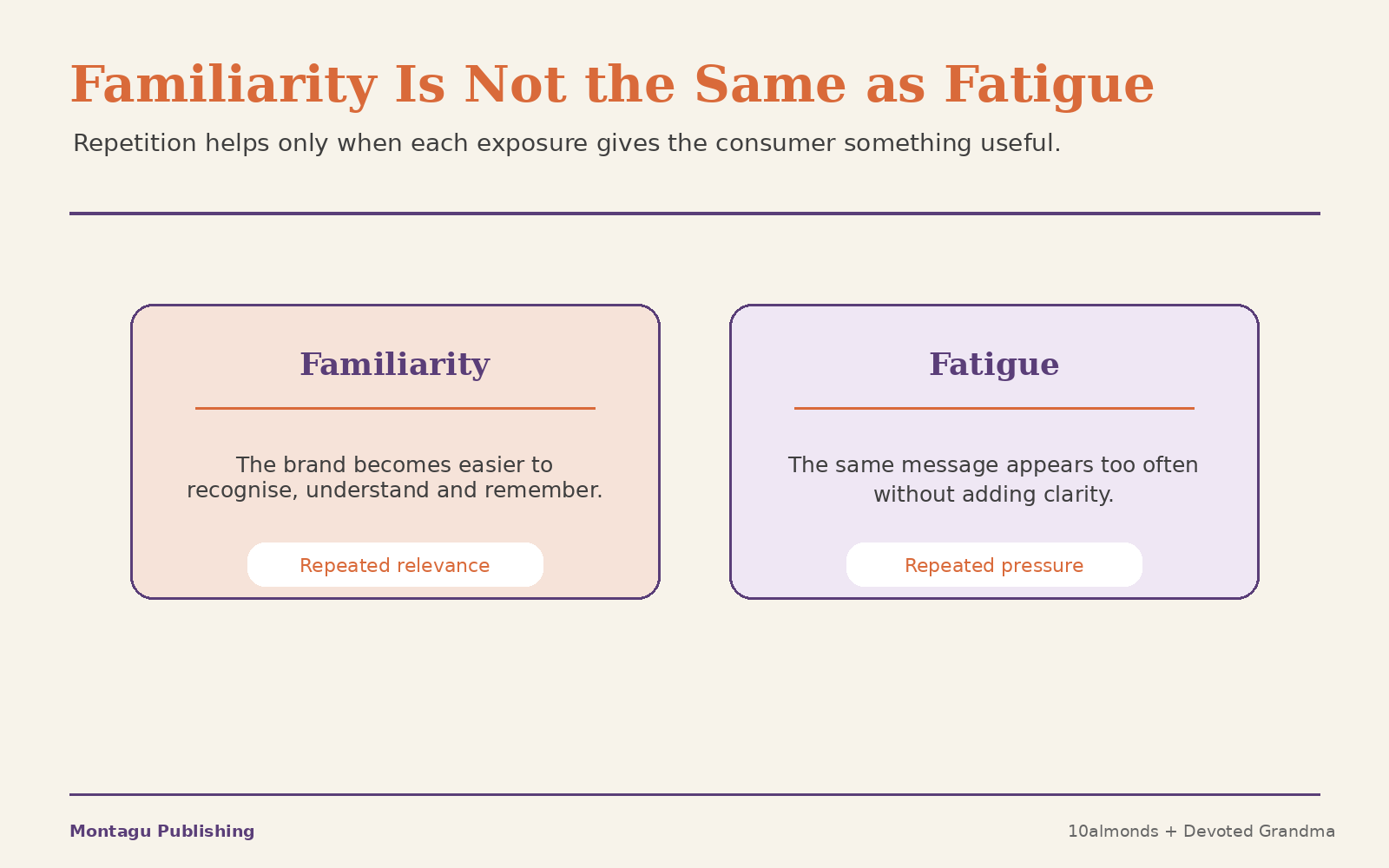
Familiarity means the consumer recognises the brand and has some useful understanding of what it stands for, what problem it solves and why it may be relevant.
Fatigue means the consumer has seen the message too often without learning anything new. At that point, the campaign is not building trust. It is adding noise.
The line between the two is not only frequency. It is whether each touchpoint gives the consumer a reason to keep paying attention.
Give Every Exposure a Job
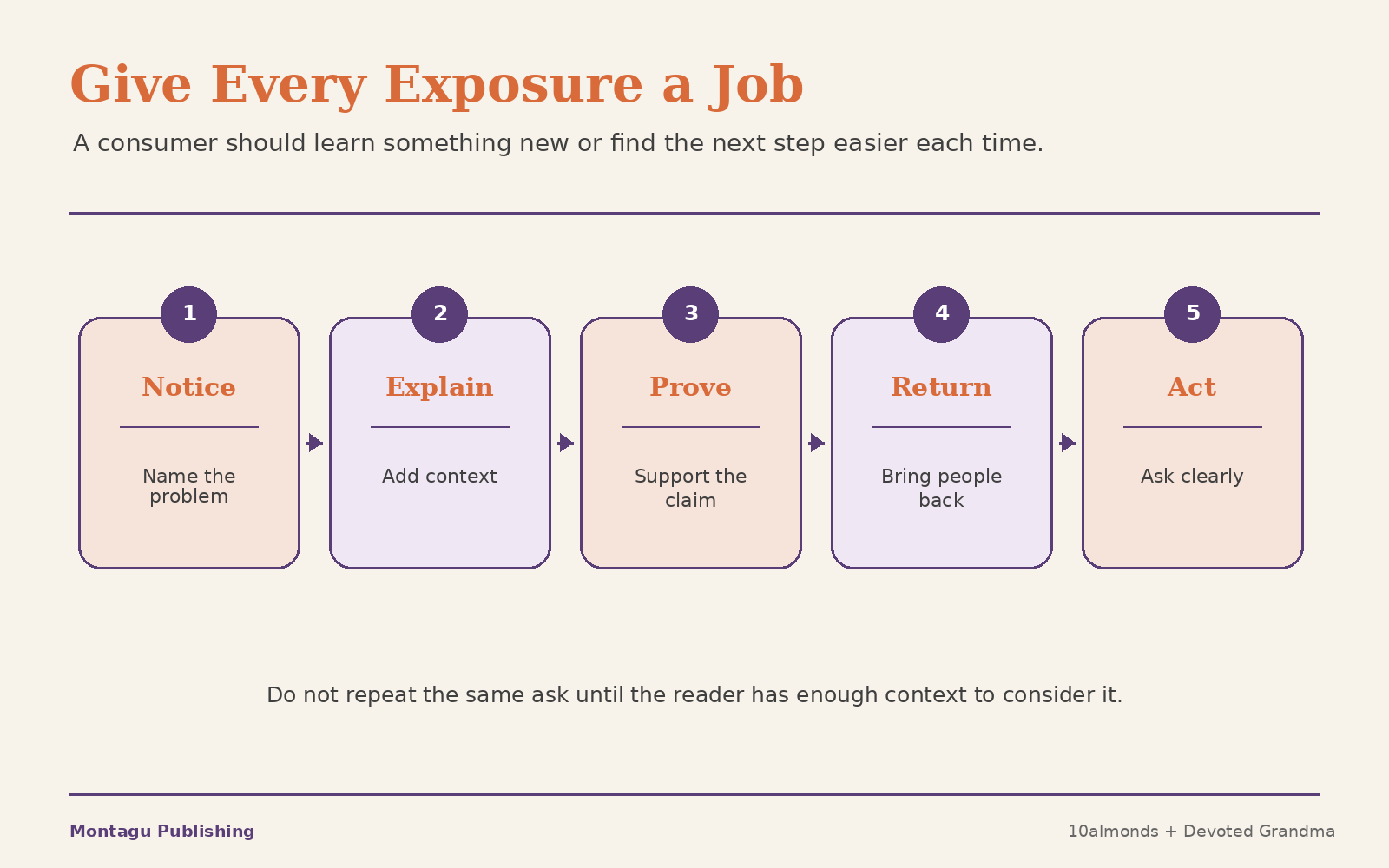
A stronger sequence gives each touchpoint a different role.
| Touchpoint | Job | Example message role |
|---|---|---|
| First exposure | Create notice | Name the problem in plain language. |
| Second exposure | Add context | Explain why the problem matters and who it affects. |
| Third exposure | Build confidence | Provide evidence, examples or clear product fit. |
| Fourth exposure | Bring people back | Use retargeting, email or search to help interested people return. |
| Final step | Ask for action | Give one clear next step that matches readiness. |
Where Ads Often Fall Short
Paid ads are useful when the job is to create notice or bring someone back. They are less effective when the consumer needs a fuller explanation before the product feels relevant.
That does not make ads weak. It means ads should not carry the entire education job alone.
A short ad can introduce a problem. A newsletter article or sponsored educational placement can explain it. Retargeting can then return people to the product once the idea makes sense.
The Community-Based Marketing Lens
Community-based marketing changes the starting point. Instead of asking how many times a brand can follow a consumer, it asks where the brand can show up in a way that feels useful to a reader community.
In a trusted newsletter environment, the brand has more room to explain, answer questions and become familiar through relevance rather than repetition alone.
That is particularly useful for smaller brands because they may not have the budget to buy constant exposure across every platform. They need each exposure to carry more meaning.
How to Build Familiarity on a Tight Budget
- Start with one audience problem rather than a broad brand claim.
- Use one educational asset to explain the problem properly.
- Support that asset with a primary newsletter placement or direct ad placement where the audience fit is strong.
- Retarget people who engaged instead of paying to reach cold audiences again.
- Review whether repeat visitors behave better than first-time visitors before deciding whether to renew.
A Practical Familiarity Sequence
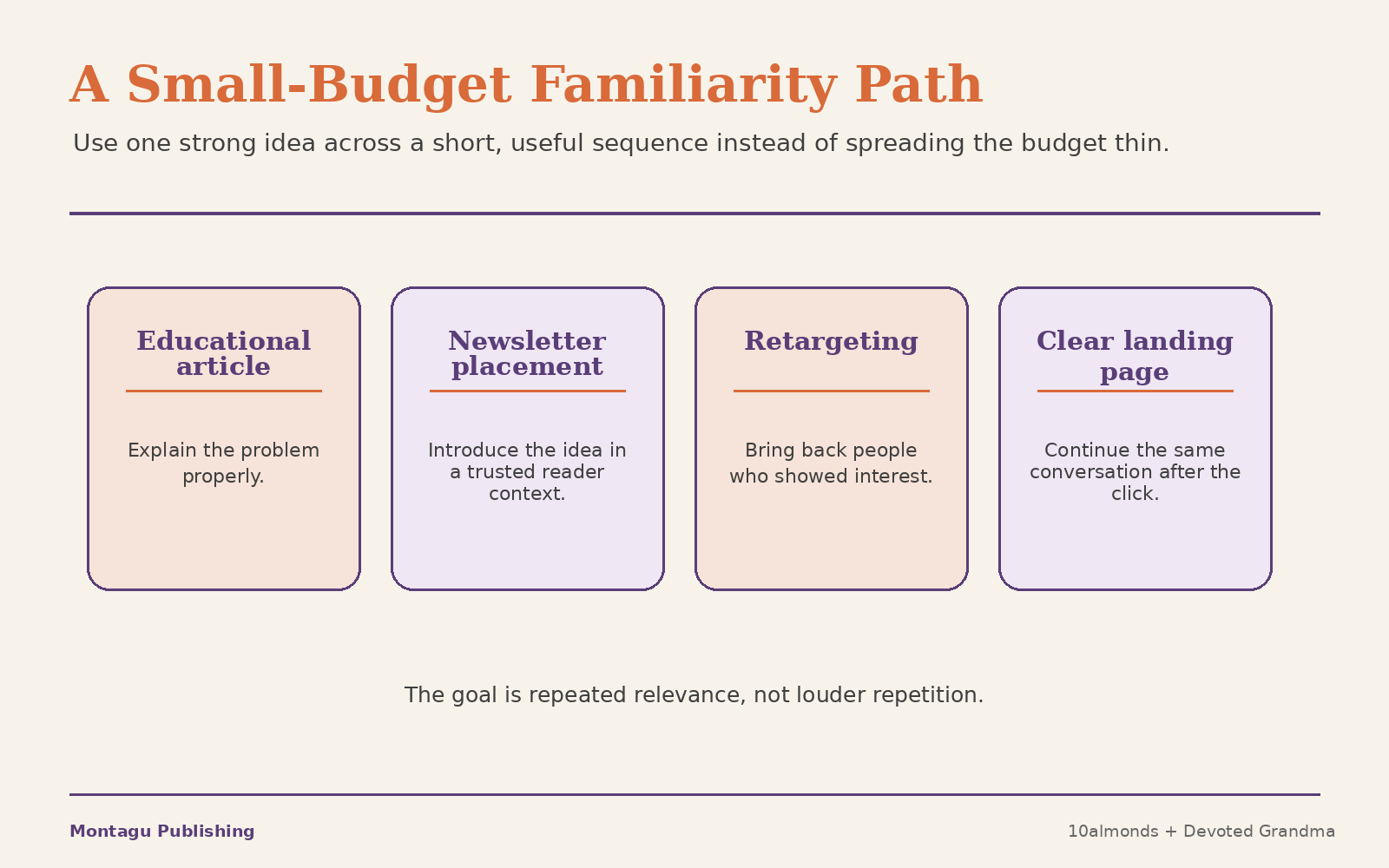
Familiarity works best when a reader can see a clear progression. The first exposure can name a problem. The next can explain why it matters. A later placement can show supporting information or a product detail. Only then may a direct ask make sense for readers who have enough context.
This does not require a long campaign or a large number of placements. It requires each exposure to have a different job. Repeating the same headline, image and request gives the reader little reason to pay attention again. Giving each exposure one useful purpose makes repetition easier to justify.
A team can plan this sequence before the first send. Write down what the reader should understand after each step, where she should go next and what result will be reviewed. That makes it easier to see whether the campaign is building familiarity or simply adding more pressure.
What We Would Do
If we were helping a smaller wellness brand build familiarity with women over 50, we would avoid launching with five unrelated messages across five channels.
We would choose one reader problem, such as sleep quality, mobility, energy or healthy ageing. Then we would build a short sequence around it: one educational piece, one direct placement, one retargeting path and one landing page that brings interested readers back.
The purpose would be to make the brand easier to understand each time the reader sees it, not simply more visible.
Where 10almonds and Devoted Grandma Fit
10almonds can help brands build familiarity around health, wellbeing and evidence-informed lifestyle decisions. Devoted Grandma can help brands build familiarity in family, household, gifting and intergenerational decision contexts.
In both cases, the value is not only the send. It is the reader environment. A message that would feel cold in an ad feed can feel more natural when it answers a question the reader already cares about.
Frequently Asked Questions
The Bottom Line
Brand familiarity is not the result of showing up more often with the same message. It is the result of showing up with relevance often enough for the consumer to understand and remember the brand.
For marketers with tight budgets, this matters. A thoughtful sequence can do more than a larger spend that repeats the wrong message in the wrong place.
The goal is not to chase consumers around the internet. It is to become familiar in the moments where they are already open to learning. Brands can then get more value from sponsored content after it runs.
Planning a Familiarity-Building Campaign?
Montagu Publishing helps brands reach engaged female reader communities through newsletter placements and sponsored educational content.
For campaigns that need more than a quick impression, the opportunity is to build familiarity through useful context, repeated relevance and a reader environment that already has attention. For newsletter placements or sponsored educational content, email sales@10almonds.com.