


Direct Answer
A smarter alternative to increasing Meta budget is not simply moving the money to another platform. It is first finding out what Meta is no longer doing well for the campaign.
If Meta is still creating qualified awareness, it may deserve a place in the plan. But if performance is declining because consumers need more information, the landing page is weak, the audience has seen the same message too often or the brand is not yet trusted, adding more spend will only scale the same problem.
In many cases, the better move is to split the next layer of budget across demand capture, retargeting, educational content and conversion improvements before increasing Meta spend again.
Quick Summary
- Do not increase Meta budget until you know why performance has slowed.
- If the problem is demand, test paid search.
- If the problem is trust or explanation, test educational content or newsletter partnerships.
- If the problem is conversion, fix the landing page before buying more traffic.
- If the problem is repeated exposure, refresh creative before increasing spend.
- The best alternative to increasing Meta budget is usually a better-balanced media plan, not a complete move away from Meta.
The Real Question Is Not Whether Meta Still Works
Most marketing teams do not question Meta when performance is strong. The question usually appears when costs rise, conversion rates soften or the same campaign stops producing the results it once did.
At that point, the instinct is often to make one of two moves: spend more to regain volume or cut Meta entirely and look for the next channel. Both can be too blunt — a pattern we walked through in more detail in where brands should invest when Meta performance starts declining.
A weaker Meta result does not automatically mean Meta has stopped working. It may mean the campaign has reached the limit of what Meta can do on its own. That distinction matters because it changes the next decision.
Before increasing spend, ask whether the campaign needs more reach or whether it needs more trust, more education, better retargeting or a clearer conversion path.
Why Increasing Meta Spend Can Make the Problem Worse
Increasing spend usually makes sense only when the campaign is already healthy. If the audience is right, the creative is fresh, the landing page converts and the offer is understood, adding budget may help scale what is already working.
The problem comes when marketers use extra spend to compensate for weaknesses elsewhere. More traffic will not fix unclear messaging. More impressions will not make a complex product easier to understand. A larger audience will not solve a trust problem.
For wellness, healthcare, financial services and products aimed at women over 50, this matters even more. These audiences often need context before they act. If the product requires explanation, Meta can introduce the brand, but it may not be the best place to carry the full burden of education.
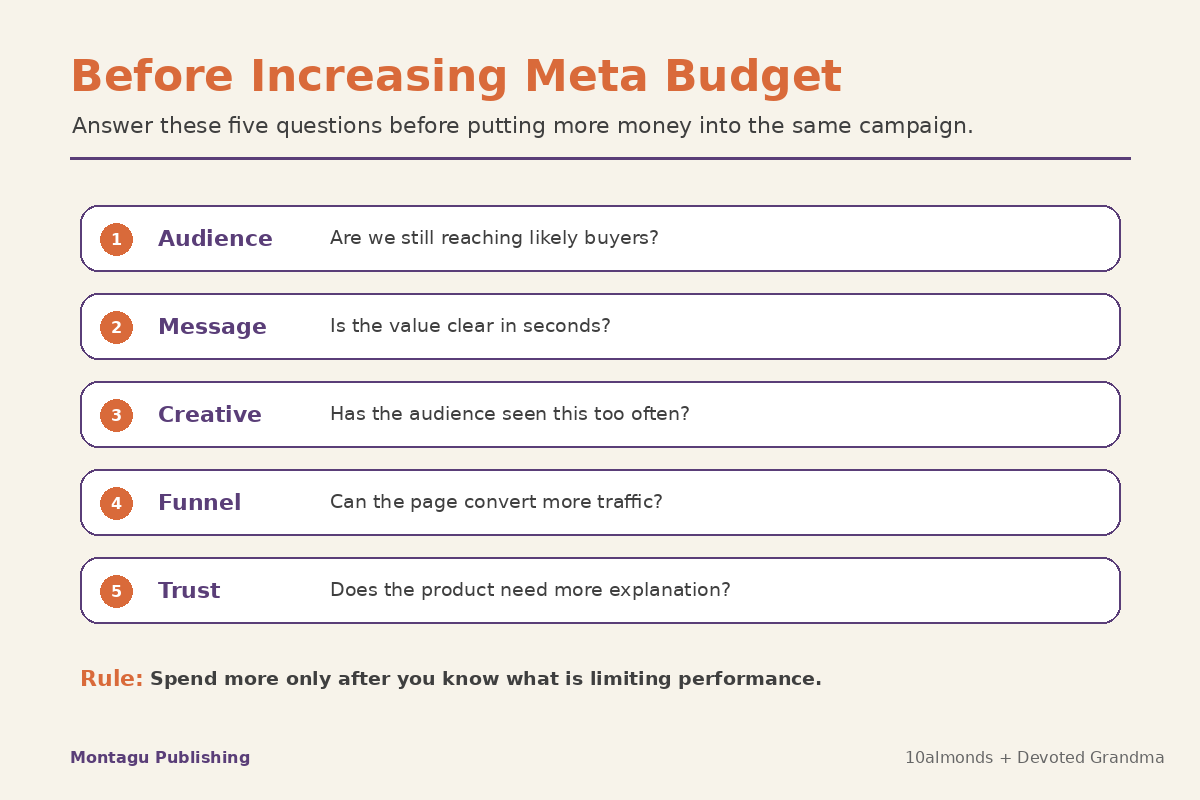
Five Questions to Ask Before Increasing Meta Budget
Before approving extra spend, answer these questions honestly.
- Is Meta still reaching the right people?
- Is the creative still doing its job?
- Is the landing page strong enough?
- Does the product need more education?
- Are you measuring the right outcome?
Question 1: Is Meta Still Reaching the Right People?
A campaign can look active while gradually reaching less useful audiences. If impressions remain high but qualified clicks, return visits or conversions decline, the issue may not be budget. It may be audience quality.
Before increasing spend, review whether the people clicking are behaving like potential customers. Look at time on site, product page visits, email sign-ups, returning visitors and assisted conversions. Cheap reach is not useful if the audience is not moving closer to purchase.
Question 2: Is the Creative Still Doing Its Job?
Creative fatigue is one of the most common reasons paid social performance declines. The audience may not be wrong. The message may simply be worn out.
If click-through rate has fallen while landing page conversion remains broadly stable, refresh the creative before increasing spend. New angles, clearer benefits, stronger proof points and different formats may recover performance without changing the budget.
Question 3: Is the Landing Page Strong Enough?
If people click but do not stay, the issue may sit after the advertisement. A weak landing page can make every channel look worse than it is.
For products that need explanation, the landing page should answer the buyer’s immediate questions: what is this, who is it for, why does it matter, what proof supports it and what should I do next? If those answers are missing, increasing Meta budget simply buys more exits.
Question 4: Does the Product Need More Education?
Some products can be understood in seconds. Others cannot. A magnesium supplement, menopause support product, skincare active, financial planning service or healthy ageing offer may require more explanation before the buyer feels comfortable taking action.
If the product depends on understanding, do not expect a short social ad to do all of the work. Use Meta to introduce the idea, then support it with a channel that gives the audience time to learn.
Question 5: Are You Measuring the Right Outcome?
Meta often gets judged by immediate conversions because the reporting is close at hand. That can be useful, but it can also narrow the decision too much.
If Meta is creating awareness but not closing the sale, the answer may not be to abandon it. The answer may be to add the missing layer that helps consumers move from awareness to confidence.
A Smarter Alternative: Add the Missing Layer
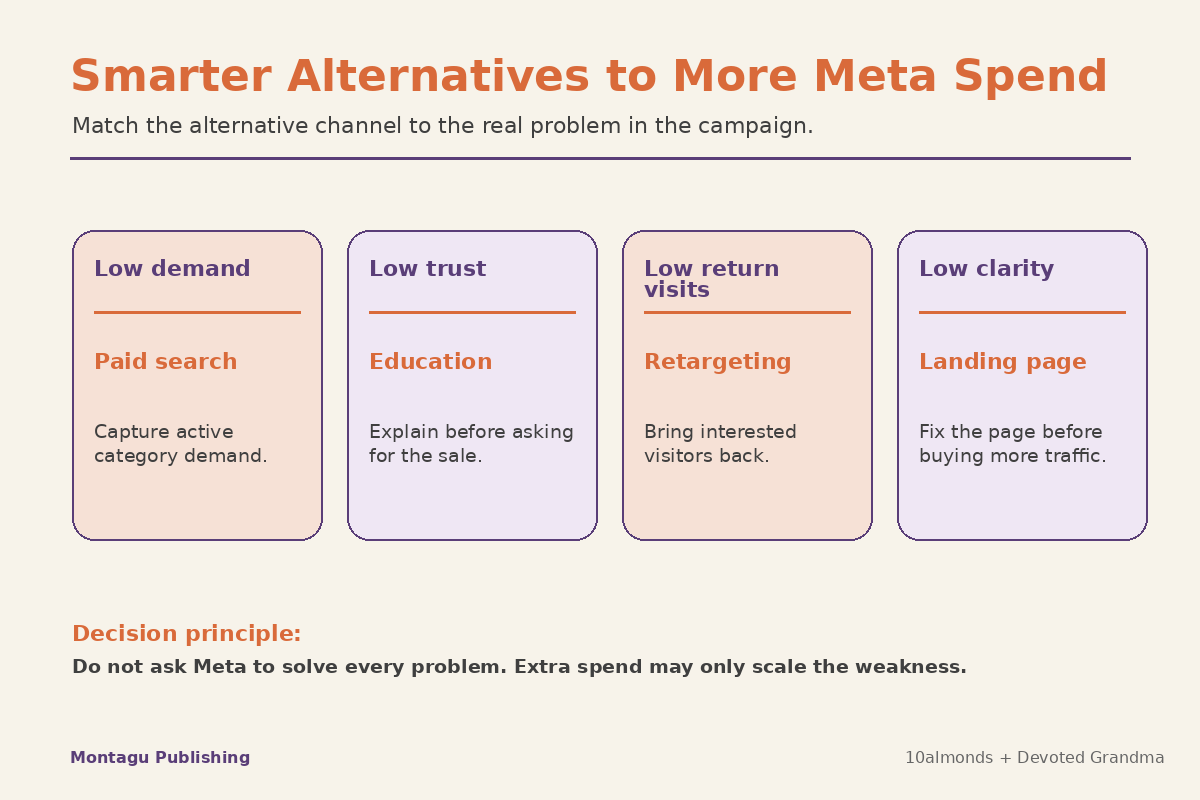
The best alternative to increasing Meta budget depends on what is missing from the campaign. More money should not be the default response. A better next step is to identify the weakest part of the customer journey and invest there first.
If the Problem Is Demand, Invest in Search
When people are already searching for the category, paid search can capture demand that exists today. This is especially useful for established product types where consumers already know what to look for.
Search is less useful when the product is new or unfamiliar. If people do not know the category exists, they are unlikely to search for it by name.
If the Problem Is Trust, Invest in Education
When consumers hesitate because they do not fully understand the product, educational content can help. This is particularly relevant for wellness brands, where buyers often want to understand ingredients, safety, expected benefits and whether the product is right for them.
Educational content works because it answers questions before asking for the sale. It gives the brand a role in the research process rather than appearing only at the point of promotion.
If the Problem Is Return Visits, Invest in Retargeting
Some visitors are interested but not ready. Retargeting allows the brand to reconnect with people who have already shown intent, rather than spending the entire budget on new audiences.
This is often more efficient than adding more cold traffic, especially when the product has a longer decision cycle.
If the Problem Is Conversion, Fix the Page First
Before spending more on any channel, check whether the website is converting the traffic it already receives — the same principle behind choosing the most cost-effective way to reach women over 50. A clearer landing page, stronger proof, better product explanation or simpler next step can improve performance across every channel.
If the page is not ready, increasing Meta spend does not create growth. It creates waste faster.
Where Newsletter Partnerships Fit
Newsletter partnerships become useful when the missing layer is understanding and trust. They are not a replacement for Meta, search or retargeting. They do a different job.
Meta can introduce the brand. Search can capture demand. Retargeting can bring people back. Newsletter partnerships can give the audience time to understand the topic in a setting where they have chosen to read.
For brands targeting women over 50, this can be especially valuable. A reader considering a health, wellness, household, travel or financial product may want more than a short advertisement before she acts. She may need context, reassurance and a reason to believe the brand understands her needs.
Where 10almonds and Devoted Grandma Fit
At Montagu Publishing, 10almonds and Devoted Grandma are useful for brands that need to educate and build trust with older female audiences in the United States.
10almonds is best suited to brands focused on the reader’s own health and wellbeing, including supplements, healthy ageing, sleep, nutrition, gut health, mobility, skincare, menopause support and preventative wellness.
Devoted Grandma is better suited to products and services connected to family life, household decisions, travel, gifts, financial planning, home safety and lifestyle choices that may affect more than one generation.
The important point is not that either publication should replace Meta. They are more valuable when they strengthen the part of the media plan Meta cannot carry alone: deeper explanation and trust.
A Practical Example
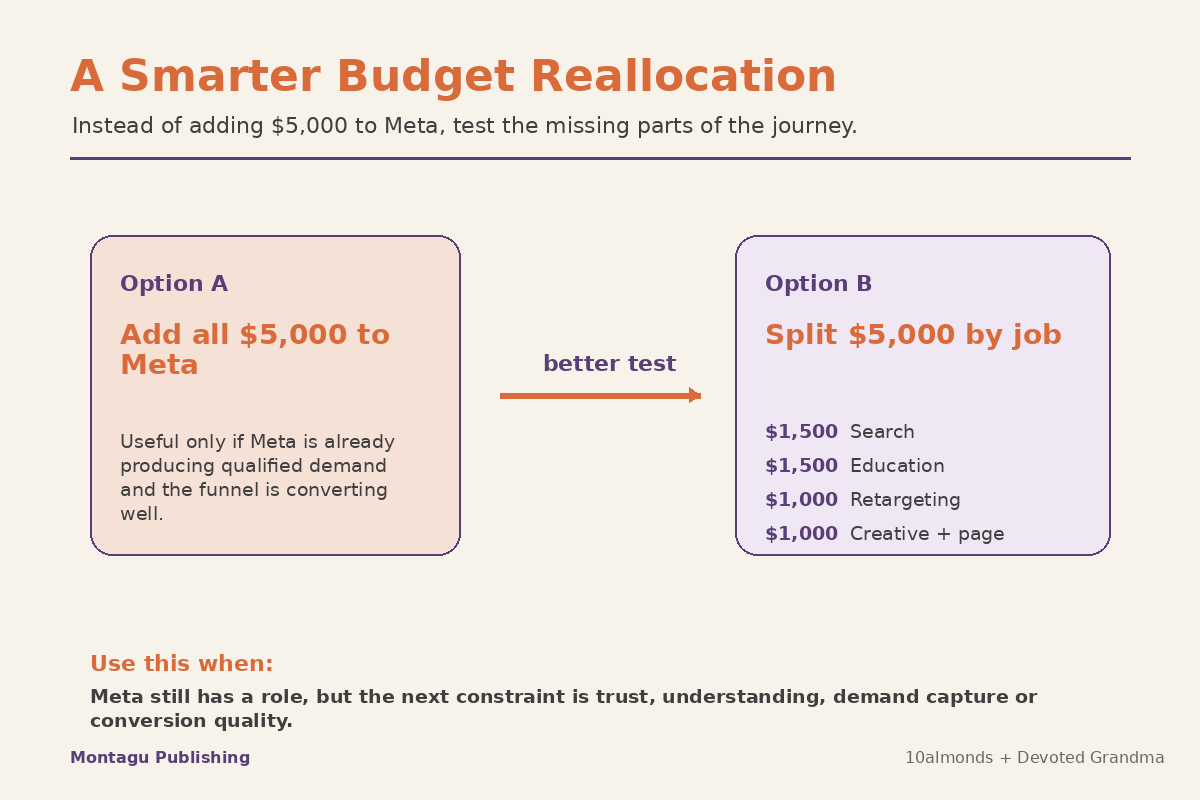
Imagine a wellness brand has an extra $5,000 available after a Meta campaign starts to flatten — not unlike the budget-allocation exercise in how a wellness brand should spend its next $10,000 to reach women over 50. One option is to add all of that money to Meta and hope the platform finds more of the same audience. Another option is to split the money by job.
A Smarter $5,000 Test
| Budget | Investment | Purpose |
|---|---|---|
| $1,500 | Paid search | Capture people already looking for the category |
| $1,500 | Educational content or newsletter partnership | Build understanding and trust around the product |
| $1,000 | Retargeting | Bring interested visitors back after they have had time to consider |
| $1,000 | Creative and landing page improvement | Improve the quality of the existing funnel before scaling |
This test does not remove Meta from the plan. It reduces the risk of asking Meta to solve every part of the customer journey alone.
What We Would Do
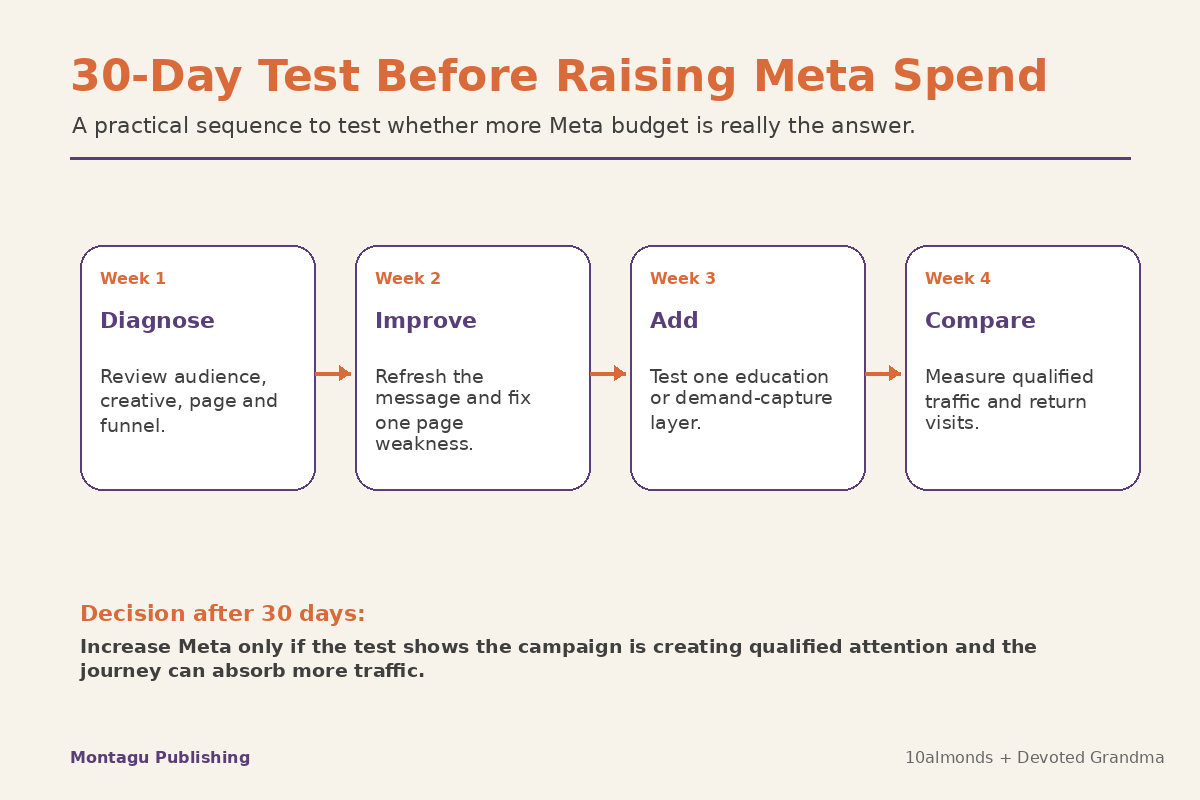
If we were advising a wellness brand in this position, we would not increase Meta budget immediately. We would first diagnose the constraint.
If Meta is still bringing in qualified visitors but those visitors are not buying, we would examine the landing page and retargeting sequence before adding spend. If the product is difficult to understand, we would add an education layer and use paid media to reinforce it. If demand already exists, we would test search alongside Meta rather than asking Meta to carry the full plan.
Only after those changes would we consider increasing Meta budget again. At that point, the campaign would have a stronger foundation and more traffic would have a better chance of turning into useful demand.
The Mistake We Often See
The mistake is treating a declining Meta campaign as a media buying problem when it is often a customer journey problem.
If the buyer does not understand the product, more impressions will not help. If the landing page does not answer the right questions, more clicks will not help. If the brand has not earned trust, more reach will not help.
More budget is only useful when the journey is ready to absorb it.
Frequently Asked Questions
The Bottom Line
The smartest alternative to increasing Meta budget is not always another platform. It is a clearer understanding of what your campaign is missing.
If the issue is awareness, Meta may still be useful. If the issue is demand, search may be the better next test. If the issue is trust, educational content and newsletter partnerships may add what paid social cannot. If the issue is conversion, the landing page should be fixed before any new budget is added.
The better question is not whether to spend more on Meta. It is whether more Meta spend would solve the real problem. If the answer is no, invest first in the part of the journey that gives buyers enough understanding, confidence and reason to act.
Considering a Newsletter Partnership?
If your next campaign needs to educate women over 50 before asking them to buy, a newsletter partnership may be worth testing alongside your existing paid media.
Through 10almonds and Devoted Grandma, Montagu Publishing works with brands to combine primary newsletter placements with brand-supported educational content, helping readers understand a topic before they consider a product.
If this approach might fit an upcoming campaign, reach out to sales@10almonds.com.