


Direct Answer
There is no single best marketing channel for reaching women over 50. The most cost-effective approach depends on what you are trying to achieve.
If your goal is to capture people who are already looking for a solution, paid search is difficult to beat. If you are launching a new product or entering a new category, paid social can introduce your brand to people who have never heard of it. If your product requires explanation before purchase, trusted publisher partnerships often become far more valuable because they give consumers the time and context to understand why your product matters.
The strongest campaigns rarely rely on one channel alone. They use each channel for the job it does best.
Quick Summary
- Cost-effective marketing is not about choosing the cheapest channel. It is about choosing the right channel for the job.
- Women over 50 rarely make wellness purchases on impulse. They research, compare and build confidence before buying.
- Paid search, paid social, influencer marketing, newsletter partnerships and retargeting each play different roles within a campaign.
- Measuring every channel by immediate conversions often leads to poor investment decisions.
- A balanced media mix generally outperforms relying on a single platform.
Imagine You’re Planning Next Quarter’s Campaign
It is Monday morning. Your product team has finalised a new joint health supplement aimed at women over 50. Finance has approved a modest marketing budget, and your leadership team wants to see results within the quarter.
The obvious question follows. Where should the money go? Google Ads? Meta? Influencers? Publishers?
The temptation is to look for one answer: one channel, one platform, one campaign. In reality, that is rarely how strong media plans are built — as we found when working through the budget allocation for a similar brand in how a wellness brand should spend its next $10,000 to reach women over 50.
The question is not which channel works best. The better question is this: which channel is best suited to the job I need done? That small shift in thinking often leads to much stronger campaigns.
Why This Question Has Become More Difficult
A decade ago, marketers had fewer choices. Today, consumers discover brands through search engines, social media, newsletters, YouTube, online communities and recommendations from people they trust.
At the same time, the cost of digital advertising has increased across many categories. Marketing teams are expected to justify every dollar they spend while proving both short-term performance and long-term brand growth.
Choosing the wrong channel is no longer just an inefficient use of budget. It can mean reaching the right audience in the wrong way.
The Way Women Over 50 Discover New Brands
One of the biggest mistakes marketers make is assuming that every audience discovers products in the same way.
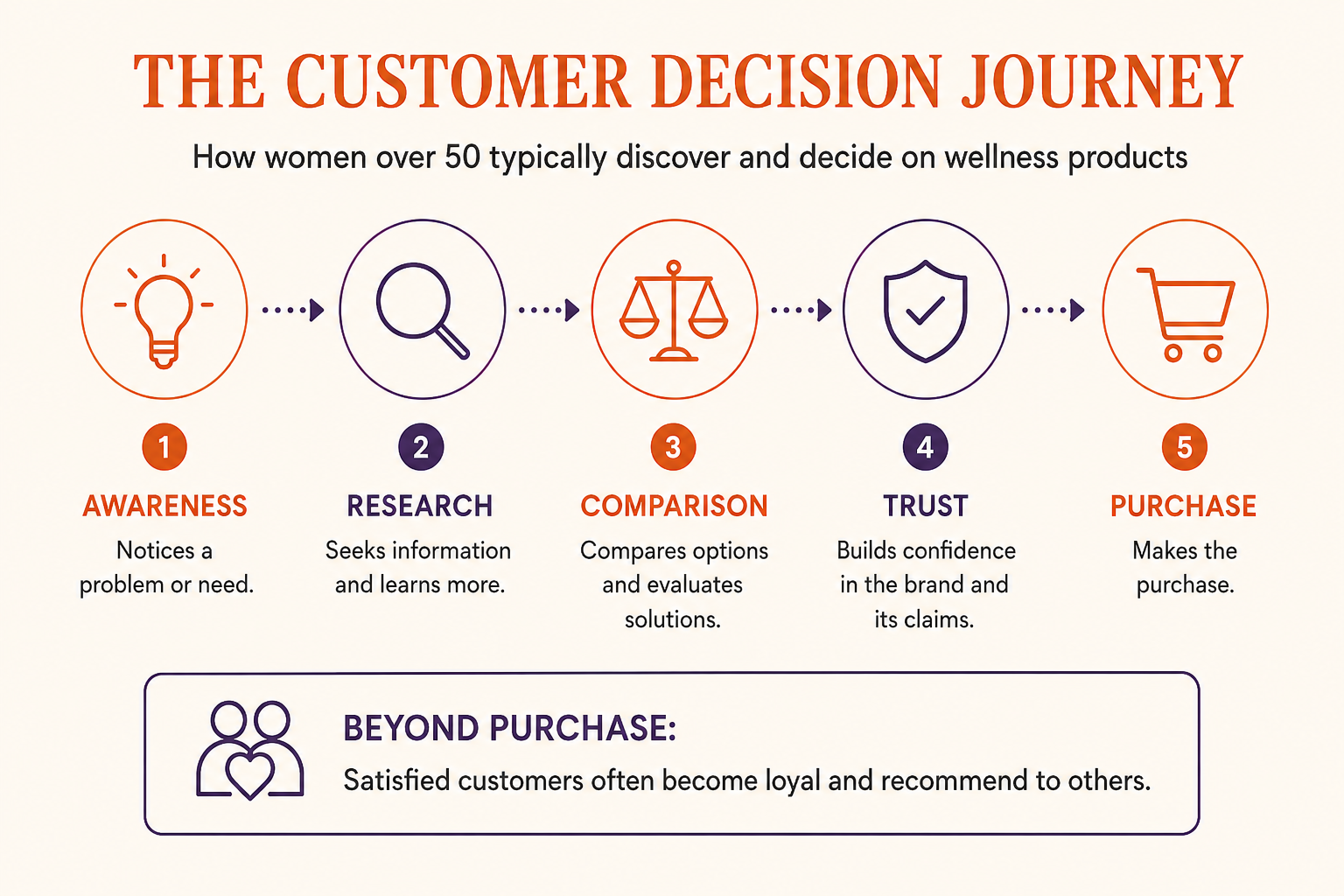
Women over 50 generally follow a different decision-making journey, particularly in categories such as wellness, nutrition, healthy ageing and healthcare. Rather than making quick purchasing decisions, they often move through several stages before buying.
They notice a problem. Perhaps they are sleeping less well than they used to, experiencing joint discomfort or looking for ways to maintain their energy. They begin researching possible explanations. This might involve reading articles, asking friends, searching online or subscribing to trusted sources of health information. Only after they understand the problem do they begin comparing possible solutions. At that point, brands enter the picture.
By the time a purchase is made, the consumer has usually interacted with multiple sources of information rather than a single advertisement. If your campaign only appears at the final stage of that journey, you are competing with brands that have already spent weeks or months building familiarity and trust.
Consumers rarely choose the first brand they see. More often, they choose the brand they understand best.
Why ‘Cost-Effective’ Is Often Misunderstood
Many marketing teams evaluate channels using metrics such as cost per click or cost per thousand impressions. Those numbers matter, but they do not tell the whole story.
Imagine two campaigns. Campaign A generates thousands of inexpensive clicks from people who know very little about your product. Campaign B reaches fewer people, but they spend several minutes learning about a health topic directly related to your product before visiting your website.
On paper, Campaign A may appear cheaper. In practice, Campaign B may produce better-qualified visitors who are more likely to trust your brand and eventually convert.
Cost-effectiveness is not simply about spending less. It is about generating the greatest business value for every dollar invested. That is why the conversation should move beyond asking which channel costs the least and towards asking which channel helps consumers move one step closer to a confident buying decision.
Give Every Channel One Job
One of the easiest ways to waste a marketing budget is to expect every channel to do everything.
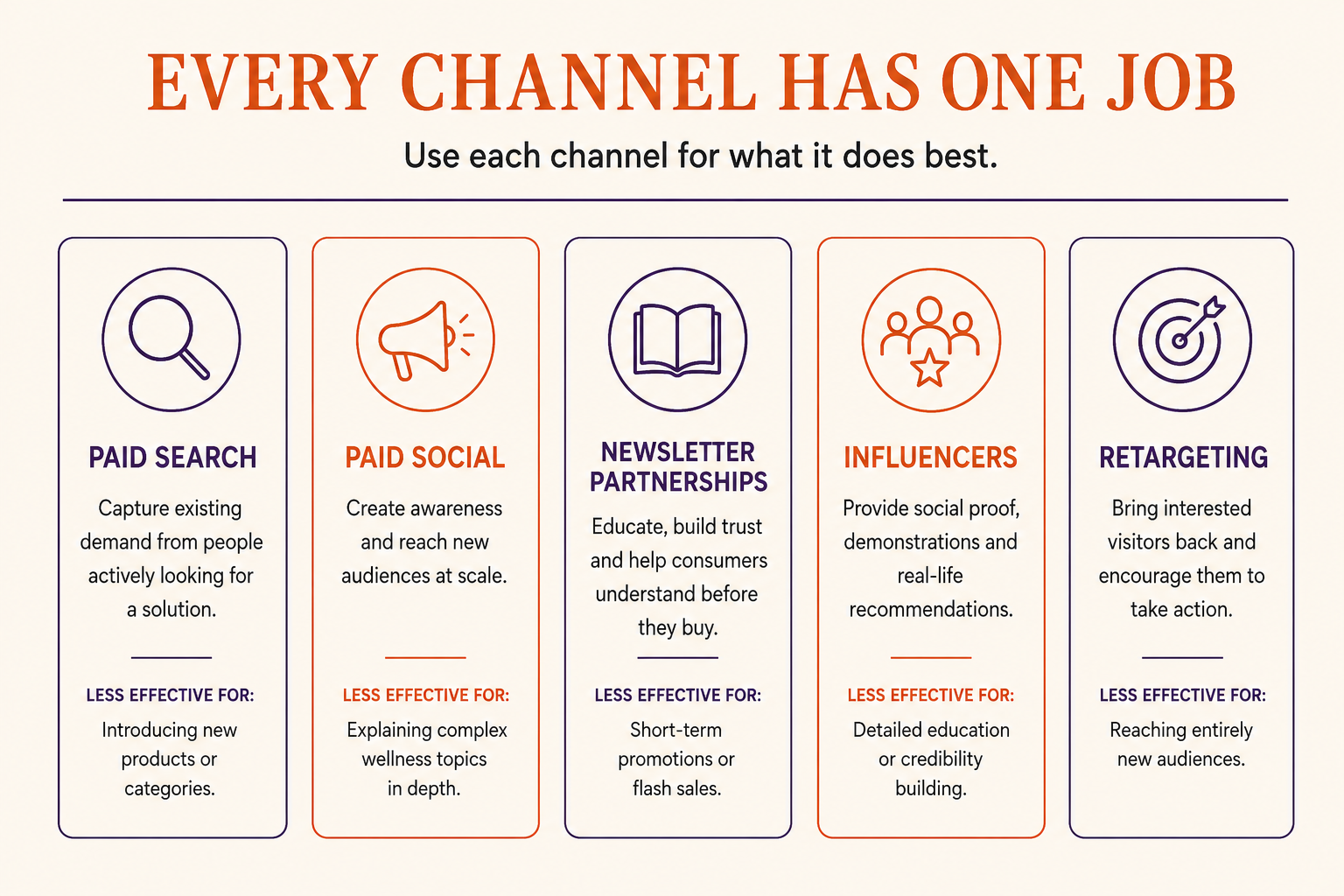
A paid search campaign is unlikely to introduce a completely new wellness product to someone who has never thought about the problem it solves. Likewise, a newsletter article is unlikely to create the urgency needed for a 48-hour flash sale.
Each channel has strengths because it was built to solve a particular problem. The question is not whether one channel is better than another. The question is whether it is being asked to do the right job.
Choose the Channel That Matches the Stage of the Customer Journey
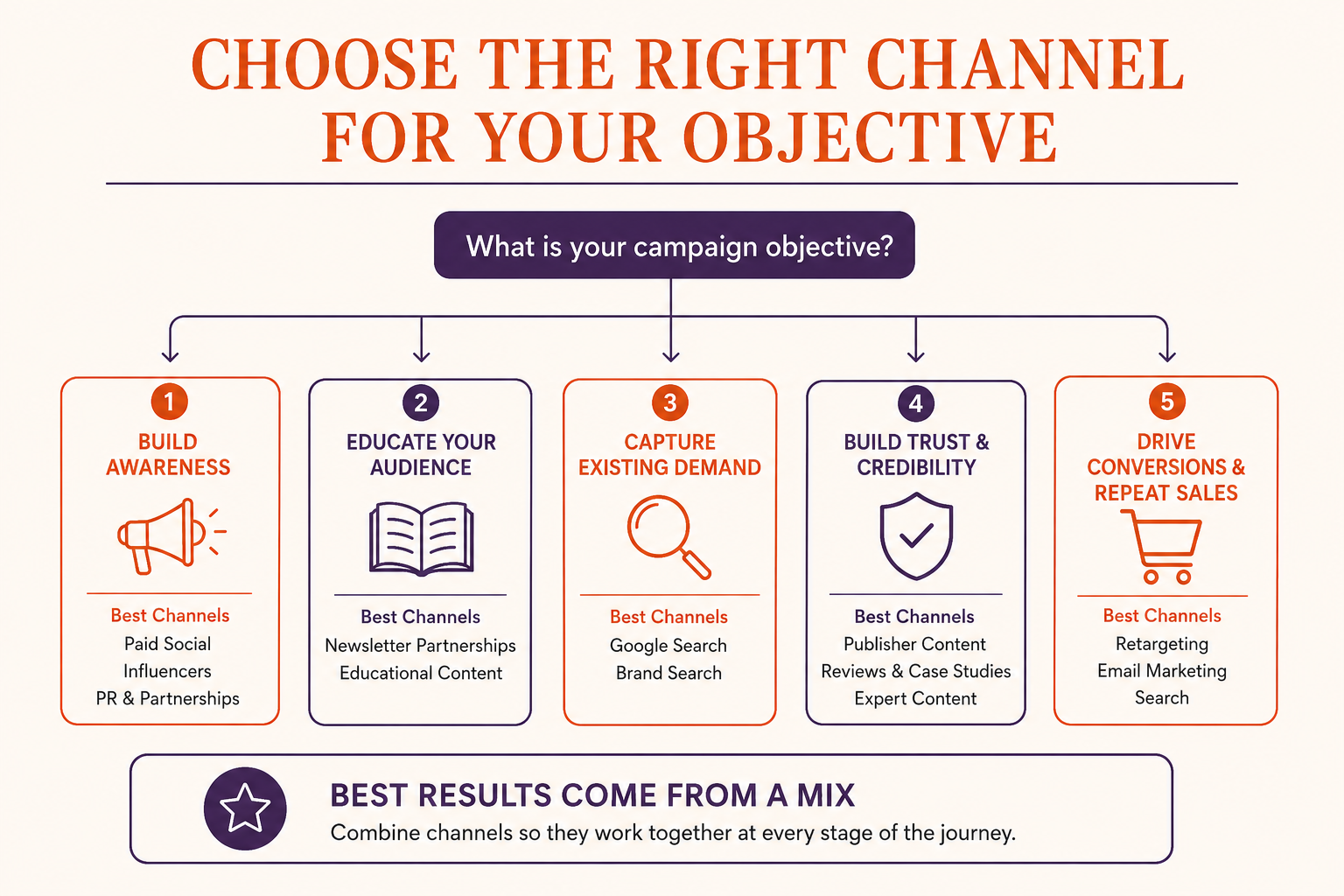
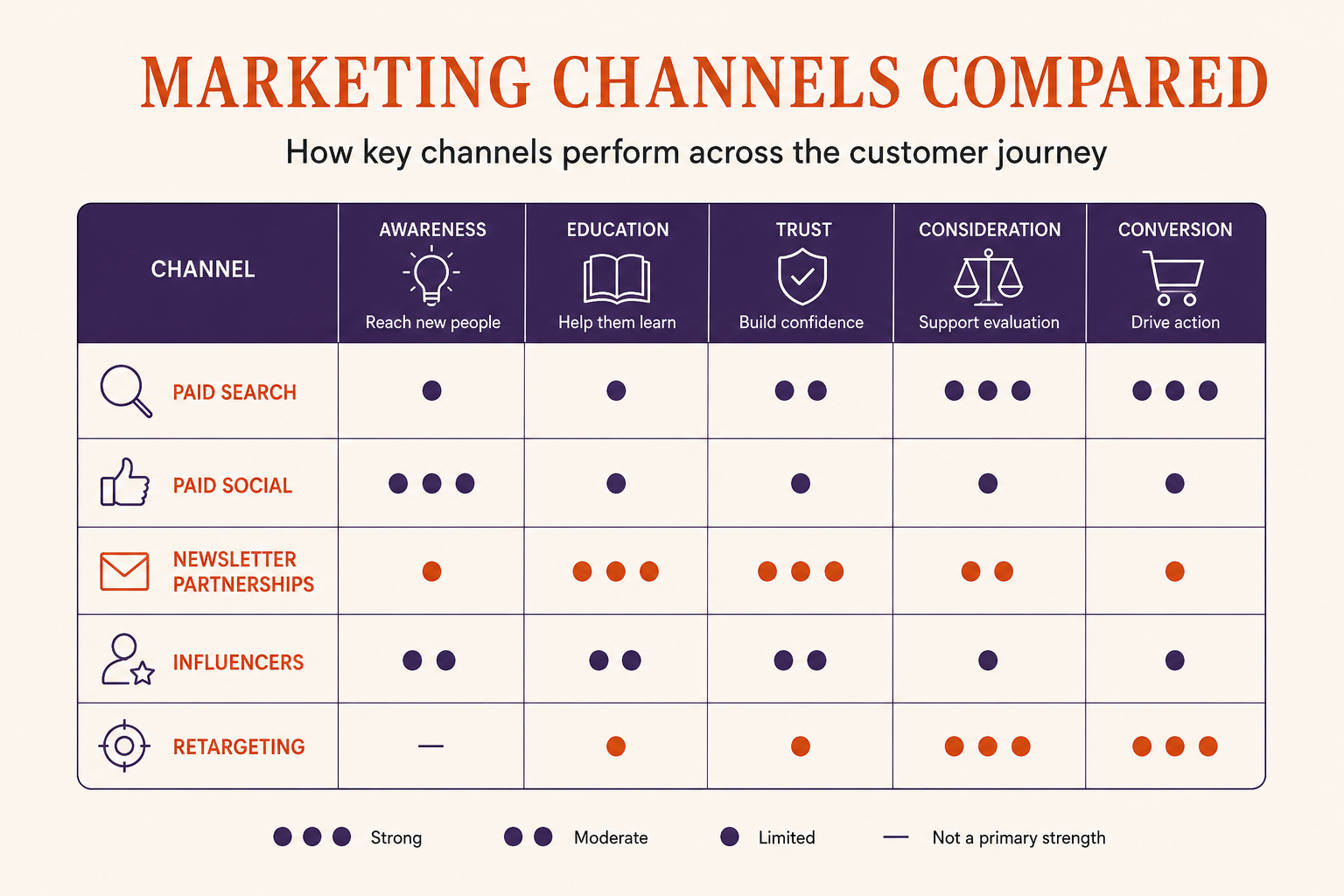
Consumers rarely move from discovering a wellness product to buying it in one step. Most follow a journey that looks something like this: awareness, education, research, consideration and purchase.
At the awareness stage, the consumer is thinking, I have never heard of this before. Paid social, PR and influencers are often effective here because they introduce the brand to a new audience.
At the education stage, the consumer asks, why does this matter? This is where educational articles and newsletter partnerships become valuable because they can explain a topic properly rather than interrupting with a short message.
At the research stage, the consumer asks, which option is right for me? Search, reviews and the brand website become more important. At the consideration stage, trust signals such as case studies, expert content and retargeting often help. At the purchase stage, search, email and retargeting tend to play a stronger role.
One mistake we often see is brands investing heavily in the purchase stage while overlooking the earlier stages. By the time someone is comparing products, another brand may already have earned their confidence simply by helping them understand the problem first.
Cost-Effective Doesn’t Mean Cheap
Marketing managers are often asked to reduce acquisition costs. That pressure can make it tempting to choose the channel with the lowest cost per click or the lowest cost per thousand impressions. The difficulty is that those metrics only describe the cost of reaching someone. They say very little about the quality of that interaction.
If one campaign produces 700 clicks and an average time on page of 18 seconds, while another produces 250 clicks and an average time on page of four minutes, the second campaign may be doing more of the work that matters. It may be building understanding, trust and intent, all of which influence future conversion.
This is why cost-effectiveness should be measured by the quality of the customer journey, not simply by the cost of attracting attention.
Five Mistakes Brands Make When Choosing Marketing Channels
- Measuring every channel the same way. Expecting an educational article to generate the same immediate conversion rate as paid search ignores the different role each channel plays. Some channels capture demand. Others create it.
- Putting too much budget into one platform. If most of your acquisition depends on a single platform, changes to pricing, algorithms or policies can quickly affect performance. Diversification is not only about growth. It is also about reducing risk.
- Trying to educate through advertisements alone. A banner advertisement has only a few seconds to make an impression. Many wellness products need much longer than that to explain ingredients, health benefits or scientific evidence.
- Judging success too early. Consumers researching wellness products often return several times before making a decision. Stopping a campaign because it did not generate immediate sales can mean abandoning it before it has had the opportunity to influence future purchases.
- Choosing channels because competitors use them. A competitor’s media plan reflects their objectives, audience, budget and product. It should not automatically become yours. Every campaign deserves its own strategy.
What We Would Do
Suppose we were helping a wellness brand launch a new magnesium supplement aimed at women over 50. We would not begin by asking which advertising platform to use. We would begin by asking what consumers need to know before they feel comfortable buying the product.
If the answer is that they first need to understand magnesium deficiency, common symptoms and expected benefits, then education becomes an essential part of the campaign rather than an optional extra. Only after that foundation exists would we decide how to use paid search, social advertising and retargeting to reinforce the message and guide interested consumers back to the product.
In other words, we would build the campaign around the customer’s decision-making process rather than the media platforms available to us.
Where Newsletter Partnerships Fit
Newsletter partnerships are often compared directly with paid social or paid search, but that comparison misses the point. They are not designed to do the same job.
Paid search captures people who are already looking for a solution. Paid social introduces your brand to people who may not know they have a problem yet. Newsletter partnerships sit somewhere in the middle. They help people understand the problem, evaluate possible solutions and build confidence in the brand behind them.
That makes them particularly valuable for products that require explanation before purchase, including supplements, healthy ageing products, skincare, menopause support and preventative health.
The question is not whether newsletters should replace your existing marketing channels. It is whether they strengthen the parts of the customer journey that your current media plan may be overlooking.
When Newsletter Partnerships Make Sense
Newsletter partnerships tend to work well when:
- Your product needs education before consumers understand its value
- Trust plays an important role in the buying decision
- Your audience prefers reading practical and informative content
- You are introducing a new ingredient, technology or health concept
- Your objective is long-term brand building as well as immediate response
They may be less suitable when:
- Your campaign is centred around a short-term promotion or flash sale
- You need nationwide awareness in a matter of days
- Your product is already widely understood and the campaign is focused purely on capturing existing demand
Like every marketing channel, their effectiveness depends on using them for the right objective.
Choosing Between 10almonds and Devoted Grandma
Although both publications reach women in the United States, they serve different purposes within a media plan.
10almonds is designed for readers who actively seek information about their own health and wellbeing. Its audience regularly engages with topics such as healthy ageing, nutrition, sleep, mobility, heart health, brain health and preventative wellness. Brands in categories such as supplements, skincare, longevity, menopause support and functional foods are often a natural fit because the audience is already interested in improving its health.
Devoted Grandma reaches women who are making decisions not only for themselves, but often for children, grandchildren and other family members. The newsletter is well suited to brands whose products or services influence family life, including household health products, family travel, financial planning, home safety, gifts, shared experiences and everyday lifestyle products.
There is some overlap between the two audiences, but the buying context is different. One reader is primarily making decisions about herself. The other is often making decisions that affect an entire household. Understanding that difference helps brands choose the right environment for their campaign.
A Mistake We Often See
Some brands think of publisher partnerships as another advertising placement. The strongest campaigns treat them differently.
Instead of asking how many clicks will this generate, they ask what questions do consumers need answered before they are ready to click. That shift changes the role of the campaign.
Instead of interrupting people with another promotional message, the brand becomes part of the research process that happens before the purchase. In categories such as wellness, that difference matters.
Frequently Asked Questions
The Bottom Line
There is no single marketing channel that consistently outperforms every other.
The strongest campaigns recognise that different channels influence different stages of the customer journey. Search captures existing demand. Social creates awareness. Retargeting keeps the conversation going. Publisher partnerships build the understanding and confidence that many wellness purchases depend on.
The real question is not which channel is the most cost-effective. It is this: which combination of channels helps my audience move from curiosity to confidence? For brands targeting women over 50, that answer will often involve a mix of channels rather than a single platform.
The most successful media plans are rarely built around chasing the lowest cost per click. They are built around helping the right people make better buying decisions.
Considering a Newsletter Partnership?
If you are planning a campaign aimed at women over 50 and your product benefits from explanation before purchase, it may be worth exploring how educational content and newsletter placements could complement your existing media mix.
Through 10almonds and Devoted Grandma, Montagu Publishing works with brands to create campaigns that combine trusted editorial environments with sponsored content and newsletter placements.
Rather than replacing your existing marketing channels, the objective is to strengthen them by reaching readers in moments when they are actively looking to learn, compare and make informed decisions.
If this approach might fit an upcoming campaign, reach out to sales@10almonds.com.