


Direct Answer
A wellness marketing budget for women over 50 works hardest when it does not rely on one channel alone. The strongest results come from splitting ten thousand dollars across paid search, paid social, retargeting and educational newsletter placements, so the campaign builds awareness, understanding and confidence at every stage of a customer’s decision, rather than relying on one form of exposure to do all of the work.
Quick Summary
- A wellness marketing budget for women over 50 usually performs best when split across three or four channels rather than one.
- Splitting the budget across several channels reduces reliance on any single platform and its rising costs.
- Paid search reaches people who are already searching for a solution, so it captures demand that already exists.
- Paid social introduces the brand to people who are not yet searching, so it creates new demand.
- Retargeting brings back people who showed interest but did not buy, which is often the most cost effective part of a plan.
- Newsletter placements give a brand the space to explain a health topic properly, which builds the trust wellness purchases depend on.
- The right split is not fixed. It should shift depending on how well known the product already is.
Start with the Objective, Not the Budget
Before deciding where the money goes, it helps to define what the campaign actually needs to achieve. A brand launching a new collagen supplement needs something different from a brand that already has an established multivitamin and simply wants to protect its position in the market. The objective should come first, because it decides everything else about the plan.
Most wellness campaigns fall into one of five categories: introducing a new product, building general brand awareness, educating consumers about a health topic they do not yet understand, driving qualified traffic to a website, or generating trials and first purchases. Once the objective is clear, the channel mix follows from it rather than being decided by habit or familiarity.
Why Women Over 50 Need a Different Marketing Approach
Women over 50 are one of the most commercially valuable groups for wellness brands. Many are actively investing in products that support healthy ageing, better sleep, joint mobility and long term nutrition, and they tend to keep buying once a product earns their trust.
At the same time, this audience researches before it buys. Wellness purchases are rarely impulse decisions in the way a piece of clothing or a night out might be. A woman considering a magnesium supplement usually wants to understand what it does, why her body needs it, and whether the claims on the packet are actually true before she adds it to her basket. This single fact shapes almost everything else in this guide, so it is worth holding onto as we move through the rest of the plan. It also changes the job that marketing has to do. A campaign aimed at this audience is not simply trying to catch attention for a few seconds. It is helping someone make an informed decision she feels comfortable standing behind.
The Most Common Mistake in Wellness Media Plans
Many brands put the majority of their budget into a single advertising platform because the reporting feels immediate and familiar. Paid search and paid social remain genuinely important tools, but leaning on one channel alone creates two problems.
First, performance becomes tied to the rising costs and shifting algorithms of that one platform, so a good result this quarter offers no guarantee for the next. Second, a consumer who only ever meets a brand through an advertisement never gets the chance to learn more about the product in a setting built for reading and understanding, which is exactly where wellness decisions tend to be made.
A stronger approach treats different channels as having different jobs to do, rather than asking one channel to do all of them at once.
One Way to Structure a $10,000 Wellness Launch Budget
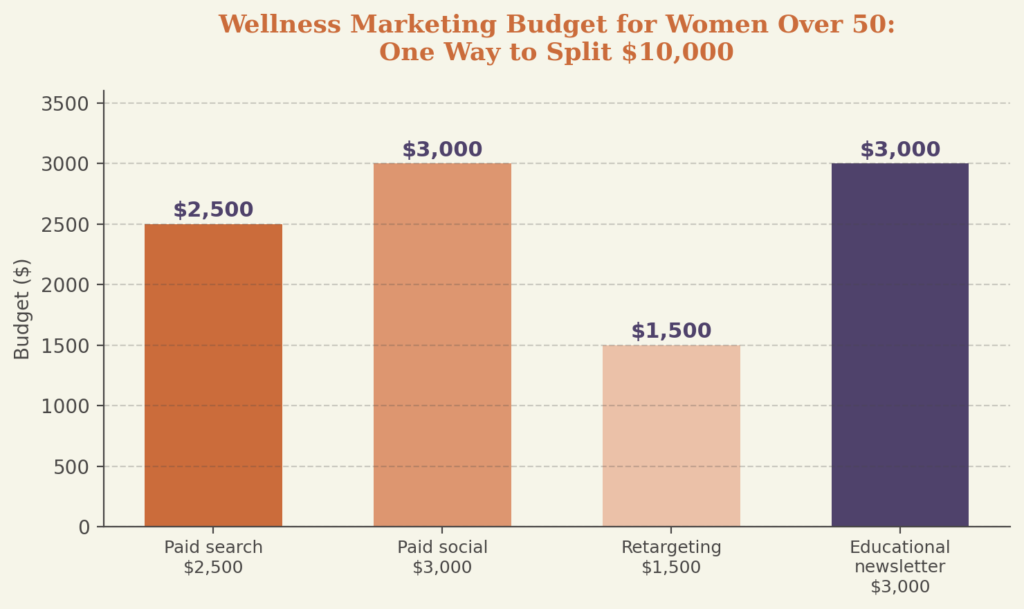
The figures below describe one reasonable way to split a launch budget for a magnesium supplement aimed at women over 50. They are an illustration of the reasoning involved, not a fixed formula, and any real allocation should be adjusted against a brand’s own product, price point and past results. What matters more than the exact numbers is the reasoning behind each one.
Paid search receives a quarter of the budget because demand already exists in that channel, so every dollar spent there tends to work harder than a dollar spent trying to create interest from nothing. Paid social receives a slightly larger share because it has a harder task, introducing the brand to people who are not yet searching for a solution, which needs broader reach to succeed. Retargeting receives the smallest share because it works on a limited pool of people who have already visited the site, so there is a natural ceiling on how much it can usefully absorb. Educational newsletter placement receives the largest single share because wellness products are rarely bought on impulse, and this is the part of the plan that gives a reader the understanding she needs before she feels ready to buy.
| Activity | Illustrative Budget | The Job It Does |
| Paid search | $2,500 | Captures demand that already exists |
| Paid social | $3,000 | Builds awareness ahead of demand |
| Retargeting | $1,500 | Reconnects with people who already showed interest |
| Educational newsletter placement | $3,000 | Builds the understanding a purchase depends on |
When Should You Change This Allocation?
This split works well as a starting point, but it should move depending on where the brand already stands.
- If the product is already well known, increase the share going to search, because the demand already exists and the job is simply to capture it.
- If the brand is launching an entirely new category, increase the share going to education, because the reader needs to understand the problem before she will consider any solution.
- If the product is a subscription, increase the share going to retargeting, because the value of a returning customer justifies spending more to bring back someone who has already shown interest.
- If the goal is a fast, time limited promotion, reduce the share going to newsletter placements, because education takes longer to work than a short discount window allows.
Give Every Channel One Job
It helps to give each channel exactly one job and resist asking it to do more than that. Search captures demand. Social creates awareness. Newsletter placements educate. Retargeting closes the loop. A channel tends to perform well when it is left to do its own job, and tends to disappoint when it is asked to do someone else’s.
| Channel | Best Suited For | Less Suited For |
| Paid search | Capturing demand that already exists | Introducing a product nobody is searching for yet |
| Paid social | Building awareness among new audiences | Explaining a complex health topic in depth |
| Influencer content | Demonstration and social proof | Detailed product education |
| Newsletter partnerships | Consumer education and credibility | Time sensitive, short term promotions |
None of these channels is a universal winner. The right choice depends entirely on what the campaign needs to achieve at that stage.
Why Educational Content Matters in Wellness Marketing
Many wellness products need the consumer to understand a problem before she can appreciate the solution. A woman is unlikely to search directly for a collagen peptide or a joint support supplement by name. She is far more likely to search for a question, such as why her joints ache more as she gets older, how she might improve her sleep without medication, or which vitamins matter most at this stage of life.
Because this audience researches before it buys, channels that allow explanation become more valuable to a brand than channels designed purely for interruption. Educational content lets a brand take part in that earlier conversation, before the product is even mentioned, and that sequence tends to build more trust than leading with the product itself.
Where Newsletter Partnerships Fit in the Plan
Newsletter partnerships are not a replacement for paid media. They work best as one part of a broader plan, and what they offer that advertising alone cannot is the chance to educate a reader in a setting where she has already chosen to spend time reading.
A newsletter article that explains a health topic properly, written in partnership with the brand rather than presented as a straightforward advertisement, gives the reader understanding before it introduces the product. A newsletter placement that follows can then reinforce that message with an audience who has already shown a genuine interest in wellness and healthy living.
What this does well
- Holds a reader’s attention for longer than a passing advertisement usually can
- Carries the trust the reader already places in the newsletter itself
- Leaves room to properly explain a topic rather than simply interrupt with a message
Where it falls short
- Not well suited to flash sales or short, time limited promotions, since education takes longer to land than a discount code
- Reaches a smaller audience than a platform such as Meta, so it will not replace scale on its own
Both replace nothing on their own. Newsletter partnerships strengthen the rest of the plan by adding a trusted environment where education comes before the pitch.
Where 10almonds and Devoted Grandma Each Fit
Montagu Publishing runs two newsletters, and they are built for two different moments in a woman’s life, so a brand should think about them separately rather than as one combined audience.
10almonds
10almonds reaches over 38,000 subscribers, almost all of them women aged forty-five and above in the United States, with an open rate close to 48%. The focus is health and wellness in the reader’s own life, which makes it a natural fit for supplements, nootropics, skincare, gut health, heart health, menopause support, sleep and bone health brands looking to reach a reader who is actively researching her own wellbeing.
Devoted Grandma
Devoted Grandma reaches over 73,000 subscribers, women aged 50 and above in the United States, with an open rate above 55%. This reader is often making health, lifestyle and purchasing decisions not only for herself but for her wider family, which suits brands whose products matter across generations or households rather than to one person alone.
Questions Brands Commonly Ask Next
How much should a wellness brand spend on paid social versus paid search?
There is no fixed ratio that works for every brand. Paid search deserves a larger share when a category already has clear search demand, such as a well known supplement, while paid social deserves a larger share when the product is new enough that nobody is searching for it yet.
Is a newsletter partnership worth it for a brand with a small budget?
It can be, provided the brand treats it as the education layer of the plan rather than the entire plan. A single placement rarely converts a reader on its own, but it builds the familiarity that makes the rest of the campaign work harder.
How long does it take for educational content to influence a wellness purchase?
Wellness decisions are rarely made in one sitting. A reader often needs several points of contact, first understanding the problem, then learning about a possible solution, and only later feeling ready to buy, which is why education and paid media work better together than either does alone.
What We’ve Observed
Across the wellness content we publish, we consistently see readers spend longer on an article that explains a health condition than on one that introduces a product outright, and the product tends to perform better once that understanding is already in place. This is not a general marketing theory. It is simply what happens, again and again, inside two publications reaching more than 100,000 women who read for exactly this kind of guidance.
Five Questions to Ask Before Approving a Media Plan
- Does this plan reach the audience we actually want to reach?
- Are we educating consumers as well as promoting the product?
- Are we relying too heavily on a single platform?
- Does every channel in the plan have a clear and distinct purpose?
- Will this campaign teach us enough to improve the next one?
If the honest answer to most of these is no, the allocation is worth revisiting before the budget is spent rather than after.
What We Would Do
If we were launching a new magnesium supplement with this budget, here is honestly what we would do. We would not spend the whole amount chasing an immediate sale. We would first make sure the reader understood why magnesium matters to her at this stage of life, using an educational newsletter placement to do that properly. We would then let paid search and retargeting reinforce that understanding, bringing back the readers who had already shown interest once they were ready to consider buying. Only once that foundation existed would we judge the campaign by conversions, because asking for a sale before someone understands the product rarely works as well as earning the sale once she does.
The Bottom Line
$10,000 is unlikely to transform a wellness brand overnight, but it is enough to build a considered campaign that meets consumers at different stages of their decision. Awareness alone rarely closes a wellness sale. Consumers also need context, reassurance and credible information before they feel ready to buy, so the better question is not where the budget should go, but how the plan can help a consumer feel confident in her decision.
Considering a Newsletter Partnership?
If the objective is to educate health-conscious women rather than simply generate impressions, a trusted newsletter partnership may be worth testing alongside existing paid channels.
At Montagu Publishing, we work with brands through 10almonds and Devoted Grandma, helping marketers reach engaged female audiences through a combination of newsletter placements and brand-supported educational content.
If this approach might fit an upcoming campaign, we would be glad to discuss it. Reach out to sales@10almonds.com.